Reserves and smoothing: how guaranteed funds buffer the rate cycle

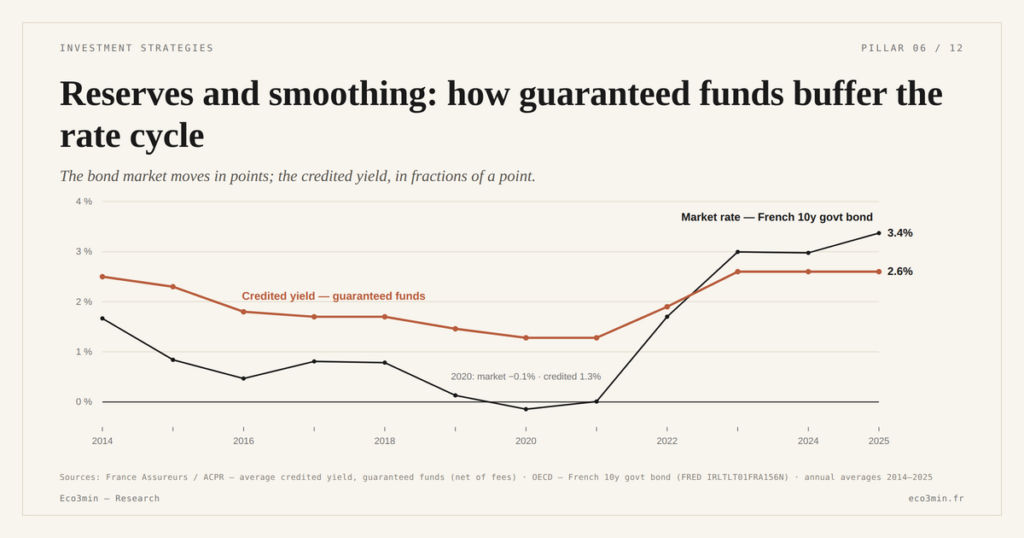
A guaranteed fund’s yield does not mirror the year’s bond market: it is built from a stock of older bonds and a set of reserves the insurer releases or rebuilds. Together they produce a smoothing that no unit-linked holding possesses.
TL;DR
Reserves let a guaranteed fund post a near-flat yield while bond markets swing by points: insurers set income aside in good years and release it when portfolio income softens.
- The market's average provision fell from about 4.5% of assets at end-2023 to 3.7% at end-2025 on industry data, meaning part of the yield credited recently came from reserves banked earlier, not from current income alone.
- The stock effect and the ratchet complete the buffer: only a fraction of the portfolio renews each year, and once interest is credited the capital can no longer fall in nominal terms; but a reserve that is repeatedly tapped eventually thins.
The credited yield of a guaranteed fund is not a live mirror of any single year’s bond market. It is constructed. The insurer holds a large portfolio of bonds bought at different dates, and it carries reserves — provisions set aside in good years — that it can release when markets are less generous. Together, the legacy bond stock and those reserves produce smoothing: the credited rate moves little from one year to the next, where a bond ETF passes rate moves through at once. Grasping this mechanism is the precondition for seeing why a guaranteed fund never behaves like a unit-linked holding, even when both are ultimately exposed to the same rates. It is the buffer, not raw performance, that defines the guaranteed pocket.
The bond stock: a slowly renewing portfolio
The first source of smoothing lies in the composition of the insurer’s portfolio. It does not buy its bonds all at once, but in a continuous flow, year after year. At any moment, its portfolio therefore aggregates securities subscribed at widely different dates, at widely different rates: bonds issued when rates were near zero sit alongside securities bought recently at higher coupons. The yield this whole produces is a weighted average of that history, not the rate of the day. More context: what the rate cycle does to listed property.
From this structure follows a mechanical behaviour: only a fraction of the portfolio matures each year and is replaced with securities at prevailing conditions. The average yield can therefore converge towards new rates only gradually, at the speed at which old lines are repaid and reinvested. This is the stock effect. A portfolio whose average maturity runs into years renews only a limited share of its lines each financial year; it follows that even a sharp rise in market rates seeps into the credited yield only a little at a time.
An order of magnitude fixes the idea. If an insurer renews roughly a tenth of its bond portfolio each year, it takes close to a decade for a durable change in market rates to feed almost entirely into the average yield. The exact proportion varies from one insurer to another with the maturity and structure of its assets, but the order of magnitude is why one reasons here in years, not quarters. That inertia is the price of stability: a portfolio that renewed quickly would track rates better, but would deliver far choppier yields, closer to those of a market support. A broader view: how the cycle reorients investment selection.
The clearest illustration is the recent sequence. Market rates rose mostly in 2022 and 2023, yet the average credited yield on guaranteed funds only reached about 2.6% in 2023, a level carried over in 2024 and again in 2025 on industry data. Between the moment the insurer could reinvest at higher rates and the moment the saver saw the trace of it in their yield, several years elapsed — the time for the stock to recompose. This staggering is no failure of management: it is the direct consequence of the slow renewal of a long-term bond portfolio.
The stock effect cuts both ways. Just as it slows the transmission of a rise, it delays that of a fall: a portfolio stocked with older well-paid securities keeps crediting a yield above current rates for a while after they ease. The guaranteed pocket therefore never follows the market in real time; it returns an averaged, staggered, damped version of it. It is precisely this temporal lag that the analysis of the lag in the credited yield treats separately; the present article focuses on the construction of the buffer itself.
The reserves: the provision that flattens the curve
The bond stock alone does not explain the remarkable regularity of credited rates. A second, more discretionary mechanism is added to it: reserves. In years when the portfolio throws off ample income, the insurer is not obliged to redistribute everything at once. It can set part of that income aside in a regulated provision, then release it later, when current income softens. This provision has a bounded life: the sums reserved must be reattributed to policyholders within a limited period, which makes it a smoothing tool rather than one of permanent retention.
The result is a path of credited rates far flatter than that of the portfolio’s actual income. A lean year can be offset by releasing reserves accumulated in fat years; a fat year can, conversely, serve to rebuild the provision rather than to inflate the posted rate. The insurer thus continuously arbitrates between flattering the year’s yield and preserving its future capacity to smooth. That is what lets credited rates move by a few tenths of a point where the underlying markets swing by several points.
This mechanism carries a cost and a limit, visible in recent figures. To support their rates through the transition from low rates to higher ones, many insurers drew on their reserves. The market’s average provision, expressed as a share of assets, fell from roughly 4.5% at the end of 2023 to about 4% at the end of 2024, then to around 3.7% at the end of 2025 on industry data. In other words, part of the yield credited in recent years came from ammunition accumulated earlier, not from current income alone. A buffer that is repeatedly tapped eventually thins: reserves are not bottomless, and an insurer that had exhausted its provision would be forced to credit close to its portfolio’s income, with no room left to smooth.
This smoothing performs a transfer across time. Reserves released to a saver today were, in part, income withheld from earlier savers; those the insurer rebuilds this year are drawn from the current return of present policyholders. Nothing is improper here — it is the very logic of a mutualised, regulated provision. But it means the rate credited in a given year results as much from a distribution decision as from income actually earned. The figure on the statement is the output of a trade-off, not a simple thermometer reading.
One last spring completes the architecture: the ratchet effect. Once a yield is attributed and the interest credited, it is definitively acquired, and the accumulated capital can no longer fall in nominal terms. Stock, reserves and ratchet together form the buffer. It is this combination — not an exceptional single year’s performance — that gives the guaranteed fund its distinctive shape.
Why this buffer has no unit-linked equivalent
The reach of this mechanism shows best by contrast. A unit-linked holding has no smoothing stock, no reserve, no ratchet. Its value is the market value of its support, recalculated continuously. A bond fund held as a unit-linked support does not average its lines the way an insurer does: it is marked at market price, so a rise in rates immediately lowers its value, with no damping and no delay. That is the whole subject of the article on the direct exposure of a unit-linked holding.
The same rate move therefore produces two opposite paths depending on the pocket. In the guaranteed fund, the rise diffuses slowly, through the renewal of the stock, and the credited yield climbs with a lag; in the unit-linked bond support, the rise hits the valuation at once, downward. This divergence is not a matter of caution or daring, but of structure: one pocket has an institutional buffer, the other does not. The direct comparison between a guaranteed fund and a bond support held outright — set against a directly held bond ETF — shows that the difference in behaviour rests entirely on this smoothing device, not on the underlying securities, which are often similar.
This reading sits within the wider frame of the guaranteed-versus-unit-linked trade-off: the wrapper houses, side by side, a support that damps the rate cycle and a support that mirrors it. Placing the buffer back in that regime logic is also what the body of content on choosing investments by rate cycle allows.
- A guaranteed fund’s yield is a weighted average of a stock of bonds bought at different dates, not the year’s market rate: only a fraction of the portfolio renews each year.
- Reserves let the insurer set income aside in good years and release it in lean ones, flattening the path of credited rates; the market’s average provision fell from about 4.5% of assets at end-2023 to 3.7% at end-2025 on industry data.
- Stock, reserves and the ratchet effect form the buffer; it has a limit, because reserves that are tapped eventually thin.
- A unit-linked holding has none of these devices: its value follows the market directly, with no smoothing and no delay.
Smoothing through the stock and the reserves explains the “how” of the guaranteed fund: why its yield path is so flat. It does not yet say the “how long” — why it takes several years for the credited yield to reach current rates. That temporal dimension, a direct consequence of the portfolio’s slow renewal, belongs to a distinct mechanism treated on its own. What matters here is more fundamental: it is not a single year’s raw performance that defines the guaranteed pocket, but the buffer that structurally sets it apart from a unit-linked holding.
Last updated — 12 July 2026
Disclaimer – Financial Information: The analyses, commentary, and content published on eco3min.fr are provided for informational and educational purposes only. They do not constitute investment advice or a solicitation to buy or sell financial instruments. Past performance is not indicative of future results. All investment decisions involve risk and are the sole responsibility of the reader.
Read next
Full pillar →Beneficiary Designations, the Step-Up in Basis, and the 10-Year Rule: How US Accounts Transfer at Death
At death, most US financial accounts pass outside the will, straight to a named beneficiary, under tax rules…
The Fee Stack in Variable Annuities: M&E Charges, Riders, and Subaccount Costs
A variable annuity does not carry one fee, but a stack of them. Mortality and expense charges, subaccount…
The Conventional 401(k)-Match-First Funding Order: Where It Comes From, How It Works
The question of what order to fund accounts in usually draws a fixed list, presented as a rule…