How Indonesia Took Control of the World’s Nickel Supply

By banning raw ore exports in 2020, Indonesia forced nickel processing onto its own soil and captured more than half of world production. That industrial-policy lever turned the country into the swing producer of a market it now steers through its mining quotas.
TL;DR
Indonesia's 2020 raw-ore export ban made it nickel's swing producer: having flooded the market to four-year-low prices, it then cut quotas in 2026 to flip the narrative toward shortage.
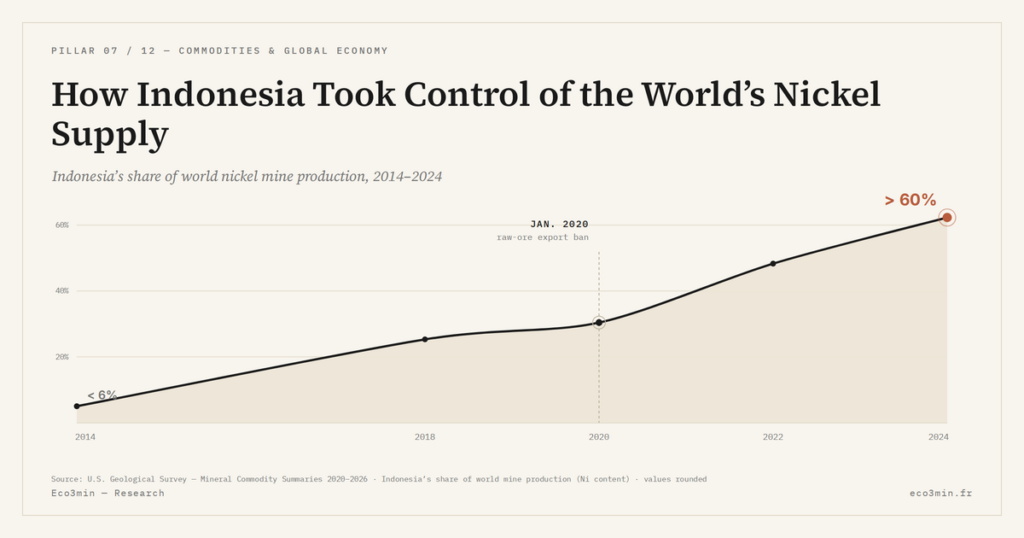
- Its share of global mine production rose from under 6 percent in 2014 to over 60 percent in 2024 (US Geological Survey), with output up roughly 1,285 percent across 2014-2023.
- Two routes underpin the grip: class 2 nickel pig iron for stainless steel, tied to coal-fired power, and HPAL leaching for class 1 battery sulphate, scrutinised over its waste and energy use.
- Production costs among the world's lowest leave Indonesian supply nearly insensitive to price falls that force higher-cost rivals such as BHP's Australian Nickel West to cut, world mine output ebbing to about 3.7 million tonnes in 2024.
Understanding how a single country took control of the world nickel supply illuminates one of the metal’s structural fragilities: a trajectory hung on a small number of sovereign decisions rather than on price signals.
1. The 2020 export ban: an industrial-policy lever
The tipping point dates to January 2020, when Jakarta banned exports of raw nickel ore. The logic was explicit: to stop Indonesia from remaining a mere supplier of raw material and to compel it to process its ore at home, capturing the value added by the industrial stages. The country held a decisive asset for this — laterite reserves among the largest in the world — and an unanswerable bargaining position: any processor wanting access to that ore now had to invest in capacity on Indonesian soil.
The measure was not entirely new. A first ban had been attempted between 2014 and 2017 before being eased, to give processing capacity time to come online. The 2020 version completed the strategy, at a moment when smelters financed by foreign capital, largely Chinese, were ready to absorb the ore locally. The result was striking: instead of exporting rock, Indonesia began exporting processed metal, shifting the industrial centre of gravity of nickel toward Southeast Asia in one move. To place that manoeuvre within the wider frame of resource-state strategies, it helps to read it against the geopolitics of critical-mineral supply.
The logic was not only about volume but about value capture. Exporting raw ore leaves the bulk of the industrial margin abroad, in the smelters and refineries of importing countries; processing at home shifts that margin onshore, along with the jobs, the technology and the downstream pull toward batteries and stainless steel. By tying access to its ore to investment on its soil, Indonesia converted a geological endowment into industrial leverage, drawing in the capital and know-how needed to climb the value chain rather than remain at its base. The export ban was, in that sense, less a trade measure than the keystone of a development strategy.
2. Two technological routes: nickel pig iron and HPAL
The Indonesian boom rested on two distinct technological routes, matching the metal’s two main uses. The first is the production of nickel pig iron in electric furnaces. This route yields a so-called class 2 product, less refined, destined for stainless steel, which absorbs the bulk of world demand. It was through this route that Indonesia first flooded the market, multiplying a capacity few other countries could match on cost.
The second route, more complex, is high-pressure acid leaching, known by the acronym HPAL. It converts low-grade lateritic ore into an intermediate that can be refined into nickel sulphate, the feedstock for battery cathodes. This route targets battery-grade nickel, known as class 1, and allowed Indonesia to claim it could feed not only stainless steel but also the growing electric-vehicle market. The coexistence of these two routes on a single territory explains why Indonesian influence now extends to both segments of a market that the nature of its uses had nonetheless kept apart.
That dual capacity has, moreover, blurred a boundary once thought sharp. By announcing in 2021 a process to convert nickel pig iron into matte, itself convertible into sulphate, a major Indonesian producer raised the prospect that abundant class 2 could feed the supposedly tight battery segment. The mere prospect was enough to send prices tumbling, illustrating how heavily Indonesian command of the processing routes weighs on the expectations of the whole market.
The two routes also carry different footprints. HPAL is capital-intensive and has drawn scrutiny over its waste and energy use, while pig iron production is comparatively cheap but tied to coal-fired power. These differences matter for buyers who increasingly weigh the carbon intensity of their nickel, and they add a further axis along which Indonesian supply is judged — not only on cost and volume, but on how it is produced.
3. From under 6% to over 60%: the rise of a swing producer
The scale of the shift is measured in figures. According to the US Geological Survey, Indonesia accounted for less than 6 percent of global nickel mine production in 2014; its share reached around 48 percent in 2022, 50 percent in 2023, and most estimates put it above 60 percent in 2024. Over 2014-2023, Indonesian output jumped roughly 1,285 percent, taking the country from bit player to market maker in under ten years. No other major commodity has seen its supply recomposed so fast and so concentrated.
The decisive edge of these routes is cost. Backed by abundant ore, cheap energy and heavy investment, Indonesian operations show production costs among the lowest in the world. That advantage has a direct consequence: when prices fall, it is producers elsewhere, on higher cost, that must cut or halt output, while Indonesian capacity keeps running. Concentration therefore rests not only on volume but on a position on the cost curve that leaves Indonesian supply nearly insensitive to the price declines that would force its competitors to capitulate.
That dominance leaned heavily on Chinese capital, which financed both the smelters and the downstream chain, from stainless-grade nickel through to battery materials. Geographic concentration was thus compounded by ownership concentration: a substantial share of world capacity belongs to a restricted group of linked operators. It is this configuration that gives Indonesia the status of a swing producer, able to influence the world price through its decisions alone, much as a large energy exporter bears on its own market. This grip on supply is one of the three pillars of the instability laid bare by the March 2022 nickel squeeze.
The Indonesian ascent left scars elsewhere. The inflow of low-cost metal compressed prices to the point of rendering historic sites unprofitable: according to sector analyses, BHP suspended its Australian Nickel West operations, New Caledonia saw output fall sharply amid unrest and high costs, and the Philippines and Australia cut their volumes. The US Geological Survey thus estimated that world mine production had ebbed to around 3.7 million tonnes in 2024, with most of the closures concentrated outside Indonesia. The rise of a dominant producer did not add to existing supply: it partly replaced it, deepening concentration further still.
4. From glut to managed scarcity
The power of a swing producer is read in its ability to reverse the market regime. Having flooded the market and driven prices to four-year lows in 2024 and 2025, Indonesia set about cutting its mining quotas, bringing permitted output down from very high levels to markedly lower ceilings, in an avowed logic of scarcity meant to support prices. In early 2026, a roughly 70 percent cut to the quota of the world’s largest mine supported a rebound, with the market narrative flipping from overwhelming surplus to looming shortage.
That ability to move the market from surplus to tension by a single administrative decision is precisely what sets nickel apart from a metal with dispersed supply. Where the copper price integrates a multitude of independent trade-offs among many producers, the nickel price hangs on the timing and scale of Indonesian decisions. This dependence on the structure of physical resource markets makes price formation more opaque and more vulnerable to ruptures. It also combines with the structure of demand, because the reach of a supply decision depends on the segment it targets: a shock to class 2 pig iron does not read like a shock to battery nickel, as the analysis of nickel’s split demand sets out.
Indonesian quota cuts are often presented as the guarantee of a lasting tightening of supply. That reading is too quick: many analysts doubt they will suffice to clear the surplus, given how abundant installed capacity is and how long it takes for a restriction on raw ore to reach smelter output. A quota announcement does not equal immediate scarcity.
- The 2020 ban on raw ore exports forced processing onto Indonesian soil and shifted the industrial centre of gravity of nickel toward Southeast Asia.
- Two routes coexist: class 2 nickel pig iron for stainless steel, and HPAL leaching producing class 1 nickel for batteries.
- Indonesia’s share rose from under 6 percent in 2014 to over 60 percent in 2024, giving it swing-producer power to reverse the market regime through its quotas.
Conclusion
Indonesian control of nickel supply is not a market accident but the product of a deliberate industrial strategy, built on an abundant resource, foreign capital and a simple regulatory lever. The result is a market whose trajectory depends, more than for any other base metal, on a small number of sovereign decisions. Whether that grip holds once battery manufacturing scales outside China and other territories seek to diversify supply, or whether concentration, once installed on this scale, tends to perpetuate itself by driving out marginal producers, remains an open question.
Last updated — 28 June 2026
Disclaimer – Financial Information: The analyses, commentary, and content published on eco3min.fr are provided for informational and educational purposes only. They do not constitute investment advice or a solicitation to buy or sell financial instruments. Past performance is not indicative of future results. All investment decisions involve risk and are the sole responsibility of the reader.
Read next
Full pillar →Reading the refinery utilisation rate: the threshold, the season, the turnarounds
A refinery runs full near ninety percent, not a hundred: the last slice of nameplate capacity is a…
IMO 2020: the regulatory shock that rewrote product spreads
An environmental rule on marine sulfur can move a refining spread more than a swing in crude. IMO…
The 2022–2023 refining golden age: anatomy of an episode
In 2022, refined fuel prices climbed faster than crude. That gap, measured by the 3-2-1 crack spread, reached…