Battery Nickel: Class 1, NMC Cathodes and the Electric-Vehicle Cycle

Electric-vehicle batteries require refined class 1 nickel, distinct from the pig iron that feeds stainless steel. This segment, tethered to the electric-vehicle cycle and threatened by nickel-free chemistries, has become a price driver as powerful as it is unstable.
TL;DR
Battery-grade class 1 nickel feeds NMC cathodes whose nickel share is a moving target, raised for range then trimmed for stability and cost, leaving demand hard to size.
- Nickel sits in the cathode to raise energy density; makers pushed nickel-rich formulations for range, then partly back as cheaper, more stable, lower-cobalt chemistries matured.
- As the first large cohorts of EV batteries reach end of life, recovered nickel could meet part of demand without new mining, loosening the assumed link between EV growth and primary class 1 metal.
- LFP cells, which contain no nickel, have gained share on entry and mid-range vehicles, so every point they win is class 1 demand that electrification does not deliver.
Grasping what the battery end of nickel demand involves — its chemistry, its purity constraint and its technological dependence — clarifies why this segment adds a volatility that stainless steel alone would never have generated.
1. The class 1 constraint: why batteries require refined nickel
The whole difficulty turns on a distinction of grade. Nickel does not come in a single form: the industry separates class 2, lightly refined, which groups the nickel pig iron and ferronickel destined for stainless steel, from class 1, a high-purity metal indispensable to batteries and certain specialised uses. A battery cannot be made from nickel pig iron: it requires nickel sulphate, itself derived from refined class 1 metal. That purity requirement creates a supply chain distinct from stainless steel’s, with its own capacity, its own costs and its own price dynamics.
This is why nickel is not a homogeneous market but the two-tier nickel market, where two segments with different drivers coexist under one name. A class 2 surplus does not mechanically relieve a class 1 tension, and vice versa: the two grades do not substitute freely. That segmentation is essential to reading a price move, because news affecting batteries does not have the same effect as news touching stainless steel, even though the quoted contract is the same.
The distinction has a direct economic translation: class 1 nickel, rarer and costlier to produce, generally trades at a premium to class 2. When battery demand tightens, it is this premium that widens, without the price of pig iron destined for stainless steel necessarily moving. Following the headline quote alone can therefore mask tensions concentrated on a specific segment of the market.
2. NMC chemistry and nickel’s role in the cathode
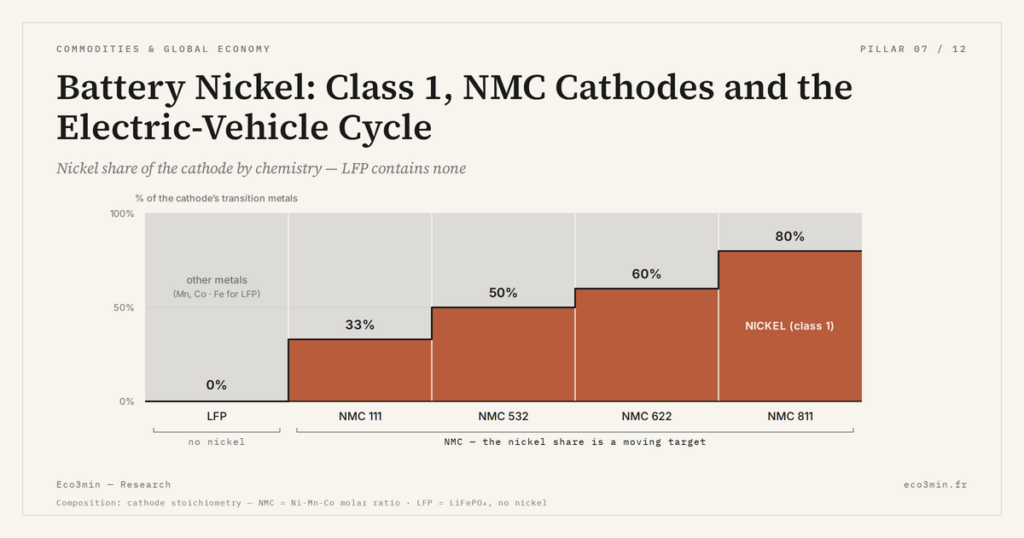
In a lithium-ion battery, nickel sits in the cathode, the positive electrode. So-called NMC chemistries, for nickel-manganese-cobalt, are its main outlet. Nickel’s role there is precise: to raise energy density, the amount of energy stored per unit of mass. As manufacturers sought to extend electric-vehicle range, they increased the share of nickel in the cathode, moving from balanced formulations to nickel-rich chemistries. More nickel means more range, at the cost of greater manufacturing complexity and heightened safety requirements.
This trade-off is not neutral. Nickel-rich cathodes deliver the energy density that long-range vehicles demand, but they are more prone to thermal instability and rely on cobalt, itself a contested material. Manufacturers have therefore pushed nickel content up to cut cobalt and extend range, then partly back as cheaper, more stable chemistries matured. The result is that the very share of nickel in a cathode is a moving target, set by engineering and cost decisions rather than by any fixed recipe, which adds yet another layer of variability to how much nickel a given volume of batteries actually consumes.
This class 1 demand has a partly Indonesian origin, which ties the battery segment to the supply dynamic described elsewhere. High-pressure acid leaching, or HPAL, converts low-grade lateritic ore into an intermediate refinable into sulphate. It is through this process that Indonesia’s HPAL route could claim to feed the battery market, and no longer only stainless steel. The boundary between class 2 and class 1, long thought watertight, was thereby blurred: the 2021 announcement of a process to convert pig iron into matte and then sulphate had been enough to send prices tumbling, a sign that the market dreads any challenge to that separation.
Turning the metal into sulphate adds a link that stainless steel does not have. Between refined nickel and the cathode lies a conversion step into sulphate, whose capacity is concentrated in a small number of countries, China first among them. That refining concentration, distinct from Indonesian mining concentration, creates a second bottleneck: a manufacturer can have access to the metal without having sulphate to the required specifications. The battery chain therefore depends not only on the mine, but also on a refining capacity that the West is still seeking to build out to reduce its dependence.
3. A demand driver tethered to the electric-vehicle cycle
The defining feature of the battery segment is that it tracks the electric-vehicle cycle, itself far more erratic than steady industrial production. Stainless-steel demand follows, more or less, ordinary economic cycles; battery-nickel demand depends on the pace of electric-vehicle adoption, which responds to public subsidies, interest rates, vehicle prices and technological shifts. A change in purchase-incentive policy or a rise in rates can bend the trajectory of this segment far more abruptly than a classic industrial slowdown would.
The 2024 and 2025 episode illustrated it. After several years of rapid expansion, electric-vehicle demand slowed in Europe and North America, wrong-footing a nickel supply sized for sustained growth. Capacity, notably Indonesian, designed to feed a fast-rising battery market, found itself partly redirected toward a less dynamic outlet than expected, accentuating the glut. The battery segment thus showed it could, on its own, turn an expectation of shortage into oversupply, even as stainless-steel demand stayed relatively stable. This capacity to swing reinforces the nickel market’s structural fragility as a whole.
Price formation complicates the reading further. The benchmark quoted contract remains class 1 nickel on the London Metal Exchange, but battery makers buy sulphate, traded at its own premium or discount and largely over the counter. The price signal that guides battery producers is therefore not exactly the one on the trading screen, and the absence of a sulphate market as liquid as the refined-metal one deprives the segment of a transparent reference. This partial opacity, added to demand volatility, makes investment decisions in the battery chain particularly delicate. Companion analysis: After Nickel: The LME, the 2022 Cancellation and a Metals Exchange’s Credibility.
4. Chemistry competition: LFP and class 1 uncertainty
A second source of uncertainty weighs specifically on battery nickel: competition between cathode chemistries. Lithium-iron-phosphate batteries, known as LFP, contain no nickel. Less energy-dense but cheaper and reputedly safer, they have gained market share, particularly on entry and mid-range vehicles. Every point of market share captured by LFP is demand that escapes class 1 nickel. The trajectory of this demand therefore depends not only on the pace of electrification, but also on a technological trade-off that neither producers nor markets control.
This dependence on chemistry choices sets battery nickel apart from a classic industrial metal, whose demand would simply track economic growth. Chemistry that shifts under the producer’s feet is also what pushes cell costs down faster than most forecasts, the mechanism behind the way storage has rewritten energy economics. A producer sizing capacity years ahead must bet not only on how many electric vehicles will be sold, but on the chemistry they will carry. The same technological uncertainty runs across the other battery materials: lithium price volatility offers an instructive parallel, as these markets react to the same expectations about electrification and its reversals. To place these transition metals in a wider frame, they can be tied to strategic resource markets, where concentrated supply and technological demand combine.
Geography sharpens the stakes. Because both the mining and the refining of battery-grade nickel are concentrated outside the West, governments in Europe and North America have moved to onshore parts of the chain, through incentives for domestic processing and sulphide projects and through rules on where battery materials may be sourced. These efforts pull in the opposite direction from the cost advantage of Indonesian and Chinese capacity, and their success is uncertain. For class 1 nickel, then, demand is shaped not only by chemistry and the electric-vehicle cycle but by an unfolding contest over where the battery supply chain will be allowed to sit.
Over the longer run, recycling adds a further variable. As the first large cohorts of electric-vehicle batteries reach end of life, recovered nickel could supply part of demand without new mining, tempering the call on primary class 1 metal. The scale and timing of that secondary supply remain uncertain, but it is one more factor that loosens the once-assumed link between electric-vehicle growth and primary nickel demand.
It is often assumed that electric-vehicle growth guarantees ever-rising nickel demand. That reading is incomplete: only NMC chemistry consumes nickel, and the rise of nickel-free LFP batteries can decouple electric-vehicle adoption from class 1 nickel demand. More electric cars does not mechanically mean more nickel.
- Batteries require class 1 nickel, refined into sulphate, from a supply chain distinct from that of class 2 stainless-steel nickel.
- In NMC cathodes, nickel raises energy density; its demand tracks the electric-vehicle cycle, sensitive to subsidies, rates and technology.
- Competition from nickel-free LFP batteries adds a distinct uncertainty: electric-vehicle adoption does not mechanically translate into class 1 nickel demand.
Conclusion
The battery end of nickel demand illustrates how a new outlet can reinforce a market’s instability rather than dilute it. By layering onto stable stainless-steel demand a segment tethered to the erratic electric-vehicle cycle and exposed to competition from nickel-free chemistries, the market inherited an additional source of volatility. One open question remains: will battery-nickel demand stabilise as electrification becomes widespread, or will the rivalry between cathode chemistries keep this segment in lasting uncertainty, regardless of how many electric vehicles are sold?
Last updated — 22 July 2026
Disclaimer – Financial Information: The analyses, commentary, and content published on eco3min.fr are provided for informational and educational purposes only. They do not constitute investment advice or a solicitation to buy or sell financial instruments. Past performance is not indicative of future results. All investment decisions involve risk and are the sole responsibility of the reader.
Read next
Full pillar →Reading the refinery utilisation rate: the threshold, the season, the turnarounds
A refinery runs full near ninety percent, not a hundred: the last slice of nameplate capacity is a…
IMO 2020: the regulatory shock that rewrote product spreads
An environmental rule on marine sulfur can move a refining spread more than a swing in crude. IMO…
The 2022–2023 refining golden age: anatomy of an episode
In 2022, refined fuel prices climbed faster than crude. That gap, measured by the 3-2-1 crack spread, reached…