The Role of Inventories in Commodity Price Formation
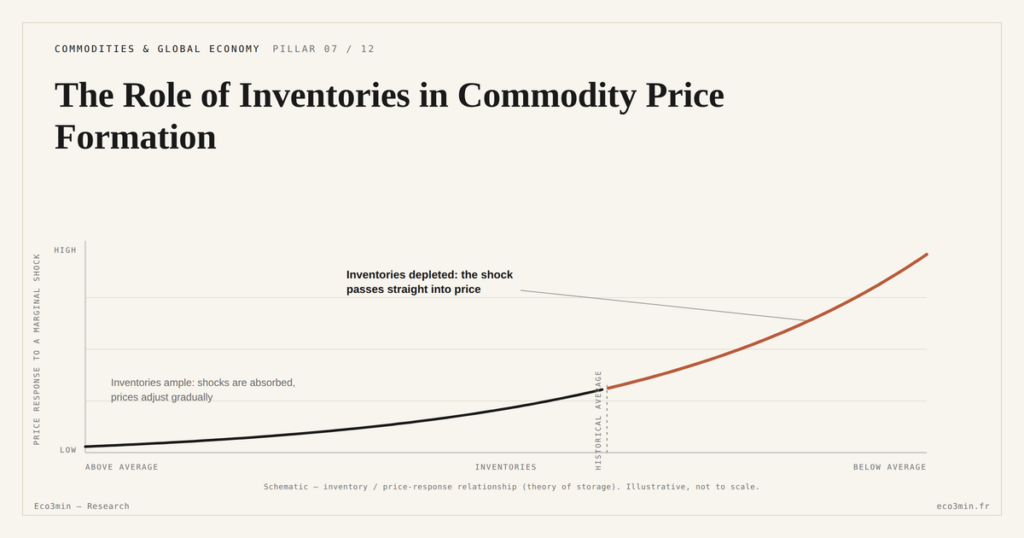
Inventory levels are the main stabilisation mechanism between rigid commodity supply and volatile demand. When reserves erode, every marginal shock translates directly into prices, regardless of underlying fundamentals.

Inventory levels determine the capacity of commodity markets to absorb or amplify imbalances. They constitute the main stabilisation mechanism between rigid supply and volatile demand.
TL;DR
Inventory levels decide whether a commodity market absorbs or amplifies a shock: ample reserves smooth price adjustments, thin reserves turn marginal shocks into outsized moves. This point is illuminated in the Eco3min mapping of commodity price formation.
- In several energy and metal markets, inventories running roughly 10 to 15% below their five-year average have historically coincided with price swings disproportionate to actual volume changes.
- When commercial inventories cover only a few weeks of consumption, the market loses its absorption capacity and participants price in a risk premium tied to supply continuity.
- Inventories act as the transmission channel between physical constraint and financial demand; the spot-to-forward spread and the gap to five- and ten-year averages signal how much cushion remains.
When inventories are abundant, demand variations are first absorbed physically and prices adjust gradually. Conversely, low reserves make markets hypersensitive to logistical, climatic or geopolitical shocks, triggering rapid and disproportionate adjustments. Reducing inventories to a secondary variable leads to underestimating a central determinant of price dynamics. This analysis examines why inventory levels are a structural indicator of commodity market tensions.
Why inventories are the market’s tipping point
In most commodity sectors, production cannot adjust quickly. Mining, agricultural and energy capacity respond to long investment cycles, while demand can shift within a few quarters under the influence of the business cycle, public policy or global trade. Inventories therefore play a buffering role against imbalance. A parallel read: why silver supply is largely a mining by-product.
When inventory levels are comfortable, a demand variation is first absorbed physically. Prices react with a lag and gradually. Conversely, when inventories sit below their historical averages, every marginal shock — climatic, logistical or geopolitical — translates almost immediately into prices.
This logic explains why two similar demand situations can produce very different price dynamics depending on the initial inventory level.
When inventories cease to play their cushioning role, price formation gradually shifts toward more binding economic thresholds. At that point, the absolute level of demand matters less than the price level required to cover marginal production cost and trigger a supply response. This logic is developed in the analysis dedicated to the role of marginal cost in commodity equilibrium price formation, which explains why some tensions persist even in the absence of immediate scarcity.
Low inventories: a volatility multiplier
Part of the consensus holds that prices primarily reflect the instantaneous balance between supply and demand. This reading implicitly assumes that inventories play a neutral, even passive role. Market observation, however, shows that it is precisely tight-inventory phases that generate the most abrupt price moves.
When commercial inventories cover only a few weeks of consumption, the market loses its absorption capacity. Participants are forced to incorporate a risk premium tied to supply continuity. This suggests that volatility is not merely an emotional reaction but the translation of a measurable physical constraint.
By way of illustration, in several energy and metal markets, inventories running roughly 10–15% below their five-year average have historically coincided with price swings disproportionate to the actual variations in volumes.
The discreet link between physical inventories and financial price formation
Commodity prices are largely formed on derivatives markets, but those markets remain anchored in physical reality. When inventories are abundant, financial participants have room to manoeuvre: intertemporal arbitrage limits tensions. By contrast, when inventories become critical, the boundary between financial demand and physical constraint tightens substantially.
This interaction lies at the core of the opposition between physical supply and financial demand, developed in greater depth in the reference analysis on price formation between physical constraints and financial flows. Inventories act as the transmission channel between these two dimensions.
Why this question has become more sensitive since 2024–2025
Since 2024, several commodity sectors have operated with structurally lower inventories than during the prior decade. The combination of past underinvestment, higher financing costs and more fragmented supply chains has reduced the capacity to rapidly rebuild reserves.
Against this backdrop, even a stabilisation of global demand is not always sufficient to ease prices. The market remains dependent on inventory levels that normalise slowly, which makes price signals more sensitive and at times misleading in the short run. Read alongside: the arabica-robusta spread as a supply-stress signal.
What readers really want to understand
The actual question is not so much whether prices are rising or falling, but whether the market still has a safety cushion. Behind interest in inventories lies a more fundamental question: does a price move reflect a transient imbalance or a structural fragility of the market? The same pattern appears across the cocoa chain, analysed in the 2024-2026 cocoa episode.
What could invalidate this reading
This analysis rests on the assumption that production capacity remains rigid in the short run. A coordinated acceleration of investment, or an exceptional release of strategic inventories, could temporarily restore a buffering effect. Conversely, a sharp negative demand shock would relieve pressure on inventories without going through prices.
These scenarios remain conditional and depend on political, industrial or macroeconomic decisions that are still uncertain.
Key indicators for tracking the role of inventories
- Commercial inventory levels relative to monthly consumption
- Gap between current inventories and 5- and 10-year averages
- Capacity and pace of inventory rebuild
- Spread between spot and forward prices (market structure)
What this mechanism really reveals
The role of inventories extends well beyond the local balance between supply and demand. It is embedded in a global commodity economy, where physical constraints, trade flows and global macroeconomic conditions determine the persistence of tensions and the diffusion of price shocks.
- Inventories transform small physical imbalances into large price moves.
- Low levels reduce the market’s capacity to absorb shocks.
- Volatility is often a symptom of insufficient inventories, more than an isolated speculative signal.
This is not the central scenario adopted by all market participants, but the reading helps explain why some commodity markets remain unstable despite seemingly contained demand. The risk is less visible than an abrupt supply shock, but more durable, because it rests on a slow and often underestimated erosion of available reserves. A companion piece: the effect of a Brazilian frost on world prices.
Last updated — 12 July 2026
Disclaimer – Financial Information: The analyses, commentary, and content published on eco3min.fr are provided for informational and educational purposes only. They do not constitute investment advice or a solicitation to buy or sell financial instruments. Past performance is not indicative of future results. All investment decisions involve risk and are the sole responsibility of the reader.
Read next
Full pillar →Reading the refinery utilisation rate: the threshold, the season, the turnarounds
A refinery runs full near ninety percent, not a hundred: the last slice of nameplate capacity is a…
IMO 2020: the regulatory shock that rewrote product spreads
An environmental rule on marine sulfur can move a refining spread more than a swing in crude. IMO…
The 2022–2023 refining golden age: anatomy of an episode
In 2022, refined fuel prices climbed faster than crude. That gap, measured by the 3-2-1 crack spread, reached…