Iron Ore, Steel Margins and the Coking Coal Complex

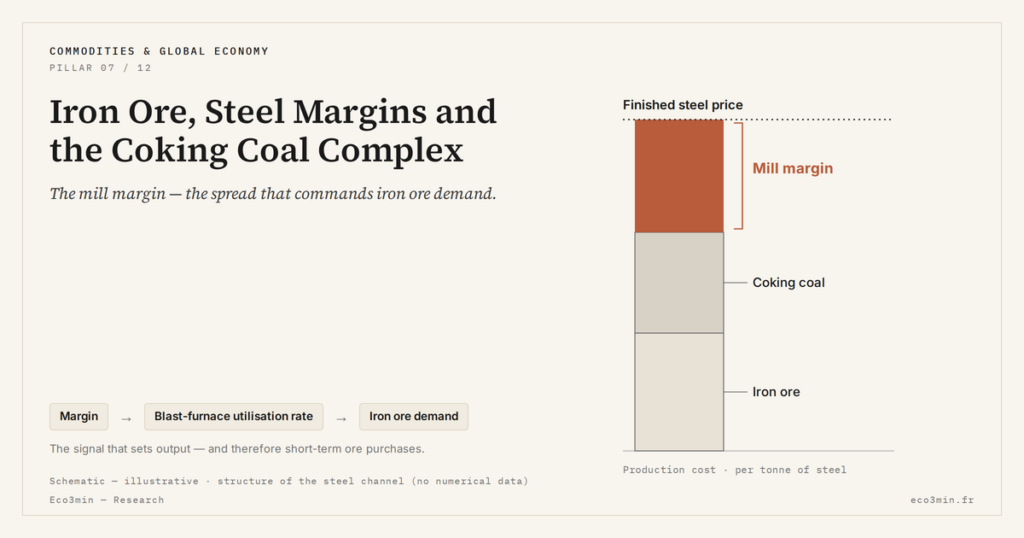
The iron ore price does not depend only on mine supply and steel demand: it runs through mill profitability. The margin between the finished steel price and its inputs — ore and coking coal — modulates mills’ appetite for ore, and can move the price even before construction has shifted.
TL;DR
Chinese steel-mill margins, the spread between finished steel and the cost of ore and coking coal, govern short-term ore demand, so the iron ore price can move before construction does.
- The blast furnace runs on two inputs, iron ore and coking coal, a metallurgical grade distinct from thermal coal; coke also acts as a reducing agent, stripping oxygen from the ore to free the iron.
- The mill margin compresses for three independent reasons, falling steel or dearer ore or dearer coke, so utilization and effective ore demand can drop with no change in construction.
- Coking coal trades largely seaborne, with Australia a leading exporter, on a thinner and more disruption-prone market, so a coke price spike alone can squeeze margins and feed back onto ore demand.
- Mills destock or rebuild ore inventories ahead of output changes, so the ore price leads or lags the construction signal rather than tracking real consumption directly.
Between construction demand and the ore price sits an often-overlooked link: the steel mill. Its margin decides its utilization rate, and therefore how much ore it buys in the short term. It is a discreet but powerful transmission channel.
The blast furnace and its two inputs
The dominant steelmaking route, in China as worldwide, is the blast furnace. It turns iron ore into pig iron, then steel, consuming two main inputs: the ore itself and coking coal — a metallurgical grade of coal, distinct from the thermal coal burned in power plants. Coke, made by baking coking coal, serves both as fuel and as a reducing agent, stripping oxygen from the ore to free the iron. Without coking coal, no blast furnace; without ore, nothing to reduce.
This dependence on two inputs is the key to the steel channel. The cost of producing a tonne of blast-furnace steel is largely set by the combined price of ore and coking coal, on top of energy and labour. Iron ore is therefore not bought in isolation: it is bought against the price of the steel it will yield and the cost of the other input. It is this relationship — between what steel earns and what its raw materials cost — that governs mills’ decisions, and through them their ore demand. This mechanism extends the analysis of the basics of the iron ore market on the downstream side, where ore meets the metal it serves.
This mechanics applies to the blast furnace, but a second route exists, the electric arc furnace, which starts from recycled scrap and electricity rather than ore and coke. Its margin obeys different inputs — the price of scrap, the cost of electricity — and does not call on iron ore. The gradual rise of this route in China, as available scrap increases, therefore shifts part of production outside the ore-coke channel. As long as the blast furnace dominates, however, it is its margin that commands most of ore demand.
The mill margin, a spread that commands
The steel margin is, in its simplest form, the spread between the finished steel price and the cost of the raw-material basket needed to produce it — iron ore and coking coal foremost. This spread measures a mill’s instantaneous profitability: wide, it encourages running flat out; narrow or negative, it pushes toward cutting or halting production. The margin is therefore the signal that decides blast-furnace utilization rates, and through that the quantity of ore consumed.
What makes this mechanism important is that the margin moves with its three components, not only with final steel demand. The steel price depends on construction demand, but also on competition among mills and on exports. The ore price and the coking coal price each have their own market and their own shocks. A margin can therefore compress because steel falls, but also because ore or coke gets dearer, independently of any change in construction. It is this partial autonomy that makes the margin a distinct channel, able to move ore demand for reasons specific to the steel complex.
Margins also reflect the competitive structure of Chinese steelmaking. With a large, fragmented industry running near a billion tonnes, individual mills have limited power over the finished steel price; when demand softens, competition among them compresses margins quickly. Add to this the role of exports — when domestic demand weakens, mills push output abroad, which supports volume but at thinner margins — and the margin becomes a sensitive gauge of how much pressure the steel sector is absorbing. A persistently squeezed margin signals a steel industry producing more than its home market profitably wants, a state with direct consequences for how much ore it is willing to take.
How the margin modulates ore demand
The transmission mechanism is direct. When Chinese steelmakers’ margins compress, mills respond: they cut their utilization rates, defer purchases, or draw down their ore inventories rather than purchase fresh tonnes. This fall in effective ore demand weighs on the price, even though underlying construction demand has not necessarily changed. Conversely, a comfortable margin encourages producing more and rebuilding inventories, which supports the price.
The role of inventories sharpens this lag. A mill anticipating a deteriorating margin destocks its ore before cutting actual output; a mill betting on a recovery rebuilds stocks before steel demand materializes. Inventory moves, at ports and in mills, therefore often precede production changes, and the ore price reacts to these inventory adjustments as much as to real consumption. It is one more reason an isolated quote does not directly report the state of construction.
This responsiveness introduces a lag between the ore price and the construction signal. Ore can fall because margins have compressed — say through a rise in coking coal or a passing weakness in the steel price — before building demand softens at all. It can also rebound on restocking that anticipates a recovery. The ore price thus leads or lags the pure demand signal, swinging with margins and mills’ inventory decisions. This short-term noise overlays the structural signal analysed in the underlying demand signal, and one risks misreading the trend by confusing it with that.
The coking coal complex
The second input deserves attention of its own, because it has its own market dynamics. Coking coal is, like iron ore, largely traded by sea, with Australia a leading exporter. Its price obeys its own supply factors — mining incidents, logistical constraints, export policies — and its own demand, itself closely tied to steelmaking. When coking coal gets dearer, the cost of producing steel rises, the margin compresses, and the pressure passes indirectly to ore through the channel described above.
The relative weight of the two inputs matters for how shocks propagate. Iron ore is typically the larger line in the raw-material bill, but coking coal is more prone to sharp, supply-driven spikes, given a thinner and more disruption-prone seaborne market. A coke price spike can therefore compress margins abruptly even when ore is stable, and the resulting cut in utilization then feeds back onto ore demand. The two inputs do not move in lockstep, and the gap between their prices is itself part of what determines where the margin sits.
Ore and coking coal thus form an input complex whose prices interact through the margin. A shock to one alters the profitability of steel and therefore mills’ appetite for the other. This interaction explains why the iron ore price cannot be read in isolation from the coking coal price: together they make up the raw-material cost at the blast furnace, and it is this combined cost, set against the steel price, that determines the margin and the utilization rate. A rise in ore, from the mine-supply side analysed in mine supply and Simandou, transmits to production only through this margin filter.
- The blast furnace consumes two inputs — iron ore and coking coal — and the cost of steel depends on their combined price set against the finished steel price: that is the mill margin.
- The margin decides blast-furnace utilization, and so short-term effective ore demand; it can compress because steel falls, but also because ore or coke gets dearer.
- Through this channel, the ore price can lead or lag the construction signal, adding short-term noise to the structural demand signal.
- Ore and coking coal form an input complex: a shock to one transmits to the other via steel profitability, and ore cannot be read in isolation from coke.
Reading the ore price through margins
The practical consequence is a reading rule. A move in the iron ore price should always be questioned in the light of steel margins. A decline can signal a weakening of Chinese construction — the structural signal — or a simple margin compression driven by dearer coke or temporarily weak steel — complex noise. Confusing the two leads to over-reacting to moves that lack the reach one ascribes to them.
The same discipline cuts the other way. A rally in the ore price need not signal a construction recovery; it can reflect restocking on improved margins, or a coke shock that lifts the whole input complex. The honest reading neither dismisses every move as noise nor treats every move as a demand signal, but asks each time which of the three forces — Chinese demand, mine supply, mill margins — best accounts for it. That triage is the difference between using the price and merely reacting to it.
This discipline completes those imposed by the market’s other forces. The ore price blends, at every instant, Chinese construction demand, producer supply and the steel-margin channel. To track the share belonging to each, drawing on the historical 62% Fe price data and setting it against margins and coking coal prices is essential. Placed within the wider set of physical resources, inside the physical-resources overview, the steel channel illustrates a general rule: the price of a raw commodity is never fully legible without the transformation link that creates its demand.
Last updated — 28 June 2026
Disclaimer – Financial Information: The analyses, commentary, and content published on eco3min.fr are provided for informational and educational purposes only. They do not constitute investment advice or a solicitation to buy or sell financial instruments. Past performance is not indicative of future results. All investment decisions involve risk and are the sole responsibility of the reader.
Read next
Full pillar →Reading the refinery utilisation rate: the threshold, the season, the turnarounds
A refinery runs full near ninety percent, not a hundred: the last slice of nameplate capacity is a…
IMO 2020: the regulatory shock that rewrote product spreads
An environmental rule on marine sulfur can move a refining spread more than a swing in crude. IMO…
The 2022–2023 refining golden age: anatomy of an episode
In 2022, refined fuel prices climbed faster than crude. That gap, measured by the 3-2-1 crack spread, reached…