Iron Ore Supply: The Big Four, Simandou and the Cost Curve

The iron ore price is pulled by Chinese demand, but it is not set by demand alone. A supply concentrated among four producers, a cost curve that leaves Chinese ore as the swing variable, and the arrival of Simandou in Guinea shape a supply side that can move the price independently of construction.
TL;DR
Four producers sit at the bottom of the iron ore cost curve while costly Chinese ore acts as the marginal tonne, so a price fall squeezes that swing supply first.
- Simandou in Guinea, around 65% iron and formally launched in late 2025, adds a third high-grade pillar alongside Australia and Brazil, with first cargoes reaching China around the turn of 2026.
- Supply is itself a signal: world output grows in 2026 (Guinea, Australia, Brazil) while Chinese output stays roughly flat, and after the 2010s expansion left the market well supplied the majors have at times held volume back rather than depress prices.
Reading a quote correctly means separating what comes from demand from what comes from supply. And iron ore supply follows its own logic: an oligopoly of low-cost producers, a costly marginal producer, and now a capacity shock out of West Africa.
A concentrated, low-cost supply
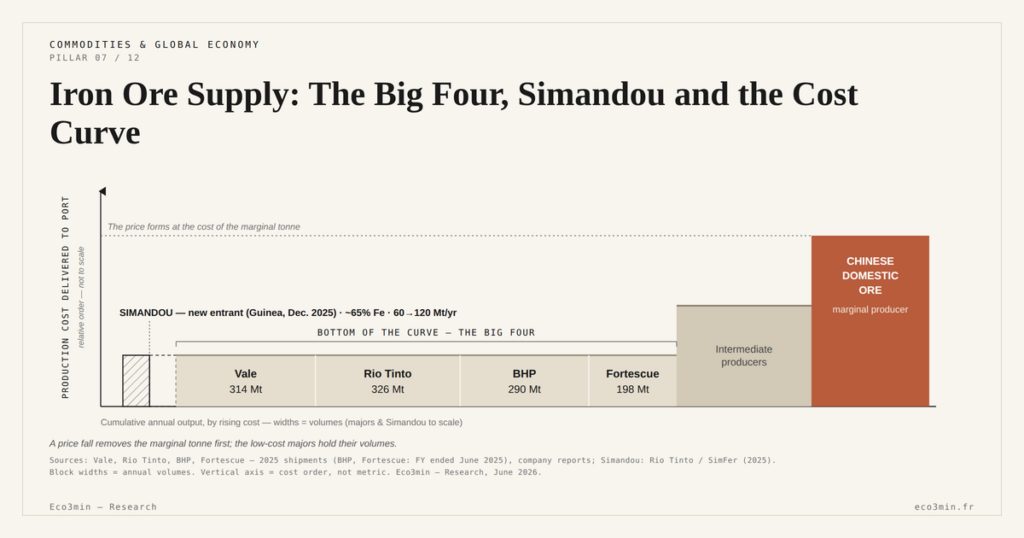
The seaborne iron ore market is one of the most concentrated in commodities. Four producers — Vale, in Brazil, and three Australia-anchored groups, Rio Tinto, BHP and Fortescue — supply most of the tonnage exported by sea: 326 million tonnes shipped from the Pilbara by Rio Tinto in 2025, 314 million sold by Vale, 290 million for BHP and 198 million for Fortescue (financial years ended June 2025 for the last two), according to company reports. These majors work rich, very low-cost deposits served by dedicated infrastructure — deep-water ports, rail lines hundreds of kilometres long — built during the two decades of sustained Chinese demand. Their position at the bottom of the world cost curve is the structuring fact of the supply side.
This concentration does not, however, give the majors price-setting power comparable to an oil cartel. Iron ore remains a demand market, where the price forms at the quote. Producers influence the balance through their volume decisions — opening or delaying an expansion, holding or cutting output — but they remain largely price-takers. This nuance, set out in our presentation of how the 62% Fe benchmark works, separates concentration of supply from control of the price. What matters here is not market power but the majors’ place on the cost curve, which determines which tonne sets the clearing price.
The cost curve and the marginal producer
The iron ore cost curve is organized in tiers. At the very bottom sit the Australian and Brazilian majors, whose all-in cost delivered to a Chinese port is among the lowest in the industry. Above them stack intermediate producers, then, at the very top, Chinese domestic ore — low-grade, deep, costly to mine and beneficiate — and various non-major producers. It is this top-of-curve ore that plays the role of marginal producer: the most expensive tonne still needed to clear the market.
The marginal-price mechanism explains the dynamics of quotes. When Chinese demand is strong, the market must call on costly domestic ore to satisfy the last increment of consumption, and the price rises until it covers that high cost. When demand weakens, this marginal ore exits first — the most expensive Chinese mines close — and the price falls back toward the costs of intermediate producers, then, in extreme phases, toward those of the majors. The position of the various producers on the curve thus determines how far the price can fall before supply contracts.
From this structure comes a characteristic asymmetry. Because the majors produce at low cost, they keep running even when the price falls to levels that force Chinese mines to idle. A price decline therefore squeezes the marginal producers first, while the Big Four hold their volumes. The market is slow to clear on the downside and asymmetric in its adjustment: it takes a marked fall for the majors’ supply to contract, whereas a rise quickly recalls marginal ore. This asymmetry is a permanent feature of the market, independent of any demand move.
A producer’s position on this curve depends on durable factors: the richness of the deposit, which sets how much useful ore is extracted per tonne of rock; the distance to port and to China, which weighs on transport cost; and the quality of infrastructure, which governs throughput. The Australian majors combine rich deposits with geographic proximity to Asia; Brazil offsets a greater distance with high grades. This cost hierarchy is slow to shift, because it is written into geology and infrastructure, which makes the cost curve relatively stable from year to year.
Simandou, the supply shock out of Guinea
To this now-established structure a first-order novelty is added: Simandou. Located in southeastern Guinea, this deposit is one of the largest bodies of ultra-high-grade ore — around 65% iron — left undeveloped in the world, flagged as early as the 1990s but kept for nearly three decades at project stage, held back by infrastructure costs, political obstacles and the complexity of its ownership. Its development was formally launched in late 2025, and the first cargoes left Guinea for China around the turn of 2026.
The project is carried by two ventures: Simfer, a joint venture between Rio Tinto and the Chinese group Chinalco, and the Winning Consortium Simandou, backed notably by the Chinese steelmaker Baowu and the Winning group. The ramp-up is gradual: an intermediate plateau on the order of 60 million tonnes a year is targeted for the first phase, with combined capacity that could approach 120 million tonnes annually at full build-out late in the decade. Exports started at a few hundred thousand tonnes a month and rose appreciably through 2026, the commissioning of rail and port infrastructure remaining the main throughput constraint.
One feature of Simandou deserves attention: the presence of Chinese interests in its ownership, through Chinalco and Baowu. For Chinese steelmaking, the world’s largest importer, securing a source of high-grade ore outside Australia answers a supply-diversification objective, in a market long dominated by a handful of majors. This strategic driver — reducing dependence on a small number of suppliers — illuminates the long-term investment made to bring into production a deposit that lay idle for nearly three decades.
Simandou’s significance lies less in its raw volume than in its nature. The deposit adds a third high-grade pillar to a market structured until now around two — Australia and Brazil. Its high grade destines it for premium segments, those of less carbon-intensive steelmaking routes, and so exerts specific pressure on the high-grade premium more than on the market as a whole. Above all, Simandou brings additional supply just as Chinese demand plateaus: according to sector projections, world iron ore output is growing in 2026, led by Guinea, Australia and Brazil, while Chinese output stays roughly flat. The analysis of this cost curve and Simandou’s arrival extends directly the demand question treated in the peak steel debate: a supply that is expanding into a demand that is flattening.
The high-grade dimension also intersects with the structural demand question. As steelmaking faces pressure to cut emissions, high-grade ore — which raises furnace productivity and lowers coke use — gains relative appeal, and Simandou’s roughly 65% iron content is positioned for exactly those premium, lower-emissions routes. Whether that premium positioning translates into a durable advantage depends on how fast lower-carbon steelmaking scales, a demand-side question rather than a supply one. The supply shock and the demand transition are, in this sense, entangled.
Seeing Simandou as a programmed collapse in the iron ore price. The deposit adds a high-grade pillar, in stages and under infrastructure constraints; it weighs mainly on the high-grade premium and raises competitive pressure, without threatening Australia’s dominance in volume. The effect is incremental and gradual, not a sudden flood.
When supply, not demand, moves the price
The supply side is a reminder that a fall — or a rise — in the ore price does not always reflect a change in Chinese demand. Several events can move the price independently of construction. A supply disruption at a major — an accident, a weather event, a logistical interruption — cuts available supply and supports the price even though demand has not moved. Conversely, the arrival of new capacity, such as Simandou, or a loosening of volume discipline among producers, can weigh on the price without demand having weakened.
Past episodes illustrate this. Disruptions to Brazilian supply have, in the past, removed significant volumes from the market and contributed to price surges, independently of the path of Chinese demand. Symmetrically, the majors’ expansion waves have periodically flooded the market and weighed on quotes. For anyone tracking the price over a long horizon — accessible through the historical iron ore price trajectory — separating supply moves from demand moves is essential to a correct interpretation.
Supply discipline itself is a variable worth watching. After the 2010s expansion left the market well supplied, the majors have at times shown restraint in adding volume, mindful that flooding a demand-constrained market would depress the very prices they depend on. A decision to hold back or to accelerate an expansion is therefore a supply signal in its own right, distinct from any move in Chinese construction. Reading the price well means tracking not only mine disruptions and new projects, but also the volume posture of the producers who sit at the bottom of the cost curve.
This reading discipline also applies to the steel channel. The ore price is not determined solely by mine supply and steel demand: it also depends on mill profitability, which modulates their appetite for ore in the short term. This aspect, complementary to the supply side, is the subject of a separate study on the effect of steel margins on the price. Together, mine supply, Chinese demand and steel margins make up the three forces an isolated quote blends, and that a macro reading must disentangle.
Placed within the wider set of physical resources, treated inside the other physical-resource markets, iron ore’s supply side illustrates a general rule: even a demand-governed commodity has a production geography, a cost curve and supply shocks of its own, which cannot be ignored without risking a misreading of its price.
Last updated — 22 September 2026
Disclaimer – Financial Information: The analyses, commentary, and content published on eco3min.fr are provided for informational and educational purposes only. They do not constitute investment advice or a solicitation to buy or sell financial instruments. Past performance is not indicative of future results. All investment decisions involve risk and are the sole responsibility of the reader.
Read next
Full pillar →Reading the refinery utilisation rate: the threshold, the season, the turnarounds
A refinery runs full near ninety percent, not a hundred: the last slice of nameplate capacity is a…
IMO 2020: the regulatory shock that rewrote product spreads
An environmental rule on marine sulfur can move a refining spread more than a swing in crude. IMO…
The 2022–2023 refining golden age: anatomy of an episode
In 2022, refined fuel prices climbed faster than crude. That gap, measured by the 3-2-1 crack spread, reached…