Macro Regimes and Real Rates: Reshaping Household Decisions
Saving, borrowing and investment decisions shift with the prevailing real-rate, inflation and liquidity regime. Three distinct macro configurations produce three different household logics — and the early-2026 neutral-rate environment leaves a narrower margin for error.

Saving, borrowing and investment decisions shift in nature with the prevailing real rate, inflation and liquidity regime. A reading of the mechanisms that condition household financial decisions.
TL;DR
Whether saving, borrowing or investing pays off depends on the real-rate and liquidity regime in force; the eurozone has run through three since 2015: negative, transition, and neutral.
- The real rate, not the displayed nominal rate, is the price of time: when it is negative, debt cheapens in future purchasing power and cash savings erode; eurozone real rates ran durably negative in 2015–2021 before ECB tightening took the deposit rate from 0% to a 4% peak, then back to 2% by June 2025.
- Each regime rewrites the trade-off: the 2022–2025 transition handed savers a real return, with the Livret A at 3% against sub-2% inflation positive for the first time in over a decade, while the early-2026 neutral regime (deposit rate 2%, inflation 1.7%) favours neither borrowing nor saving.
- Liquidity acts as a third lever, with the Eurosystem balance sheet swelling from €4,671bn to €8,566bn between 2020 and 2022 to compress risk premia; quantitative tightening now reverses the move and shifts cross-asset correlations.
- Households are already repricing toward yield: Banque de France recorded €33.4bn of net household financial investment flows in Q1 2025, the financial saving rate rising to 9.8% in Q2, tilting toward euro life insurance and term deposits over sight deposits.
The French household saving rate reached 18.9% of gross disposable income in Q2 2025, according to INSEE — a level not seen since the early 1980s outside the Covid period. In the eurozone, Eurostat puts the same ratio at 15.1% in Q3 2025. These figures do not reflect a simple precautionary reflex. They reveal a silent adjustment of household financial behaviour to the prevailing macroeconomic regime.
What makes this issue more structural than it appears: the gap between the public discourse on purchasing power — centred on prices — and the reality of intertemporal trade-offs — driven by real rates — has never been wider. Individual financial decisions are not made in a vacuum. They sit within a regime of macroeconomic constraints whose reading conditions their relevance. This framing connects to the broader idea developed in our financial education framework on structuring decisions over time.
The real rate as the price of time
To save, to borrow or to invest is to arbitrage between the present and the future. The central parameter of that trade-off is not the nominal rate displayed by central banks, but the real rate — the nominal rate adjusted for expected inflation. When the real rate is negative, debt becomes mechanically less costly in terms of future purchasing power. When it turns positive again, the logic reverses: savings are better remunerated, and debt weighs more heavily. For more detail: the behaviour of gold under real rates.
Between 2015 and 2021, eurozone real rates remained durably negative, sometimes by several hundred basis points. This regime encouraged mortgage borrowing, risk-taking in financial markets and the under-remuneration of precautionary savings. Since mid-2022, ECB tightening — taking the deposit rate from 0% to a peak of 4% before easing back to 2% in June 2025 — has restored real rates close to zero, and even slightly positive. This shift has materially altered the hierarchy of household trade-offs. A related study: the point where cycle timing outweighs asset selection.
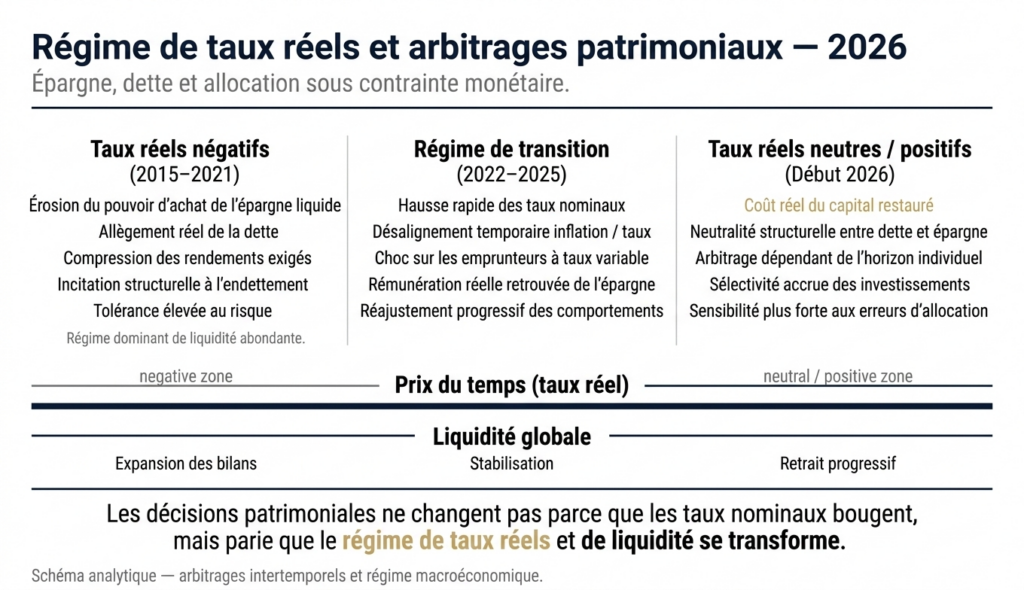
Three regimes, three household logics
The relationship between the macro regime and individual decisions can be read through three distinct configurations.
Negative real-rate regime (2015-2021). Liquid savings lose purchasing power every year. The real cost of debt declines over time. The structural incentive pushes towards borrowing and exposure to risky assets. Property prices rise mechanically — not from excess demand, but from the compression of required yields. This regime shaped the household financial behaviour of an entire generation.
Transition regime (2022-2025). Monetary tightening creates a temporary misalignment. Nominal rates rise before inflation comes down. Households still borrowing at variable rates absorb a shock. Those who save recover a real return — the Livret A regulated savings account at 3% against inflation falling below 2% delivered a positive real yield for the first time in over a decade. The ECB’s September 2025 projections anticipated average inflation of 1.7% in 2026, confirming the normalisation of the regime. Adjacent reading: the 401(k) deduction and tax brackets.
Neutral-rate regime (early 2026). With the ECB deposit rate at 2% and eurozone inflation at 1.7% in January 2026 according to Eurostat, the short-term real rate hovers around zero. This neutral regime structurally favours neither borrowing nor saving. It places the quality of the individual trade-off — horizon, liquidity, risk tolerance — back at the centre of the decision. It is a demanding regime, where reading errors carry a higher cost than in a negative-rate environment that forgave a great deal.
What inflation redistributes silently
Inflation is more than a price indicator. It is a redistribution mechanism between creditors and debtors, between holders of real assets and holders of nominal assets. When inflation accelerates beyond expectations, it mechanically lightens the real value of debt and erodes that of non-indexed savings. When it decelerates — as has been the case since mid-2024 in the eurozone — the reverse motion sets in.
Banque de France data show that in Q1 2025, the net flow of household financial investments reached €33.4 billion, with the financial saving rate rising to 9.8% in Q2. The trade-off has clearly shifted towards yield-bearing products — euro-denominated life insurance, term deposits — at the expense of sight deposits. This behaviour is consistent with a regime in which real rates turn positive again: understanding the essential financial mechanisms begins with reading the inflation regime in which those mechanisms operate.
Liquidity and risk tolerance: an underestimated link
The third macro parameter conditioning household trade-offs is global liquidity. When central bank balance sheets expand — as was the case between 2020 and 2022, when the Eurosystem balance sheet rose from €4,671 billion to €8,566 billion according to ECB data — abundant liquidity compresses risk premia and mechanically raises collective risk tolerance. Risky assets rise, spreads tighten, and the illusion of efficient diversification reinforces.
When that liquidity withdraws — as is currently the case with quantitative tightening — correlations between asset classes shift. Allocation strategies built in an abundant-liquidity regime may stop functioning in a normal-liquidity regime. The macroeconomic cycle diagnostic helps locate where one stands within this dynamic — and avoid extending arbitrage patterns that have become unsuited.
Reasoning about household choices on the basis of the latest nominal rate displayed, without integrating expected inflation or the liquidity regime. A 3.5% credit rate does not carry the same economic meaning depending on whether inflation is at 5% (negative real rate, favourable to the borrower) or at 1.5% (real rate of 2%, constraining). The relevant trade-off is always on the real rate, never on the headline rate.
When the regime shifts, “good strategies” become unsuited
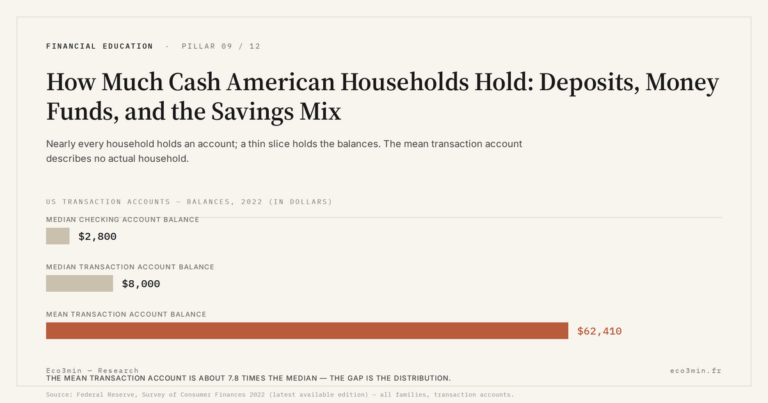
The dominant consensus tends to treat household decisions as static choices: diversify, save regularly, invest for the long term. These principles are not wrong. But they omit a decisive parameter: the macroeconomic regime in which they apply. An allocation built for a negative-rate, abundant-liquidity environment — high equity exposure, elevated property leverage, low precautionary cash — becomes fragile in a regime of neutral rates and liquidity withdrawal. See also: our analysis of US household deposit holdings.
The ECB’s macroeconomic projections, published in September 2025, estimated eurozone GDP growth at 1.2% for 2025 and 1.0% for 2026. This moderate pace, combined with inflation near target and stable policy rates, sketches an environment where expected returns are lower and margins for error are narrower. The challenge is no longer to capture asset price gains driven by falling rates, but to track the evolution of the conjunctural framework to adjust the reading of ongoing trade-offs.
The friction point for many is not the choice between saving and investing, but the inability to connect that choice to the macro regime conditioning it. Investment and allocation strategies do not change in nature because an indicator has moved. They change in nature because the regime — real rates, inflation, liquidity — has shifted.
Household trade-offs are not neutral choices: their relevance depends on the real-rate regime in which they sit, not on the nominal rate displayed.
- The real rate — not the nominal rate — determines the economic logic of saving, borrowing and investing.
- Three distinct macro regimes (negative rates, transition, neutral rates) produce three different household logics — applying the logic of a past regime to the current one is a major analytical risk.
- Central bank liquidity withdrawal alters correlations between assets and reduces the margin for error of allocation strategies.
- In early 2026, the eurozone neutral-rate regime places the quality of the individual trade-off back at the centre of the household decision.
The macroeconomic environment in early 2026 resembles neither 2019 nor 2022. The ECB has held rates at 2% since June 2025, inflation hovers around target and growth remains moderate. For investors, corporates and households alike, this regime calls for a finer reading of financing constraints, real returns and intertemporal trade-offs. The framework has changed. The reading grid for monetary transmission mechanisms must follow.
Last updated — 12 July 2026
Disclaimer – Financial Information: The analyses, commentary, and content published on eco3min.fr are provided for informational and educational purposes only. They do not constitute investment advice or a solicitation to buy or sell financial instruments. Past performance is not indicative of future results. All investment decisions involve risk and are the sole responsibility of the reader.
Read next
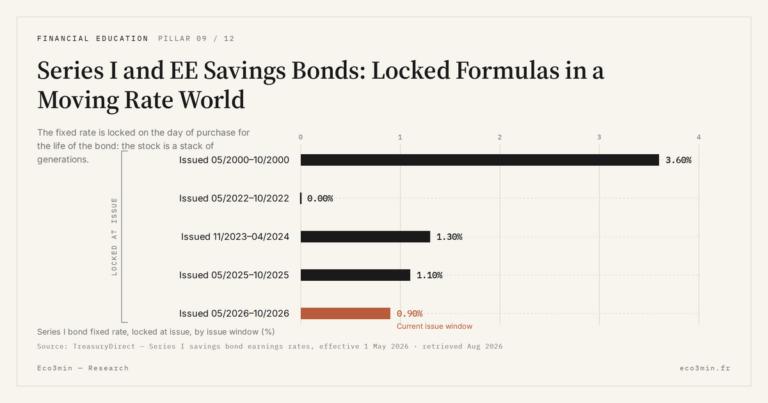
Full pillar →Series I and EE Savings Bonds: Locked Formulas in a Moving Rate World
US savings bonds lock a rate formula at the moment you buy them, for the life of the…
Where the Livret A’s Money Goes: The Caisse des Dépôts Circuit and Social-Housing Finance
The savings held on Livret A accounts do not sit idle. A regulation-set share is centralised at the…
France’s LEP vs the Livret A: A Means-Tested Higher Rate, Explained
France’s Livret d’épargne populaire is often described as "the Livret A, only better". The description misleads: the LEP…