From Pensions to 401(k)s: How America Shifted Retirement Risk onto Households

The 401(k) is an accident of tax law that became the backbone of US retirement. A minor 1978 provision displaced the defined-benefit pension within two decades, moving market and longevity risk from the employer onto the household.
People treat the 401(k) as the natural retirement system. It was a side effect of the tax code, and the structure of today’s retirement bet is a direct legacy of who was made to carry the risk.
The shift from pensions to 401(k)s was not planned as a system: it grew from a minor 1978 tax provision and moved retirement risk onto households.
- Section 401(k) of the 1978 Revenue Act allowed pre-tax salary deferral; within two decades it displaced the defined-benefit pension as the default.
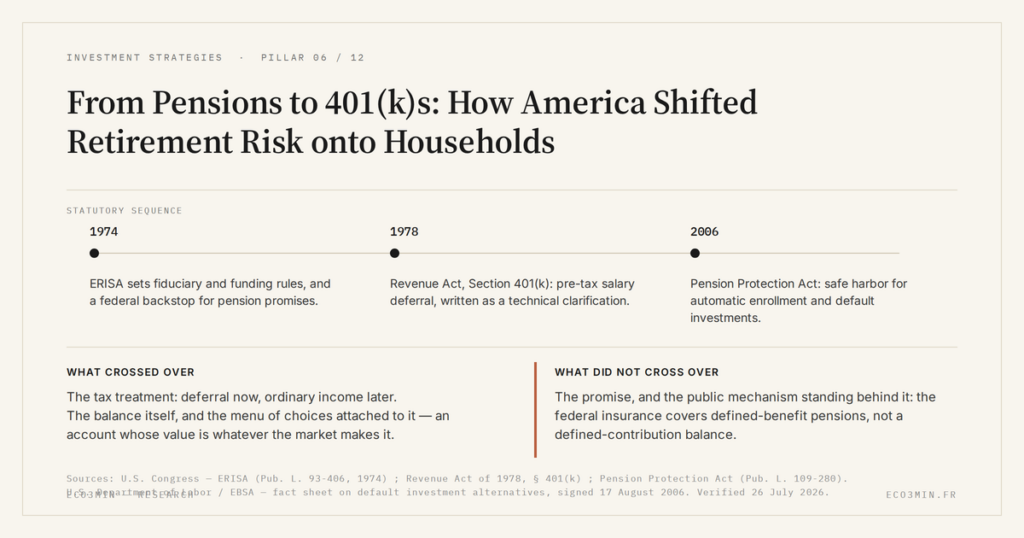
- ERISA (1974) set the guardrails; the Pension Protection Act of 2006 cleared the way for automatic enrollment, and participation followed.
- A pension promised a check; a 401(k) promises a balance and a set of choices, shifting market and longevity risk onto the household.
The 401(k) feels like the natural architecture of US retirement, as if it had been designed for the purpose. It was not. Section 401(k) of the Revenue Act of 1978 was a minor provision, and the account that grew out of it was never conceived as a national retirement system. Yet within two decades it had displaced the defined-benefit pension as the default private-sector vehicle. Reading the 401(k) as a deliberate system misses the point: its dominance is the unplanned result of a tax rule, and that origin explains today’s defined-contribution architecture, including the risks it leaves the household holding.
An accident of tax law: Section 401(k), 1978
The provision that gave the account its name was obscure at birth. Section 401(k) of the 1978 Revenue Act permitted employees to defer part of their salary into a plan on a pre-tax basis, a technical clarification more than a policy design. It was not written to replace pensions; it simply created a tax-advantaged way to save from salary. Employers, facing the rising cost and balance-sheet risk of defined-benefit promises, found in it a cheaper alternative: instead of guaranteeing a future pension, they could match a portion of what the employee chose to contribute. What began as a minor deferral rule became, through that corporate incentive, the scaffolding of a new retirement model. Built on employee choice, that scaffolding only reached scale once enrolment stopped requiring a decision at all, which is the shift traced by the effect of default options on retirement saving.
The spread was gradual, then decisive. Through the 1980s and 1990s, employers increasingly offered a 401(k) in place of, or alongside, a shrinking pension, and workers accumulated balances rather than accruing promised benefits. The account’s tax treatment, deferral now and ordinary-income tax later, is a subject in its own right, developed in the entry mechanics of the unified plan. The historical point is narrower: a rule meant to clarify salary deferral ended up reorganizing how an entire country would save for old age, without any single decision to make it so.
The corporate logic behind that drift is worth spelling out, because it explains the speed of the change. A defined-benefit pension is a long-dated liability on the employer’s balance sheet: the firm owes a future stream of payments whose cost depends on investment returns, interest rates and how long retirees live, all uncertain. A 401(k) converts that open-ended obligation into a fixed, current expense, the match paid this year and nothing more. For a company, replacing an unpredictable liability with a predictable cost is a powerful incentive, independent of any view about what serves workers best. The shift was driven at least as much by balance-sheet management as by retirement policy, which is precisely why it happened without a guiding design. In depth: the checklist for a 401(k) menu.
ERISA’s guardrails and the auto-enrollment tipping point
The 401(k) did not grow in a vacuum. The Employee Retirement Income Security Act of 1974, ERISA, had already set the framework for private retirement plans: fiduciary standards, funding rules, and protections for participants, including the insurance of certain pension benefits. ERISA was written with defined-benefit pensions in mind, but its guardrails came to govern the defined-contribution accounts that followed. The legal scaffolding for the shift was therefore in place before the account that would exploit it became widespread.
ERISA also carried a revealing asymmetry. It created a federal backstop that insures certain defined-benefit pensions when an employer fails, protecting the promise the employer had made. No equivalent backstop exists for a defined-contribution balance, because there is no promise to insure: the account is whatever it is worth. That contrast captures the whole transition in miniature. Under the old model, a public mechanism stood behind a private promise; under the new one, the household stands alone behind its own balance. The regulatory architecture protected the pension it was designed for, not the account that replaced it.
The decisive push came later. For years, 401(k) participation depended on workers actively signing up, and many did not. The Pension Protection Act of 2006 changed the default: it gave employers a safe harbor to enroll workers automatically unless they opted out, and to escalate contributions over time. The behavioral effect was large, because defaults are powerful. Automatic enrollment turned a voluntary account into a near-universal one for those with access, completing the transition that the 1978 provision had begun almost by accident. The system that looks deliberate today was assembled in stages, each solving a narrow problem.
From a promise to a balance: the risk that moved
The shift from defined benefit to defined contribution was not merely administrative. A defined-benefit pension promised a stream of income in retirement, and the employer bore the risk of funding it: if investments underperformed or retirees lived longer than expected, the employer’s balance sheet absorbed the gap. A defined-contribution account promises nothing but a balance and a menu of choices. The worker decides how much to contribute and how to invest, and carries the consequences directly. A pension promised a check; a 401(k) promises an account. The difference sounds semantic, but it relocates the entire burden of uncertainty from an institution designed to pool it to an individual who cannot. Where that individual ends up living carries its own tax consequence, one measured in the migration response to high-tax states.
What moved, in that transition, was risk. Market risk, the chance that returns disappoint, shifted from the employer to the household. Longevity risk, the chance of outliving one’s savings, shifted as well, since a balance can be exhausted while a lifetime pension cannot. This transfer is the structural fact beneath every feature of the account, from the deduction to the lock to the withdrawal doors. It is neither good nor bad in itself, but it changes the nature of the commitment: the account does not guarantee retirement income, it accumulates capital whose adequacy the household alone must judge.
What the shift left the household holding
The consequences of that transfer are still unfolding. With the defined-contribution account as the private-sector backbone, the retirement outcome of most households now rests on decisions each of them makes individually, against a public system under its own strain. Public retirement provision faces demographic pressure on pensions, as aging populations and longer lifespans stretch the ratio of workers to retirees, and debates over claiming age reflect the same arithmetic. The 401(k) did not cause that pressure, but it sits alongside it: private capitalization grows as confidence in a purely collective promise erodes. Part of what erodes that confidence is arithmetic, and the shifting balance between older Americans and children supplies its shape.
The shift also left a coverage gap the old model handled differently. Access to a 401(k) depends on having an employer that offers one, which not every worker does; those without a workplace plan are left to the individual account and their own initiative. Where a defined-benefit pension automatically covered the workers a firm employed, the defined-contribution model covers those who have access and choose to use it. The result is a system that rewards steady, long-tenure employment with a good plan and a match, and leaves the intermittent or lower-paid worker with thinner provision. That unevenness is not a flaw in any single account; it is a property of building a retirement system out of individual, employer-linked vehicles rather than a universal promise. Also relevant: our framework for the retirement number.
The lineage also shapes the account’s present form. The wrappers that hold defined-contribution savings, the employer 401(k) and the individual IRA, are the institutional descendants of that history, and the choice between them affects cost, access and protection without changing the tax code much. That distinction is developed in the inherited compartments and their wrappers. Read in the rate cycle, as the frame on long-term saving in the rate cycle sets out, the 401(k) is best understood not as a designed system but as an inherited one, whose shape records the sequence of narrow decisions that built it.
- Section 401(k) of the 1978 Revenue Act was a minor provision; corporate incentives turned it into the default retirement vehicle within two decades.
- ERISA (1974) set the guardrails and the Pension Protection Act of 2006 enabled automatic enrollment, which made participation near-universal for those with access.
- The defined-benefit-to-defined-contribution shift moved market and longevity risk from the employer onto the household, the structural fact beneath the account.
The 401(k), then, is not a rupture designed from scratch but the accumulated result of a tax provision, a regulatory framework and a behavioral nudge, each added to solve a narrow problem. Its present shape records that sequence, down to the risks it leaves the saver holding. Understanding where it came from is not an antiquarian detour: it is the condition for reading what it has become, a vehicle of individual capitalization that quietly replaced a collective promise, and shifted the weight of retirement onto the household that now owns the balance. That is also what separates a historical reading from a product sheet: the first explains the shape of the account, the second merely lists its features.
Last updated — 29 August 2026
Disclaimer – Financial Information: The analyses, commentary, and content published on eco3min.fr are provided for informational and educational purposes only. They do not constitute investment advice or a solicitation to buy or sell financial instruments. Past performance is not indicative of future results. All investment decisions involve risk and are the sole responsibility of the reader.
Read next
Full pillar →Beneficiary Designations, the Step-Up in Basis, and the 10-Year Rule: How US Accounts Transfer at Death
At death, most US financial accounts pass outside the will, straight to a named beneficiary, under tax rules…
The Fee Stack in Variable Annuities: M&E Charges, Riders, and Subaccount Costs
A variable annuity does not carry one fee, but a stack of them. Mortality and expense charges, subaccount…
The Conventional 401(k)-Match-First Funding Order: Where It Comes From, How It Works
The question of what order to fund accounts in usually draws a fixed list, presented as a rule…