Policy Rates, Market Rates and Real Rates: Understanding the Differences
Policy rates, market rates and real rates no longer move in lockstep. Their growing dissociation reshapes how monetary transmission and the macro cycle should be read in 2025-2026.

What prices imperfectly incorporate today is not so much the level of rates as the widening gap between their different layers. Policy rates, market rates and real rates no longer tell the same story, and this dissociation blurs the reading of monetary policy.
TL;DR
Policy rates set central-bank intent, market rates price expectations, and real rates carry the constraint actually felt; by late 2025 those layers had diverged enough to blur monetary policy.
- As of December 2025, major advanced-economy policy rates sat in an elevated 4–5% range, while inflation had receded from its 2022–2023 peaks to roughly 2–3%.
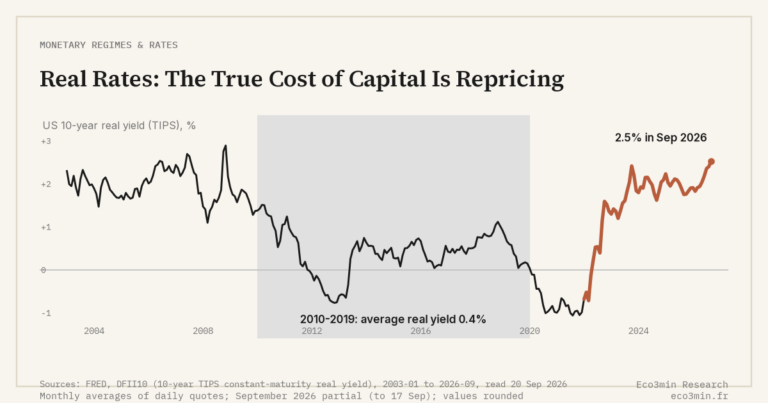
- Because inflation slowed faster than nominal rates, ex ante real rates turned firmly positive, exceeding +1.5% on some short maturities, a sharp break from the near-zero or negative real rates of 2010–2019.
- What conditions mortgage costs, corporate financing and asset valuations is the market rate, not the policy rate; a 10-year yield can fall while the policy rate holds, since it prices expected inflation and growth.
- The consensus assumes future policy-rate cuts will relax the constraint; the analysis counters that with inflation expectations anchored low, falling nominal rates can leave real rates durably restrictive.
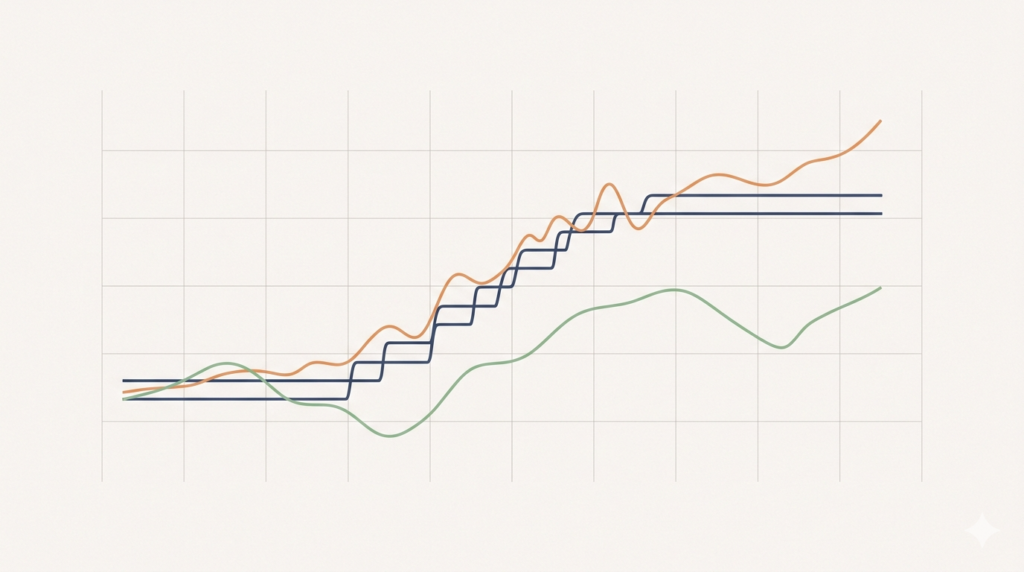
Policy rates express the intent of central banks. Market rates reflect financial expectations. Real rates translate the economic constraint actually transmitted to the economy.
Three Rates, Three Distinct Functions
This dissociation between the different rate layers can only be properly interpreted by placing it in the broader framework of monetary policy and interest rates, which structures the transmission of central bank decisions well beyond the policy rate level alone.
The starting point remains the policy rate. Set by the central bank, it defines the very short-term refinancing cost of the banking system. As of December 2025, the policy rates of major central banks remain in an elevated range, around 4% to 5% in the main advanced economies, according to institutional monetary policy frameworks.
Market rates form elsewhere. They emerge from trading between investors on government bonds, interest rate swaps and private credit. Their level depends less on past decisions than on expectations: future inflation, expected growth, assumed central bank trajectory. This is why a 10-year bond yield can fall even when the policy rate remains unchanged. This desynchronization between segments of the curve is central to our study on equity markets and the inverted yield curve, which examines how market expectations diverge from monetary steering.
Finally, real rates introduce a third reading. They correspond to a nominal rate adjusted for expected inflation. When inflation slows faster than nominal rates, real rates rise mechanically, even without a new monetary policy decision. Those decision-free stretches can run for years, and the register of all ECB rate decisions since 1999 dates each one, hold after hold.
This dissociation between monetary intent, market expectations and real constraint requires thinking in terms of rate cycles, integrating transmission lags and the intermediate phases between stabilization, plateau and effective easing, as shown in this rate cycle reading.
Why These Gaps Have Widened Recently
These gaps become particularly readable when accounting for business cycle timing in monetary policy, since the same rate level can produce very different effects depending on the cyclical phase. A dedicated treatment sits in our read of the pathway from central-bank rates to profits.
Since 2022, rapid monetary normalization has created an unusual layering. In 2025, inflation in developed economies has clearly receded from the 2022-2023 peaks, oscillating around 2% to 3% across statistical aggregates. At the same time, policy rates have remained elevated longer than some projections anticipated.
The result: ex ante real rates have turned firmly positive again, sometimes exceeding +1.5% on certain short maturities. This situation is not neutral. It means that effective monetary constraint can no longer be read in central bank announcements, but in the purchasing power of credit.
Part of the consensus assumes that future easing of policy rates will be enough to relax this constraint. The implicit assumption is that market rates will follow mechanically. The analysis diverges on this point: as long as inflation expectations remain anchored low, the decline in nominal rates can leave real rates durably restrictive.
A Transmission Mechanism Often Misinterpreted
In public debate, policy rates are often perceived as the main lever of monetary policy. In practice, market rates are what condition mortgage credit costs, corporate financing and asset valuations. Policy rates act only indirectly, through expectations and liquidity.
This gap explains why some monetary decisions appear to produce lagged or asymmetric effects. For a broader reading of the transmission mechanism, the general framework of monetary policy and its effects on the real economy places these interactions in a coherent chain.
Concrete example: a 25 basis point policy rate hike can have near-zero impact on long rates if the market considers inflation contained and the business cycle slowing. Conversely, a revision of inflation expectations can push market rates higher without any change in official policy.
What the Reader Really Seeks to Understand
The real question is not so much whether rates will fall or remain elevated, but which rate actually puts pressure on the economy. Behind this question lies a simpler concern: can the felt financial constraint persist even when monetary discourse becomes more accommodative?
A Sharper Macro Reading Through Real Rates
Historically, phases when real rates are durably positive coincide with credit slowdown and stricter selection of investment projects. Between 2010 and 2019, real rates were close to zero, or negative, supporting leverage and valuations. The 2024-2026 period marks a sharp break from that regime.
This shift modifies microeconomic trade-offs. Companies see their cost of capital rise in real terms, even if nominal rates stop climbing. Households trade off more between immediate consumption and savings, as the real return on liquidity becomes significant again.
Common Reading Errors
Confusing a policy rate decline with effective monetary easing is a common error. It is misleading because it ignores the role of inflation expectations. The correction consists of systematically observing real rates.
Over-interpreting an isolated market rate is another. A 10-year yield can fall for the wrong reasons, notably a recession expectation. It must be read against spreads and credit dynamics.
Key Indicators for Tracking Rate Dissociation
- Ex ante real rate: nominal rate minus expected inflation over 5 to 10 years.
- Yield curve slope: spread between short and long rates.
- Credit spreads: indicator of transmission to the real economy.
What Could Invalidate This Reading
A negative demand shock sharper than expected could push market rates down faster than inflation, rapidly reducing real rates. Conversely, an inflationary resurgence linked to supply or wage constraints would keep real rates elevated despite softer monetary discourse.
Conclusion: Three Rates, One Signal to Interpret
The coexistence of elevated policy rates, volatile market rates and positive real rates complicates cyclical reading. It is not the central scenario adopted by all participants, but the gap between these three levels warrants particular attention, since it conditions effective economic constraint far more than official announcements.
- Policy rates express the intent of central banks.
- Market rates reflect macroeconomic expectations.
- Real rates measure the constraint actually felt.
Last updated — 19 September 2026
Disclaimer – Financial Information: The analyses, commentary, and content published on eco3min.fr are provided for informational and educational purposes only. They do not constitute investment advice or a solicitation to buy or sell financial instruments. Past performance is not indicative of future results. All investment decisions involve risk and are the sole responsibility of the reader.
Read next
Full pillar →Real Rates: The True Cost of Capital Is Repricing
Why real rates are reasserting themselves as markets' anchor and how to recalibrate investment and financing decisions facing…
Real Interest Rates: The Quiet Signal Reshaping Markets
Real interest rates: why their persistence in positive territory in 2026 is reshaping the rules for bonds, equities,…
OAT-Bund Spread: A Quiet Gauge of French Sovereign Risk
OAT-Bund spread: how this yield gap has become a key signal on French sovereign risk, fiscal policy and…