
Strong Dollar and Silent Imbalances in the Global Economy
A durably strong dollar can persist without triggering a visible global crisis. Its effects diffuse through balance sheets, financing flows and external balances rather than concentrating in sudden shocks.

The dollar’s persistent strength is often interpreted as a stand-alone market phenomenon, reduced to a currency variable or a simple reflection of rate differentials. This reading omits transmission at the price level, which is the focus of the comprehensive guide on inflation. This reading frequently leads to an implicit expectation of rupture: if the dollar remains elevated too long, a global crisis would necessarily emerge.
TL;DR
A durably strong dollar is not the prelude to a global crisis but a sorting mechanism: it spreads financial constraints across balance sheets slowly, so imbalances build without open rupture.
- When the dollar appreciates, dollar-denominated debt grows heavier for borrowers earning mostly in other currencies; the usual response is discipline like deleveraging and investment cuts rather than outright default.
- Because structures absorb the strain unevenly, aggregate indicators can stay stable while vulnerability concentrates in the agents most dependent on external foreign-currency financing.
Yet the experience of monetary and financial cycles shows that this relationship is neither mechanical nor immediate. A strong dollar can settle in durably without triggering a visible macroeconomic shock. This persistence does not reflect an absence of imbalances, but a more diffuse mode of adjustment, embedded in balance sheets, flows and financial structures. This thesis is tested against the data in Eco3min’s reading of strong-dollar persistence.
This strong-dollar dynamic cannot be understood independently of the framework of monetary markets and inter-currency relations, where monetary policies, external imbalances and international power dynamics interact. The page dedicated to understanding currency markets and FX provides the essential reading keys for grasping these silent adjustments at the heart of the global economy.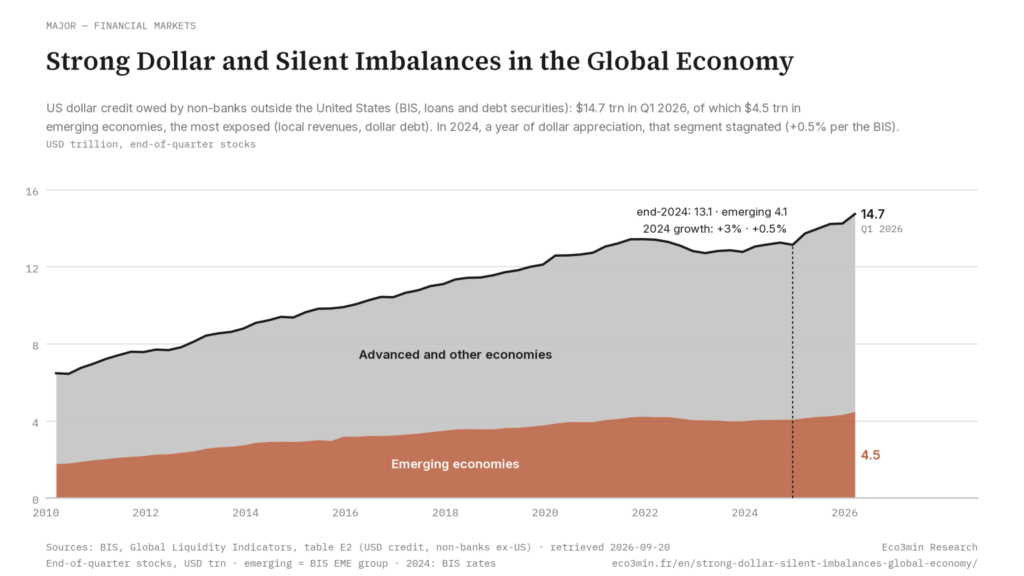
The Dollar as Pivot of International Financial Flows
In the global economy, the dollar is not limited to a transaction currency role. It constitutes a dominant unit of account — a systemic role examined in depth in our sub-pillar on the role of the dollar in the international monetary system for financing, debt and cash management. This centrality explains why its variations have asymmetric effects, well beyond currency markets alone.
When the dollar strengthens, the main impact is not immediately in asset prices, but in balance sheets. Dollar-denominated liabilities become heavier to service for some agents, while others benefit from a relative strengthening of their financial position. These adjustments translate into flow arbitrage, modifications of financing structures and stricter selection of capital uses.
What that debt weighs, as of 20 September 2026. According to the BIS global liquidity indicators (table E2), US dollar credit owed by non-bank borrowers outside the United States stood at $13.1 trillion at end-2024, of which $4.1 trillion in emerging economies, and $14.7 trillion in the first quarter of 2026, of which $4.5 trillion in emerging economies. In 2024, a year of dollar appreciation, the BIS records growth of 3% for the total and only 0.5% for the emerging segment, exchange-rate adjusted: a strong dollar does not shrink the stock, it freezes its most exposed part.
From this perspective, the strong dollar acts as a sorting mechanism. It redistributes financial constraints without concentrating them instantaneously, which explains the frequent absence of brutal rupture despite mounting tension.
External Imbalances: A Progressive Weakening
On the external balance front, a strong dollar modifies the dynamics of international trade and financing. Misalignments do not take the form of immediate shocks, but of accumulating frictions: compressed margins, more demanding financing conditions, gradual volume and price adjustments.
This pressure is exerted unevenly. Economic and financial structures most dependent on external financing in foreign currencies are exposed more quickly, while others absorb the constraint through internal adjustment mechanisms. The result is growing heterogeneity of trajectories, without a clear aggregate signal.
This diffuse character explains why global macroeconomic indicators can remain relatively stable, even as underlying vulnerabilities strengthen.
Foreign-Currency Debt and Balance Sheet Constraints
Dollar-denominated debt constitutes one of the main transmission channels of a strong dollar. When the currency appreciates, the real burden of this debt rises for borrowers whose revenues are mostly denominated in other currencies. For more detail: The ounce of gold converted into the main reserve currencies.
This phenomenon does not necessarily lead to a wave of defaults. It first manifests as heightened discipline: investment reduction, prioritization of deleveraging, defensive arbitrage in balance sheet management. These behaviors help slow economic dynamics without triggering an open crisis.
The constraint is therefore real, but extends through time. The strong dollar acts as a revealer of latent fragilities rather than as a direct trigger.
Common Errors in Strong-Dollar Analysis
A common error is to seek a single critical threshold beyond which the situation would become untenable. This approach assumes a homogeneity of financial structures that does not exist. The effects of a strong dollar vary by balance sheet, debt maturity and adjustment capacity.
Another frequent bias is focusing analysis on visible markets. This incomplete reading is broadened in our framework for analyzing market regimes. As long as assets remain liquid and spreads do not widen abruptly, tension is often minimized. Yet the bulk of adjustment occurs upstream, in financing and allocation decisions that escape traditional indicators.
This difficulty detecting early signals parallels the dynamic described in the analysis of a central bank losing control of its currency without an open crisis, where apparent stability masks growing imbalances even before a manifest crisis emerges.
The Dollar as Revealer of Asymmetric Vulnerabilities
Rather than viewing the strong dollar as a single cause, it is more relevant to analyze it as a revealer. Its persistence highlights asymmetric vulnerabilities: dependence on external financing, rigidity of cost structures, balance sheet sensitivity to exchange rate variations. This observation aligns with the analysis in our sub-pillar on FX and monetary regimes. Related research: the logic behind euro-dollar moves.
This structural reading helps explain why imbalances can accumulate without immediately leading to a systemic crisis. The system absorbs the constraint by adjusting behaviors, at the cost of prolonged and often invisible tension.
It is precisely this diffuse-constraint logic that the detailed analysis of a durably strong dollar’s effects on financial markets extends, developed in this deeper analysis dedicated to the structural impacts of a strong dollar.
Conclusion
A strong dollar is not necessarily the prelude to a global financial crisis. It functions above all as an adjustment mechanism that redistributes constraints across balance sheets, flows and external balances. The mapping of winners and losers under dollar strength reconstructs this sequence from the figures.
The absence of visible rupture does not signify the absence of imbalances. It reflects a regime where tension expresses itself progressively, asymmetrically and often silently. One of the best-documented silent channels remains imported inflation via exchange rates.
In the global economy, the most durable imbalances are rarely those that erupt, but those that settle in silently.
Last updated — 20 September 2026
Disclaimer – Financial and Legal Information: The analyses, commentary, and content published on eco3min.fr are provided for informational and educational purposes only. They do not constitute investment advice or a solicitation to buy or sell financial instruments. Past performance is not indicative of future results. All investment decisions involve risk and are the sole responsibility of the reader. Data, charts and calculated series are provided as is and may contain errors or lag behind their source: check any figure against the primary source cited before relying on it. Content describing laws, regulations or contracts reflects the law as of its publication date and does not constitute legal or tax advice; applying it to a specific situation requires a qualified legal or tax professional.
Read next
Full pillar →Weak or Strong Euro: Imported Inflation and Competitiveness
The euro's level acts on the area's economy through two opposing channels: it changes the price of imports,…
How to Read EUR/USD: What Moves a Currency Pair
EUR/USD is the price of one euro expressed in dollars: when it reads 1.14, one euro trades for…
Euro Below Parity in 2022: What Parity Means
In September 2022, the euro fell below parity with the dollar, to around 0.95, a low not seen…