T10Y3M Meaning: Understanding the 10y / 3m Treasury Spread
The T10Y3M is the daily difference between the 10-year Treasury yield and the 3-month Treasury bill, published by FRED since 1962 and used as the principal input to the NY Fed probit recession-probability model.

The T10Y3M is the daily difference between the constant-maturity yield on the 10-year Treasury and the 3-month Treasury bill yield — a curve variable published by FRED continuously since January 1962 and used by the Federal Reserve Bank of New York as the principal input to its probit recession-probability model.
TL;DR
The T10Y3M reduces the entire Treasury curve to a single number, the 10-year yield minus the 3-month, which the NY Fed treats as the principal input to its probit recession model.
- Reads as basis points: +0.75 means a 75bp gap, -1.50 a 150bp inversion; crossing zero is the watched boundary, but the duration and depth in negative territory carry the predictive signal, not the crossing itself.
- Eight sustained inversions since 1968 produced troughs from -29bp in 1998 (the false positive) to -460bp in 1980, with a historical median near -100bp.
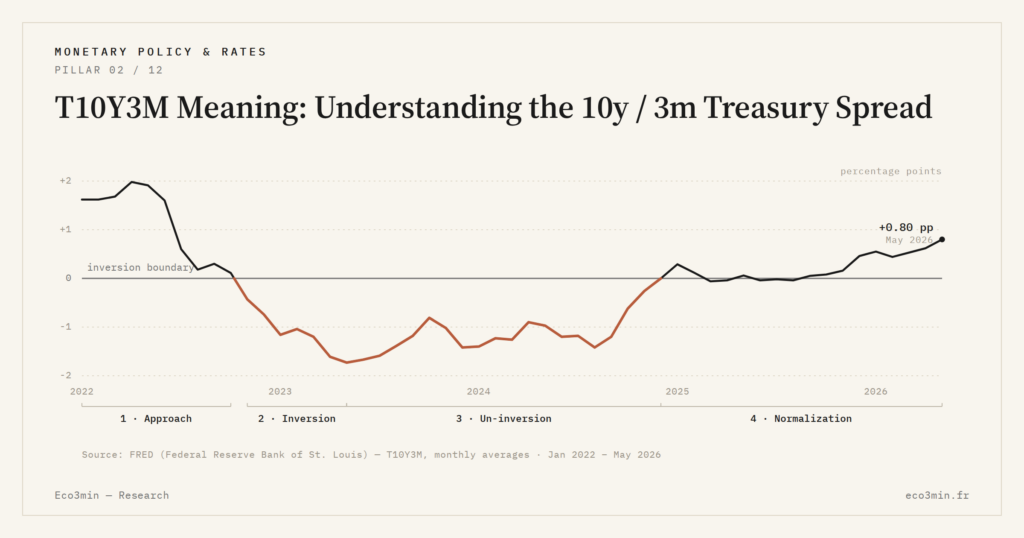
- The 2024-2026 episode sits in the post-inversion normalization phase, with T10Y3M around 70 to 90 basis points as of May 2026.
Understanding what the T10Y3M means requires three elementary questions: what does each leg measure, how is the spread read day-to-day, and how does it differ from the cousin spreads circulating in financial press.
What each leg measures
The T10Y3M is a yield differential between two U.S. Treasury instruments of sharply contrasted maturities. The long leg is the 10-year Treasury constant-maturity yield, series DGS10 at the Federal Reserve Bank of St. Louis. The short leg is the 3-month Treasury bill secondary-market yield, series DTB3 under the historical FRED convention, or DGS3MO under the constant-maturity convention used by the NY Fed. The difference DGS10 minus DTB3 (or DGS10 minus DGS3MO depending on source) is published directly under the T10Y3M ticker.
The 10-year yield is not the coupon of a specific bond but a daily interpolation computed by the U.S. Treasury Department from active securities on the secondary market. This constant-maturity construction provides a continuous time series across all business dates, independent of issuance cycles. The 3-month yield follows the same principle, drawn from 13-week T-bills currently trading in the secondary market.
The gap between the two captures the average slope of the yield curve over the 3-month to 10-year interval. When the spread is positive (the 10-year yields more than the 3-month), the curve is said to be “positively sloped” or “normal.” When it is negative (the 3-month yields more than the 10-year), the curve is “inverted” over that interval. The absolute value of the spread reflects slope magnitude.
Reading the current value day-to-day
The T10Y3M is published daily at U.S. market close, generally with a two- to three-hour delay after 4:00 p.m. New York time. It is expressed as a percentage to two decimals, which in practice reads as basis points: a T10Y3M of +0.75 corresponds to a 75-basis-point gap between the 10-year and the 3-month in favor of the 10-year. A T10Y3M of -1.50 corresponds to a 150-basis-point inversion.
Across the 1962-2026 history, the average T10Y3M value is positive, around +150 basis points outside monetary tightening episodes. The documented extreme values are a trough of -460 basis points in March 1980 under Volcker, and a peak above +380 basis points in the early 1990s during the post-recession recovery. The eight sustained inversion episodes since 1968 — whose full sequence the NY Fed T10Y3M recession signal documents — produced troughs ranging from -29 basis points in 1998 (the false positive) to -460 basis points in 1980.
Crossing the zero boundary is the operational threshold tracked by the financial community as an inversion indicator. The crossing into negative territory is instantly publicized, but it is the duration and depth of the negative-territory sequence that carry the predictive information — not the crossing event itself. A short, shallow inversion, like the one in 1998, may be a market event without macroeconomic weight.
The DTB3 and DGS3MO conventions — why two series for the “3-month”
A technical nuance deserves noting for anyone downloading the raw series from FRED. Two series measure the “3-month Treasury yield,” with slightly different calculation conventions.
The DTB3 series (“3-Month Treasury Bill: Secondary Market Rate”) is the secondary-market yield of a residual 13-week T-bill, computed from the current purchase price and the cash flow at maturity. This is the historical convention used by the Treasury Department since 1954, and it underlies the FRED T10Y3M publication.
The DGS3MO series (“3-Month Treasury Constant Maturity Rate”) is the constant-maturity yield, interpolated to exactly three months from active issuance-curve points. This is the parallel convention used by the Treasury since 1981 for international comparisons and for term-structure analyses.
The gap between the two series typically oscillates between five and ten basis points — DGS3MO being marginally more volatile because it embeds interpolation from neighboring maturities (one month, six months). The Federal Reserve Bank of New York uses DGS10 minus DGS3MO in its probit model published on its Recession Probability page; FRED publishes T10Y3M from DGS10 minus DTB3. This convention divergence does not alter signal reading on macroeconomically relevant horizons (monthly, quarterly), but it explains small numerical differences between distinct academic publications.
For day-to-day macro observation, the FRED T10Y3M series suffices. For exact replication of the NY Fed probit model, one needs to reconstruct DGS10 minus DGS3MO from the two separate series — a direct operation on FRED.
T10Y3M, T10Y2Y, and other curve spreads — elementary distinctions
The T10Y3M coexists with half a dozen candidate curve spreads measuring different slopes or different combinations. Four deserve distinction to avoid conflating them in daily reading.
The T10Y2Y spread measures slope on the 2-year to 10-year interval (DGS10 minus DGS2). It is more frequently cited in general financial press because it inverts earlier than T10Y3M and is tracked tactically by the bond market. The T10Y3M vs T10Y2Y comparison details the eight historical inversions and explains why T10Y2Y’s earliness comes with lower predictive robustness.
The Fed Funds / 10-year spread measures the gap between the policy rate administered by the Federal Open Market Committee and the 10-year yield. Its reading is close to T10Y3M in magnitude (the Fed Funds rate and the 3-month being strongly correlated), but it is administered rather than market-derived, which introduces discontinuities at FOMC decisions. It is rarely used in academic research for this reason. Related reading: Comparing 2-year and 10-year across regimes.
Full-slope indicators (slope indicators) aggregate information from several curve points by principal-component decomposition. They are used in affine term-structure models such as Adrian-Crump-Moench, but they do not serve in daily macro reading — their interpretation requires technical understanding of the underlying models.
The near-term forward spread, proposed by Engstrom and Sharpe at the Federal Reserve Board in 2018, measures the gap between the eighteen-month forward implied yield and the current 3-month yield. It has predictive power comparable to T10Y3M over the 1973-2017 window, and it has been published by the NY Fed since 2020 as a complementary indicator. But T10Y3M retains its place as the main variable in the monthly recession-probability publication.
Why a single spread rather than the entire curve
A legitimate question arises: why reduce the information from the entire curve to a single spread, when the curve contains roughly twenty maturity points (one month, three months, six months, one year, two years, five years, ten years, thirty years, etc.)? Three arguments justify the parsimony of the T10Y3M choice.
First, statistical parsimony. Across a sample of eight documented recessions since 1968, a multivariate model with ten explanatory variables produces predictable overfitting — estimated coefficients capture sample noise rather than reproducible regularity. Estrella and Mishkin’s out-of-sample tests (1996, NBER WP 5379) showed precisely that models richer than T10Y3M lose performance on out-of-sample validation windows.
Second, interpretability. A single variable communicates easily, verifies easily, and debates easily. A linear combination of ten curve points requires communicating the weights, their temporal stability, and their theoretical justification. T10Y3M’s readability is a secondary but structuring argument for its institutional adoption.
Third, theoretical anchoring. The transmission channel documented in the literature — compression of bank net interest margins, contraction of credit supply, slowdown of activity — runs through the slope on the short-long interval, not through curvature or internal convexity. Reducing the curve to a binary spread isolates the macroeconomically relevant information, ignoring tactical information (short-term positioning, auction events, duration flows) that does not carry recession signal.
This parsimony explains why the NY Fed probit model remains univariate after three decades of methodological evolution. Attempts to enrich it by adding real indicators (industrial production, employment, leading indicators) have not significantly improved out-of-sample predictive power. T10Y3M has remained the canonical barometer precisely because it is sufficient — adding information does not advance marginal accuracy. The technical detail of this use is covered in the probit formalization of the T10Y3M signal, and the raw historical series is available in the T10Y3M dataset.
The typical inversion cycle in four phases
Across the eight inversions documented since 1968, a recurring temporal pattern emerges that helps situate the current T10Y3M value within a broader cycle, and that fits within the standard reading grid of central-bank policy and rate-cycle transmission on yield-curve evolution. This pattern breaks into four identifiable phases, whose combined reading with the instantaneous spread value enriches interpretation.
Phase 1, approaching the boundary. The T10Y3M, starting from a positive expansion-cycle value (typically 100 to 250 basis points), gradually declines over six to eighteen months under a Fed tightening cycle. The short leg rises with the Fed Funds rate; the long leg slowly embeds the expectation of return toward the long-run equilibrium rate. During this phase, the spread remains positive but compresses, an early warning that the bond market tracks attentively.
Phase 2, inversion and deepening. The T10Y3M crosses zero, generally within six to twelve months of the last Fed hike of the cycle. It continues to dig into negative territory for three to eighteen months, reaching a trough whose depth varies by cycle (from -29 basis points in 1998 to -460 basis points in 1980, historical median around -100 basis points). During this phase, the NY Fed probit model rises progressively, typically exceeding 30 percent then 50 percent of conditional 12-month probability.
Phase 3, un-inversion from below. The Fed begins cutting the Fed Funds rate, which drives the short leg of T10Y3M down faster than the long leg. The spread mechanically rises, crosses zero, then turns positive. This un-inversion from below — short-rate collapse faster than long-rate decline — is historically the profile observed ahead of the 2001, 2008, and 2020 recessions, and was reproduced in the 2024 un-inversion. It differs from an un-inversion from above (long-rate rise faster than short-rate decline), rarer in modern cycles but theoretically possible in a persistent inflationary shock. Further reading: T10Y3M: The August-to-December 2024 Un-Inversion, End of Record Inversion.
Phase 4, post-cycle normalization. After un-inversion, the T10Y3M continues climbing toward a positive expansion-cycle value, typically between 100 and 250 basis points, as the Fed reaches its new policy-rate plateau. This phase can last from one to five years depending on the depth of the subsequent recession and the speed of the Fed easing cycle. In the ongoing 2024-2026 episode, phase 4 is currently unfolding with a T10Y3M around 70 to 90 basis points as of May 2026.
This four-phase segmentation is not a mechanical projection: the duration of each phase varies by cycle, and some episodes (1998 notably) depart from the standard pattern. But it provides a reading grid that contextualizes the instantaneous spread value within the broader curve movement.
- T10Y3M = 10-year Treasury constant-maturity yield (DGS10) minus 3-month Treasury bill yield (DTB3 or DGS3MO depending on convention).
- Daily FRED publication since 1962, in percentage points to two decimals equivalent to basis points.
- The inversion (negative T10Y3M) is the operational boundary tracked as indicator, but duration and depth carry the predictive information.
- T10Y3M is preferred over T10Y2Y, the Fed Funds / 10-year spread, and full-slope indices for its out-of-sample robustness (Estrella-Mishkin 1996) and institutional readability.
Last updated — 12 July 2026
Disclaimer – Financial Information: The analyses, commentary, and content published on eco3min.fr are provided for informational and educational purposes only. They do not constitute investment advice or a solicitation to buy or sell financial instruments. Past performance is not indicative of future results. All investment decisions involve risk and are the sole responsibility of the reader.
Read next
Full pillar →Real Rates: The True Cost of Capital Is Repricing
Why real rates are reasserting themselves as markets' anchor and how to recalibrate investment and financing decisions facing…
Real Interest Rates: The Quiet Signal Reshaping Markets
Real interest rates: why their persistence in positive territory in 2026 is reshaping the rules for bonds, equities,…
OAT-Bund Spread: A Quiet Gauge of French Sovereign Risk
OAT-Bund spread: how this yield gap has become a key signal on French sovereign risk, fiscal policy and…