T10Y3M vs T10Y2Y: Which Yield Curve Inversion Signal to Choose
T10Y3M and T10Y2Y are two complementary curve spreads. The former dominates in predictive robustness across eight inversions since 1968, the latter inverts earlier and captures the expectations gap among shorter maturities.

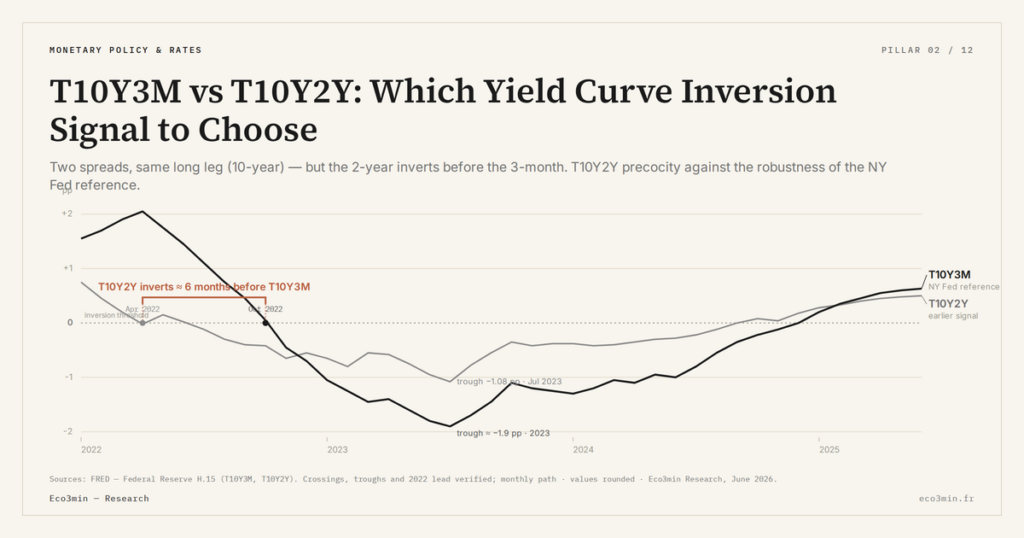
T10Y3M and T10Y2Y are two complementary curve spreads: the former dominates in predictive robustness across eight inversions documented since 1968 and remains the NY Fed’s canonical variable, while the latter inverts earlier and captures more of the expectations gap among shorter maturities.
TL;DR
The Fed lifted its target range by 275 basis points between April and October 2022; the 2-year priced the hikes ahead, inverting T10Y2Y 203 trading days before T10Y3M.
- The 2-year ran from 2.32% in early April 2022 to 4.28% by late October, outpacing the 10-year's rise from 2.65% to 4.05%, while the 3-month merely tracked policy from 0.55% to 4.05%.
- Across 1968-2024, T10Y3M logged zero major false positive (1998 aside) versus three to four ambiguous T10Y2Y signals, including 2005-2006 and the brief 2019 crossing.
- Estrella-Mishkin (1996, NBER WP 5379) found T10Y3M dominant on likelihood ratio, pseudo-R² and out-of-sample stability over 1959-1995; Bauer-Mertens (FRBSF 2018-07, 2023-14) reconfirmed it through 2023.
- The bank-funding channel anchors the choice: a 3-month deposit is the norm and a 2-year term deposit rare, so the 3-month better captures the net-interest-margin compression that transmits inversion to recession.
Choosing between the two requires understanding what each specifically measures and why the academic community prefers one when the financial press more frequently cites the other.
What each spread measures and why they diverge
T10Y3M and T10Y2Y share the same long leg — the 10-year Treasury yield (series DGS10) — but differ in their short leg. T10Y3M uses the 3-month Treasury bill yield (DTB3 or DGS3MO depending on convention), which is a direct proxy for the Fed Funds effective rate with a typical gap of five to fifteen basis points. T10Y2Y uses the 2-year Treasury yield (DGS2), which already embeds partial expectations about the future path of monetary policy — particularly anticipations of Fed hikes or cuts over the next twenty-four months. The detail of the underlying FRED series and their calculation conventions is laid out in the technical meaning of T10Y3M.
This short-leg difference produces a different reading of the curve signal. T10Y3M compares current monetary policy (embodied in the 3-month) with very long-run expectations (10-year). T10Y2Y compares two sets of expectations at different horizons (2-year vs 10-year). In practice, T10Y2Y inverts earlier because the 2-year yield rises faster than the 3-month during anticipated-tightening phases — the bond market “prices in” coming Fed hikes before they materialize in the effective Fed Funds rate. Further on this: the mechanics of yield curve control.
The 2022-2024 episode documents this precocity precisely. T10Y2Y inverted on April 5, 2022, when T10Y3M was still positive at over 180 basis points. T10Y3M did not cross the negative boundary until October 25, 2022, 203 trading days later. The same asymmetry holds on un-inversion: T10Y2Y turned positive again in September 2024, T10Y3M in December 2024 — a three-month gap as well. This sequence is documented month by month in the 2022-2024 T10Y3M inversion, which restores the precise values of both spreads over the same window.
The mechanical decomposition of this 203-day lag illuminates the structural difference between the two spreads. Between April and October 2022, the Fed raised the Fed Funds target range from 0.25-0.50 percent to 3.00-3.25 percent (a cumulative 275 basis points), but markets were already pricing additional hikes through 2023. The 2-year yield, embedding this anticipation, rose from 2.32 percent in early April to 4.28 percent in late October — outpacing the 10-year rise from 2.65 percent to 4.05 percent over the same window. The 3-month yield, meanwhile, only tracked the Fed Funds rate effectively, climbing from 0.55 percent to 4.05 percent. The T10Y2Y therefore mechanically inverted first because the 2-year was running ahead of policy reality, while the T10Y3M waited for the policy rate itself to catch up.
T10Y2Y precocity vs T10Y3M robustness — analyzing the eight inversions
Across the eight inversions documented since 1968, both T10Y2Y and T10Y3M inverted, but with variable temporal offsets. The cumulative table shows that T10Y2Y precedes T10Y3M by one to six months depending on the episode, with a median near three months. This precocity makes T10Y2Y a faster market-clock indicator. Related analysis: T10Y3M 1998: The LTCM False Signal, Unique Exception Since 1968.
But precocity is not robustness. T10Y2Y produced several short or shallow inversions that were not followed by recession — notably in 2005-2006 when T10Y2Y oscillated around zero for several months without sustained dipping, and in 2019 when it briefly crossed zero before re-steepening. During these episodes, T10Y3M remained positive or only briefly entered negative territory. This empirical difference translates statistically: across the 1968-2024 window, T10Y3M produced zero major false positive (1998 aside), while T10Y2Y produced three to four ambiguous signals depending on the threshold retained.
The comparative analysis by Estrella and Mishkin (1996, NBER WP 5379) — which laid the methodological groundwork for the NY Fed choice — tested T10Y3M against T10Y2Y and several other candidate spreads over the 1959-1995 sample. Their empirical conclusion: T10Y3M dominates on nearly every metric (likelihood ratio, pseudo-R², out-of-sample stability), with a margin sufficient to justify the NY Fed selection as principal variable of the probit model published since 2006. This dominance was reconfirmed by Bauer and Mertens (Federal Reserve Bank of San Francisco Economic Letter 2018-07 then 2023-14) over the expanded 1959-2023 sample.
Why the NY Fed retains T10Y3M despite T10Y2Y’s precocity
Three academic arguments justify the institutional preference for T10Y3M, despite the tactical convenience of T10Y2Y. These arguments explain why the NY Fed T10Y3M signal remains the empirical reference rather than an alternative substitute.
First argument, alignment with the transmission channel. The causal mechanism documented in the literature operates through bank net interest margins. U.S. commercial banks fund themselves at very short maturities (demand deposits, overnight repo, three-month certificates of deposit) and lend at long maturities. Their effective funding cost is better captured by the 3-month than by the 2-year — a 2-year term deposit is rare, while a 3-month deposit is the norm. T10Y3M thus more faithfully translates the bank-margin compression that is the transmission channel from inversion to recession.
Second argument, market purity. The 3-month yield is closely correlated with the Fed Funds effective rate (typical gap of five to fifteen basis points, without anticipation effect). The 2-year yield, by contrast, embeds expectations that may diverge from the actual Fed path. This divergence introduces noise for current-tightening reading: an inverted T10Y2Y may signal either current tightening or an expectations reversal on the future path — two distinct macroeconomic readings.
Third argument, out-of-sample robustness. The empirical tests by Estrella and Mishkin (1996) precisely measured the stability of calibration coefficients between estimation and test periods. T10Y3M produced the highest stability among all candidate spreads, which is the operationally most important statistical criterion for out-of-sample robustness. T10Y2Y produced less stable coefficients, an indicator of greater overfitting in the calibration.
These three arguments stack and converge toward T10Y3M as the principal variable. The academic debate is not closed — Engstrom and Sharpe (Federal Reserve Board 2018) reignited the discussion with the near-term forward spread as a possible alternative — but no challenger has displaced T10Y3M in the official NY Fed publication for three decades.
Why T10Y2Y remains used in financial press
If the NY Fed and academic literature converge on T10Y3M, why does general financial press more frequently cite T10Y2Y? Three non-academic factors explain the media preference.
First, tactical readability. T10Y2Y is the indicator tracked by bond traders as a barometer of short-term Fed expectations. Its daily movement is more volatile than T10Y3M’s, which produces more market events — short inversions, local divergences — that fuel daily market-coverage articles. T10Y3M, more stable and more aligned with Fed Funds, produces less material for daily market columns. On the same theme: the Eco3min framework for short versus long maturities.
Second, operational precocity. For a financial journalist who wants to flag curve inversion to readers, T10Y2Y is the first to cross the negative boundary — typically three months before T10Y3M. The “first inversion” character of T10Y2Y produces a more immediate media signal, even when the NY Fed probit signal has not yet activated.
Third, historical inheritance. The 2-year / 10-year spread has been cited in financial press since the 1980s, predating the academic formalization of T10Y3M by Estrella and Mishkin in 1996. This earlier media anchoring has persisted through editorial inertia, even after the NY Fed installed T10Y3M as canonical variable of its probit model.
Combined reading — when to use which
Rather than mechanically opposing the two spreads, the rigorous reading uses them as complementary tools covering different clocks. Three configurations deserve distinction for daily reading.
Configuration 1, anticipated signal. When T10Y2Y inverts before T10Y3M, the bond market signals an anticipation of monetary turning point before the Fed has completed its tightening cycle. This configuration was observed in April-October 2022 (T10Y2Y inverted, T10Y3M positive) and signals a high conditional probability of subsequent T10Y3M inversion — without yet constituting a recession signal in the sense of the NY Fed probit model. The appropriate reading: heightened surveillance, but no yet activation of the reference signal.
Configuration 2, confirmed double inversion. When both spreads are simultaneously in negative territory, the recession signal is confirmed on both variables — the situation observed over most of October 2022 to September 2024. This configuration is the clearest for macro reading: convergence of both indicators on a coherent signal, alignment with NY Fed probit model calibration generally exceeding 30 percent then 50 percent of conditional probability.
Configuration 3, divergence at un-inversion. When T10Y2Y turns positive before T10Y3M (as in September-December 2024), the market anticipates coming Fed cuts while effective bank funding cost remains high. This configuration is read by economists as transitory — resolved in the following three to six months by T10Y3M un-inversion as the Fed actually cuts rates. This is precisely the profile observed in the 2024 episode. In the same vein: T10Y3M: The August-to-December 2024 Un-Inversion, End of Record Inversion.
This three-configuration typology enriches the binary “inversion vs no inversion” reading by proposing a three-dimensional grid: anticipated signal (T10Y2Y alone), confirmed signal (both), exit signal (T10Y2Y un-inverted before T10Y3M). It allows using T10Y2Y precocity as preliminary alert while retaining T10Y3M robustness as the reference variable for conditional recession probability. For reading the broader cycle of central-bank policy and rate-cycle transmission, the two spreads read together rather than in competition.
- T10Y2Y and T10Y3M share the long leg (10-year) but differ in the short leg: 3-month is a direct proxy of Fed Funds effective rate, 2-year already embeds expectations.
- T10Y2Y inverts on average three months before T10Y3M but produces more ambiguous signals and marginal false positives.
- The NY Fed retains T10Y3M as canonical variable of the probit model for three reasons: alignment with the bank transmission channel, market purity vs expectations, out-of-sample stability (Estrella-Mishkin 1996).
- Recommended combined reading: T10Y2Y as preliminary alert, T10Y3M as reference signal, divergences at un-inversion as typical transition.
Last updated — 12 July 2026
Disclaimer – Financial Information: The analyses, commentary, and content published on eco3min.fr are provided for informational and educational purposes only. They do not constitute investment advice or a solicitation to buy or sell financial instruments. Past performance is not indicative of future results. All investment decisions involve risk and are the sole responsibility of the reader.
Read next
Full pillar →Real Rates: The True Cost of Capital Is Repricing
Why real rates are reasserting themselves as markets' anchor and how to recalibrate investment and financing decisions facing…
Real Interest Rates: The Quiet Signal Reshaping Markets
Real interest rates: why their persistence in positive territory in 2026 is reshaping the rules for bonds, equities,…
OAT-Bund Spread: A Quiet Gauge of French Sovereign Risk
OAT-Bund spread: how this yield gap has become a key signal on French sovereign risk, fiscal policy and…