Annuitize or Take the Lump Sum: How US Retirement Withdrawals Are Taxed

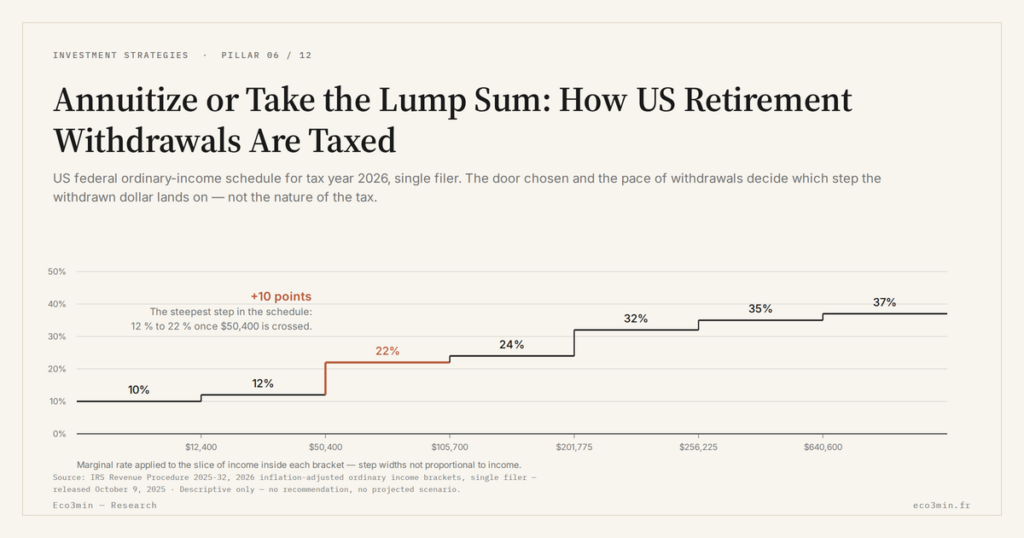
Choosing how to withdraw from a 401(k) or IRA looks like paperwork. It sets the tax bill at the deadline instead: a lump sum, an annuity and required distributions do not trigger the same rules or the same hit to the retiree’s bracket.
At withdrawal, the bet the deduction opened is settled. The door chosen changes not just the form of the income but the tax that applies to it and the year it lands.
Each exit from a traditional account has its own tax: a lump sum is ordinary income in full, RMDs force a schedule, annuities spread it out.
- A lump sum from a pre-tax balance is taxed as ordinary income in full, which can push that year into a higher bracket.
- Required minimum distributions begin at age 73, rising to 75 in 2033 under SECURE 2.0, forcing taxable withdrawals on a set schedule.
- Annuitizing converts the balance into lifetime income; where after-tax basis exists, an exclusion ratio splits the tax-free return of principal from the taxable earnings.
When a saver taps a traditional account, the form to fill in looks like a formality: take a lump sum, buy an annuity, or draw the balance down over time. That quiet choice carries large deferred effects, because each door triggers its own tax mechanics that surface only at the deadline. The most underestimated risk lies in that invisibility: a large lump sum can push the year into a higher bracket, turning a choice perceived as neutral into an added cost. This article maps each exit and its tax, without crowning a winner, since the answer depends on the retiree’s bracket, income needs and horizon. It sits within the two-sided retirement bet whose exit side it describes.
Three doors out, one deadline that will not wait
A pre-tax account offers three broad ways out, and one of them is not optional. A lump sum returns the balance in one or a few payments. An annuity converts the balance into income paid for life. A systematic drawdown withdraws the balance in installments over years. These are not mutually exclusive: a retiree can annuitize part and draw the rest. But required minimum distributions overlay all of them from age 73, rising to 75 in 2033 under SECURE 2.0, forcing a minimum taxable withdrawal each year whether the income is needed or not. The deadline, in other words, eventually chooses for the saver who does not choose. Related analysis: the trade-offs at the $10,000 level.
The choice is not only about tax: it also engages the management of retirement income, the trade-off between the security of a lifetime annuity and the flexibility of a self-directed drawdown. That management trade-off, distinct from the tax mechanics, is handled separately: annuity versus self-managed income sets out its terms, and the pace of sustainable withdrawals turns on withdrawal rates and starting valuations. The present article stays on the tax of the doors, which already separates the three routes clearly enough.
The required minimum distribution deserves a word, because it is the one door no one opens by choice. Each year from the trigger age, the retiree must withdraw a fraction of the prior year-end balance, set by a life-expectancy factor, and pay ordinary income tax on it. The fraction rises with age as the remaining horizon shortens. A retiree who does not need the income still owes the tax, which is why RMDs can push taxable income up in later years and interact with everything else on the return. Roth accounts escape lifetime RMDs, one reason the pre-tax-versus-Roth decision reaches all the way to the exit. What happens to an asset at the other end, on transfer rather than on withdrawal, follows a different rule, the one examined in the step-up basis and the gift-versus-hold trade-off.
The lump sum: ordinary income in full, and the bracket spike
A lump-sum distribution from a fully pre-tax account is the simplest door and the bluntest. The entire amount is taxed as ordinary income in the year it is taken, because neither the contributions nor the earnings were ever taxed before. On a large balance, that single event can lift the household through several brackets in one year, since the schedule is progressive and the progressive schedule at exit does not treat the marginal dollar the same at every level. The convenience of taking everything at once is therefore paid for with a concentrated tax bill that a spread-out withdrawal would have avoided.
This is where a persistent misconception surfaces. Some savers believe a traditional balance is taxed twice, once as income and once on its growth. It is not. On a fully pre-tax account, the contributions were never taxed on the way in, and the earnings were never taxed while compounding; both are taxed once, as ordinary income, at withdrawal. What feels like a double burden is simply the deferred settlement of taxes that were postponed, not duplicated.
Believing a traditional 401(k) or IRA balance is taxed twice, as income and again on its growth. It is not: on a pre-tax account, contributions and earnings were both untaxed until withdrawal, so they are taxed once, as ordinary income, not twice. On the same theme: reading the options inside a 401(k).
Annuitizing: lifetime income and the exclusion ratio
Annuitizing turns the balance into a stream of payments for life, and its taxation depends on whether the account holds any after-tax basis. For a fully pre-tax balance, each annuity payment is ordinary income in full, because nothing in it was ever taxed. Where after-tax basis exists, in a non-qualified annuity or from nondeductible contributions, an exclusion ratio separates the tax-free return of that principal from the taxable earnings, so only part of each payment is taxed. The exclusion ratio is not a loophole; it simply avoids taxing again money that was already taxed once on the way in. For most fully pre-tax retirement balances, though, no such basis exists, so the exclusion ratio does not apply and the whole payment remains ordinary income. In the same vein: our analysis of what retirement requires.
This split matters because it changes the effective tax on the income stream. Two retirees drawing the same annual annuity can face different tax bills depending on how much after-tax basis sits behind the contract. Annuitizing also removes the timing control that a drawdown keeps: the payment schedule is fixed by the contract rather than chosen year by year. That loss of flexibility is the counterpart of the longevity protection an annuity provides, and the trade-off between the two belongs to the management companion rather than to this tax map.
Systematic drawdown: steering the bracket, within the RMD floor
The third route withdraws the balance in installments over several years. Its point is not to change the nature of the tax, which stays ordinary income, but to spread the taxable amount across years. Taking the whole balance at once forces a large sum into a single year’s income, with the risk of crossing into a higher bracket; spreading the same withdrawal keeps each slice in a lower one. A systematic drawdown is therefore a tool for steering the marginal bracket, though its freedom is capped from age 73 by the required minimum distribution, which sets a taxable floor the retiree cannot go below.
This is where the bet opened at contribution closes in practice. The deduction earned at the working-life rate; the exit tax costs at the retiree’s rate, and the pace of withdrawals acts directly on that rate. Careful sequencing can preserve a favorable bracket gap, while a blunt lump sum can erase it. The same exit tax feeds the comparison with competing vehicles, developed in exit tax versus the taxable alternative. It also differs from the doors that open before retirement, when the exit comes before the deadline, whose tax follows other rules. Reading these doors together means placing each decision in the cycle, as the frame for positioning vehicles across the cycle invites.
The bracket that settles the bet is a household figure, not an account one. Withdrawals stack on top of Social Security, pensions and taxable investment income, so a drawdown that looks modest in isolation can lift the household into a higher band once everything is added, and can pull a larger share of Social Security into taxation. This interaction is why the exit is read as a multi-year problem rather than a single event: the goal of spreading withdrawals is to keep the combined income under the thresholds that matter, not merely to reduce the account’s own tax. The detailed arithmetic of those thresholds belongs to a dedicated treatment, but the principle is that the door choice and the pace of withdrawals are exercised against total income, not against the balance alone.
No door is the right one in the abstract. The lump sum offers availability at the price of a possible bracket spike; the annuity secures lifetime income under its own tax; the drawdown steers between the two by smoothing the bracket, within the RMD floor. The tax of each door reads against the retiree’s bracket, income needs and horizon, three personal parameters no general rule can set on their behalf. What this article establishes is not a ranking but a map: knowing which door triggers which mechanics is what lets the choice be made on tax, not on the sales contrast between freedom and security alone.
Last updated — 29 August 2026
Disclaimer – Financial Information: The analyses, commentary, and content published on eco3min.fr are provided for informational and educational purposes only. They do not constitute investment advice or a solicitation to buy or sell financial instruments. Past performance is not indicative of future results. All investment decisions involve risk and are the sole responsibility of the reader.
Read next
Full pillar →Beneficiary Designations, the Step-Up in Basis, and the 10-Year Rule: How US Accounts Transfer at Death
At death, most US financial accounts pass outside the will, straight to a named beneficiary, under tax rules…
The Fee Stack in Variable Annuities: M&E Charges, Riders, and Subaccount Costs
A variable annuity does not carry one fee, but a stack of them. Mortality and expense charges, subaccount…
The Conventional 401(k)-Match-First Funding Order: Where It Comes From, How It Works
The question of what order to fund accounts in usually draws a fixed list, presented as a rule…