
Cash, Savings Accounts and Euro Funds: Real Yield Against Inflation

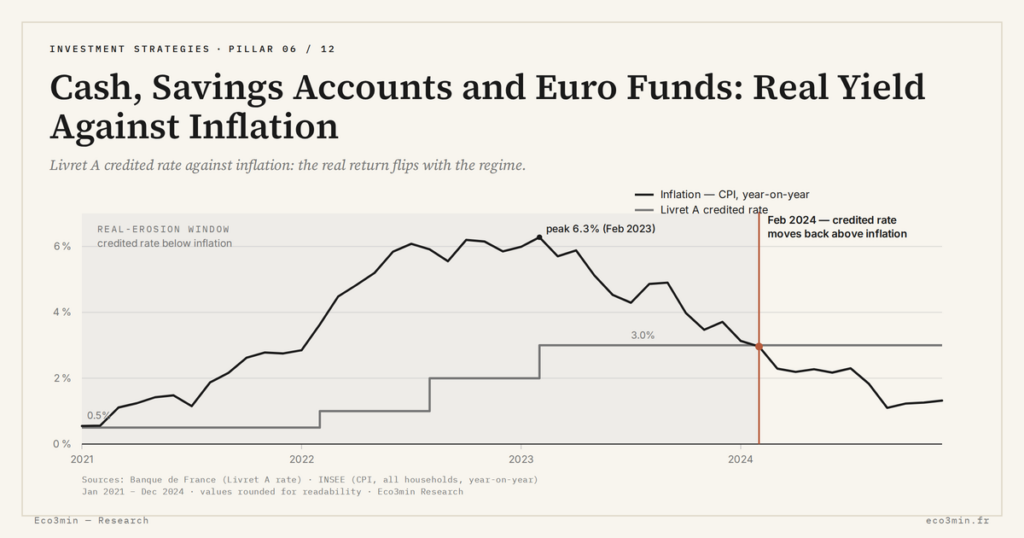
Cash, regulated savings and the euro compartment of life insurance share a guaranteed nominal capital, hence a real protection that depends entirely on the regime: positive when the credited rate exceeds inflation, silently eroded when inflation pulls ahead.
TL;DR
Guaranteed savings protect purchasing power least at the start of an inflation surge, when credited rates still lag, and regain it only once tightening lifts short rates above inflation.
- France’s Livret A stayed below inflation every month from January 2021 to January 2024; in the US, three-month Treasury bill yields sat below CPI inflation until April 2023, before both crossed back above as policy rates rose and inflation receded.
- The real return on a guaranteed vehicle sets the hurdle an active protection has to clear, and that hurdle moves with the regime: high when short rates run above inflation, below zero when real rates turn negative.
This page neither recomputes the real return nor redefines regulated accounts. It reads the nominally-anchored family as the benchmark against which every other protection in the umbrella is judged.
A family defined by its nominal guarantee
Before any “active” protection, there are the savings almost everyone holds: regulated accounts such as the Livret A or LEP, demand deposits, money-market holdings, the euro compartment of life insurance. These vehicles differ in tax treatment, ceilings and liquidity, but share a property that places them in the same family: the capital expressed in nominal terms does not fall. It is this nominal guarantee that defines their behaviour against inflation, and that makes them a case apart in the protection grid. Worth reading alongside: the short-term grid by horizon.
The guarantee covers one precise axis, nominal capital, and leaves the other axis, purchasing power, entirely exposed. The stated balance never declines. What it can buy, by contrast, varies with inflation. The nominally-anchored family therefore protects the first objective perfectly and the second one conditionally. The question “is cash a poor holding?” has an answer only regime by regime, which is what is cash a poor holding in inflation addresses. This page focuses on the reading by regime, not on the verdict.
One prior distinction avoids the most common confusion: these vehicles serve two separate functions, judged by different criteria. The first is a liquidity and precautionary function, immediate availability, certain capital, to which inflation is nearly indifferent: a precautionary reserve is not judged by its real return. The second is the protection of the purchasing power of longer-term savings, for which the real return is the only relevant criterion. Confusing the two leads to blaming a liquidity vehicle for protecting poorly, or expecting immediate availability from a protection vehicle. This page deals only with the second function. The first, specific to regulated accounts, is a separate question. A related read: our frame for protecting savings.
An entirely conditional real return
The real return on a nominally-anchored vehicle comes down to a gap: the credited rate minus inflation. When the former exceeds the latter, purchasing power rises. When inflation pulls ahead, it falls, without any negative line appearing on the statement. It is this invisibility that makes the erosion dangerous: it is not seen, it is noticed after the fact. The detail of the computation, rates net of tax, reference indices, horizons, belongs to computing real returns after inflation. The principle is kept here, not the formula.
The recent record gives a clear illustration. In France, the regulated Livret A rate sat below year-on-year inflation, as measured by INSEE, every month from January 2021 to January 2024, and crossed back above in February 2024. In the US, the three-month Treasury bill yield, which money-market funds pass through, stayed below CPI inflation from January 2021 to April 2023 and moved above it from May 2023, according to Federal Reserve data. Over that window, savings reputed to be “safe” lost purchasing power in real terms. In depth: how US households split cash and money funds. Safety was not the issue: the guaranteed capital did not move. It was real protection that was missing, because it covered the wrong axis at the wrong time. Also relevant: the regulated-cash real-return series since 1960.
This behaviour generalises beyond any single country. In most developed economies, deposit and regulated-savings rates follow policy rates with a lag, so they slip below inflation at the start of an inflationary shock and only cross back above once tightening is under way. The nominally-anchored family is therefore structurally one step behind the regime: it protects purchasing power at the end of a tightening cycle, and erodes it at the start of an inflation surge. The precautionary savings function of regulated accounts, distinct from their protection function, is handled by the savings role of the Livret A.
This lag has an uncomfortable timing. The family disappoints precisely when savers most fear inflation, at the start of a surge, when credited rates have not yet caught up and real returns turn negative. It protects again once the tightening has done its work and short rates have moved above inflation, by which point the alarm has usually faded. The instrument that feels safest in a crisis is therefore at its weakest in real terms early in that crisis, and recovers its real protection only after the worst of the fear has passed. The reflex to pile into guaranteed savings when inflation spikes meets exactly the window in which they protect least. Year by year, what those guaranteed products actually paid is laid out in historical yields on fixed annuities.
Equating “guaranteed capital” with “savings protected from inflation” confuses two distinct axes. The guarantee covers nominal capital, never purchasing power. Reading it correctly means measuring the real return regime by regime: a guaranteed vehicle can be the surest carrier of a real loss when inflation runs durably above the credited rate. Directly related: the deduction value across tax brackets.
The benchmark the umbrella measures against
If the nominally-anchored family is neither good nor bad in itself, it fills a precise function in the umbrella: it is the yardstick. The real return on a guaranteed vehicle sets a kind of hurdle that any “active” protection must clear to justify the risk it adds. In a regime where short rates run well above inflation, that hurdle is high, and the case for taking on the risk of gold, property or long bonds narrows accordingly. In a regime of negative real rates, the hurdle drops below zero, and the comparison turns more favourable to risk assets. aligning investment vehicles with the rate cycle clarifies the structural drivers behind this point.
It is in this sense that the nominally-anchored family is the baseline to beat: not a protection to discard, but the reference point from which the real usefulness of the others is judged. And since that hurdle moves with the regime, it is read with the inflation-regime grid rather than in the abstract. The benchmark moves, and that is precisely what makes it informative.
This benchmark function also explains why the nominally-anchored family is never a complete answer to the protection question. It marks the hurdle to clear, not the means of clearing it. It grows purchasing power in no regime. It preserves it only when the credited rate covers inflation. Savings held entirely in nominally-anchored form therefore pursue the second objective of saving, preservation, without ever aiming at the third, growth, which is a coherent choice but a choice, not the absence of one. Reading by the cycle, which locates where the hurdle sits at a given moment, belongs to investments by the cycle.
A practical consequence follows from this yardstick role: the part the nominally-anchored family plays is not constant over time, it strengthens or fades with the regime. When short rates exceed inflation, it becomes a real protection in its own right again, and the return gap with risk assets narrows. When inflation runs ahead of lagging credited rates, it becomes the benchmark other protections are meant to beat, without beating it itself. The same vehicle thus changes status, from protection to yardstick and back, with the path of real rates, without any of its own characteristics having changed. It is the most direct illustration of the umbrella’s thesis applied to the simplest vehicle. Further detail appears in the after-tax gap between HYSA and money-market funds.
The bridge to euro funds
The euro compartment of life insurance holds a particular position in the family, because it combines the nominal guarantee with an underlying bond exposure. Its return does not track market rates in real time: old bond portfolios, with low coupons, slowly dilute newly acquired higher-yielding securities. The credited rate therefore follows the rise in rates with a lag of several years. For the broader picture: the savings-bond rate formula locked at purchase.
This inertia has two faces depending on the regime. In a low-rate regime, it protected holders, who kept receiving returns inherited from a more generous past. When rates rise fast, it works the other way: the credited return stays behind new market conditions, and the gap with a current-rate investment can become significant. Euro funds are therefore not an enhanced cash, but a vehicle with its own dynamics, whose behaviour by rate regime is treated in detail in euro funds in detail. This page stops at the bridge: locating euro funds within the nominally-anchored family, and routing to the cluster that takes apart the mechanism.
A boundary note is needed here. Within a single life-insurance contract, only the euro compartment belongs to the nominally-anchored family. Unit-linked supports, exposed to equity, bond or property markets, offer no capital guarantee and follow the protection logics of their underlyings, not that of the benchmark studied here. Filing life insurance as a block into one category or another is therefore a classification error: it is the support, euro fund or unit-linked, that sets the protection regime, never the wrapper that holds them. Whether that mix is handed to a dated vehicle or run by the saver is weighed in target-date funds versus a self-directed glide path.
A benchmark, not a haven
The nominally-anchored family is neither the trap some describe nor the haven others see in it. It is the umbrella’s conditional benchmark: what protects nominal capital perfectly, protects purchasing power only when the credited rate covers inflation, and serves as the yardstick for every other protection. Reading it correctly is not a matter of leaving it or staying in it, it is a matter of measuring its real return regime by regime, exactly as one measures any other vehicle’s. It is the one cell of the grid where nominal protection is total and real protection entirely suspended on the regime. Companion analysis: our reading of the main asset classes.
Last updated — 7 October 2026
Disclaimer – Financial and Legal Information: The analyses, commentary, and content published on eco3min.fr are provided for informational and educational purposes only. They do not constitute investment advice or a solicitation to buy or sell financial instruments. Past performance is not indicative of future results. All investment decisions involve risk and are the sole responsibility of the reader. Data, charts and calculated series are provided as is and may contain errors or lag behind their source: check any figure against the primary source cited before relying on it. Content describing laws, regulations or contracts reflects the law as of its publication date and does not constitute legal or tax advice; applying it to a specific situation requires a qualified legal or tax professional.
Regulated and tax values: the rates, indices, caps and brackets with legal effect cited on this page are set by official decision, change over time and apply according to individual circumstances. Only the official publication in force on the relevant date is authoritative (for example the Journal officiel, INSEE, Banque de France, the IRS or the Social Security Administration). To revise a rent, sign or challenge a contract, or file a return, check the value at the source or with a professional.
Read next
Full pillar →Guaranteed funds vs unit-linked: behaviour across the rate regime
A guaranteed fund's served yield is a smoothed, lagged signal; a unit-linked value is the market's present state…
Target-Date Funds vs Self-Directed Portfolios: The Mechanics of a Delegated Glide Path
A target-date fund is sold as a simple, set-and-forget win. It is first something narrower: a delegated glide…
What Guaranteed Savings Products Have Paid: Fixed Annuity and Stable Value Yields Through the Rate Cycle
US guaranteed savings products credit a rate that trails the bond market rather than tracking it. Through the…