Uranium Supply Concentration and Political Risk, from Kazakhstan to Niger

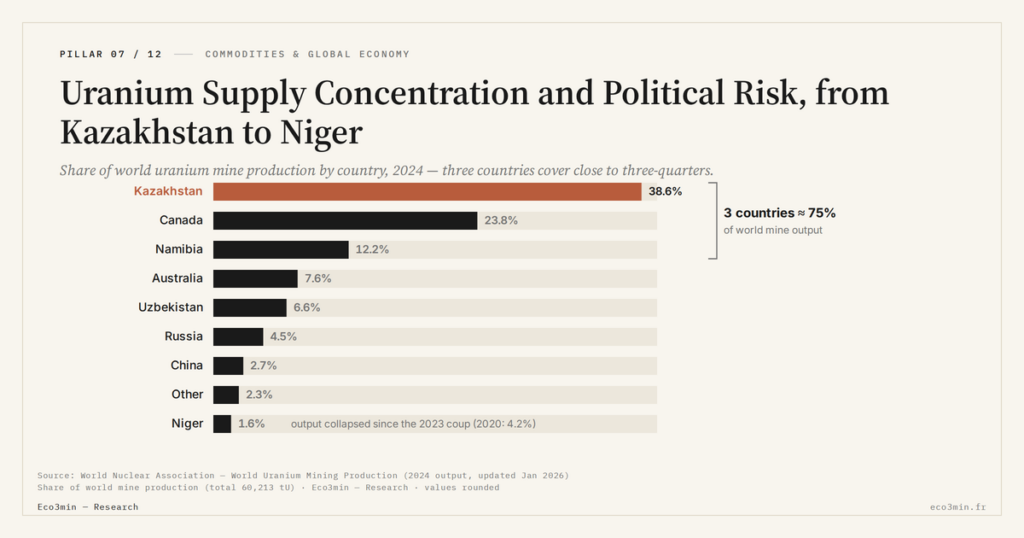
Uranium’s supply is among the most concentrated of any commodity: one country dominates the mine, three cover three-quarters, and it responds slowly to prices; Niger’s withdrawal illustrates the political risk of that dependence.
TL;DR
The dominant uranium producer is cutting 2026 output about 10 percent into a market already in deficit, where 2025 mine supply of 173 million pounds trailed demand near 204 million.
- Kazakhstan supplies about 40 percent of mined uranium, a larger share than any single nation's of world oil output, and with Canada and Namibia three countries cover close to three-quarters (WNA 2025 Nuclear Fuel Report).
- Bringing a mine online takes over a decade, and the post-Fukushima inventory cushion that has covered the deficit is thinning, so once exhausted the structural shortfall turns binding rather than an accounting note.
- Niger supplied about a quarter of the natural uranium reaching European plants in 2022 (Euratom); after the July 2023 coup, Orano lost the Imouraren permit in June 2024 and saw Somair nationalized in June 2025, with Russian actors signalling interest.
This page maps where uranium is produced, why that concentration matters, and why supply cannot adjust quickly, taking Niger as a cautionary case.
One country dominates the mine
Few commodities depend on as few sources as uranium. According to the World Nuclear Association’s 2025 Nuclear Fuel Report, Kazakhstan supplies on the order of 40 percent of world mine production, roughly 38 percent of it through the state group Kazatomprom alone, the planet’s leading producer. Together, Kazakhstan, Canada and Namibia account for close to three-quarters of global output. Such concentration has no equivalent in oil, where no single country carries such weight, nor in most industrial metals. By way of scale, a single country accounts for a larger share of mined uranium than any one nation does of world oil output, a degree of concentration that leaves the market unusually exposed to events in one place.
This dominance owes partly to method. A large share of Kazakh production uses in-situ leaching, which dissolves uranium directly underground without excavation: a low-cost technique suited to low-grade deposits, which let Kazakhstan become the cheapest producer and take a dominant place over the past two decades, overtaking historic producers such as Canada and Australia that previously led the market. Canada, by contrast, mines very high-grade deposits, among the richest in the world, while Namibia combines large open-pit operations. Three geographies, three models, but the same market consequence: most primary supply depends on a very small number of countries and operators.
To the concentration of production is added that of routes. Kazakh uranium, landlocked in Central Asia, long transited in part through Russia before reaching Western markets. Since 2022, that logistical pattern has become a risk factor in its own right, pushing for the development of alternative routes, longer and more costly, across the Caspian. The dependence therefore lies not only in where the metal is mined, but in the corridors through which it travels, a discreet but sensitive link in the supply chain.
Supply does not respond quickly
Geographic concentration is compounded by an inertia that sets uranium apart from short-cycle commodities. Bringing a uranium mine online takes years, often more than a decade from discovery to first commercial delivery, owing to studies, permits and the construction of processing facilities. Even incumbent producers run into material constraints: Kazatomprom has repeatedly cited difficulties sourcing sulphuric acid, an input essential to leaching, to explain delays in its expansion. Supply cannot be ordered on demand: it is planned long in advance. A price signal that would prompt a near-immediate response in copper or oil takes years to translate into additional uranium, if indeed it translates at all over the course of a cycle.
This inertia was deepened by the decade of depressed prices that followed Fukushima. During those years, capital left the sector, projects were mothballed, and the engineering and permitting pipeline thinned, so that the industry approaches recovering demand with a depleted project pipeline. Rebuilding that capacity does not happen in a few quarters, and new projects face a higher bar for financing and permitting than a decade ago, with stricter environmental scrutiny and investors wary of a sector with a long record of disappointing returns. To this is added a declared supply discipline: the dominant producer explicitly ties its production pace to the level of prices, refusing to return to full capacity until it judges the return sufficient, which adds a strategic decision to an already physical constraint.
The most revealing fact of the moment, however, is that the dominant producer chooses to restrain, not raise, its output. Kazatomprom announced a roughly 10 percent cut to its 2026 target, lowering it from 32,777 to 29,697 tonnes of uranium, judging that the level of prices did not justify a return to full capacity. That cut alone removes on the order of eight million pounds, close to 5 percent of global primary supply, precisely as reactor additions accelerate contracted demand. The market was already running a deficit: in 2025, world production of about 173 million pounds fell short of primary demand of about 204 million, with the gap of some thirty million pounds covered by secondary supply, that is, inventories, reprocessing and reconverted material, whose role is detailed among the stages of the fuel cycle. To this is added the pressure of Chinese demand, whose imports, on the order of 70 million pounds in the recent period, divert a substantial share of supply away from Western markets.
The secondary supply that fills this deficit is not, however, inexhaustible. The inventories built up over the decade of depressed prices that followed Fukushima are shrinking as they are drawn down, and several of the sources that fed them, such as the blending-down of military material, have already largely played their part. As that cushion thins, the market depends more on current mine production, precisely the output that geography makes slow to raise and that the principal producer chooses to restrain. Once that buffer is exhausted, any gap between mine output and reactor demand can no longer be papered over, and the market’s structural deficit becomes a binding constraint rather than an accounting note.
Confusing abundant reserves with available supply leads to underestimating the constraint. Uranium is not rare in the ground: the Imouraren deposit in Niger ranks among the largest in the world, and produces nothing. What is rare is genuinely available production, which requires years of investment, permits and a political stability that the geography of supply does not always guarantee.
Political risk: the Niger case
The concentration of supply turns any localized political shock into market risk, and Niger offers the clearest illustration of recent years. The country ranked among the world’s top ten producers and supplied, on Euratom data, about a quarter of the natural uranium delivered to European power plants in 2022. Its production was long carried by France’s Orano, heir to a presence of more than fifty years.
The coup of July 2023 broke that balance. The military government began a gradual dismantling of the partnership with France: in June 2024 it revoked Orano’s operating permit for the Imouraren deposit, which holds about 200,000 tonnes of uranium and ranks among the largest undeveloped deposits in the world, its development frozen since 2015 after the price collapse that followed Fukushima; it then took operational control of the group’s three main mines in 2024, before nationalizing the Somaïr subsidiary in June 2025. Orano, which legally retains a roughly 60 percent stake, has lost control of operations and launched arbitration proceedings; exports to France were suspended in the standoff, and Russian actors signalled interest in the assets, raising the prospect that a source lost to Western buyers could drift toward Russian influence, compounding a dependence that already runs deep at the enrichment stage. By late 2025, Niger announced it would place its uranium on the international market.
The lesson goes beyond the particular case. When supply depends on a small number of countries, a sovereign decision, a nationalization or a logistics disruption in any one of them suffices to shift flows and reconfigure the supply of an entire continent. Niger was not the world’s leading producer, but its withdrawal deprived Europe of a major source and was a reminder that uranium’s scarcity is as political as it is geological. Diversifying in response is anything but immediate: replacing a major source means opening or restarting mines elsewhere, and so running into the same multi-year lead times that characterize all primary supply. Political risk and physical inertia thus reinforce each other, the one creating the need for alternatives that the other makes slow to deliver. This risk sits within the wider field of the geopolitics of critical minerals, where security of supply has become a strategic priority of the first order.
A concentration that extends downstream
Mine concentration does not read in isolation: it extends, and worsens, at the next step of the chain. Enrichment, essential before fuel can power most reactors, is even more concentrated than mining, dominated by a player whose position is inherited from the Cold War. The way the concentration of enrichment doubles that of the ore is the subject of a separate analysis; here it is enough to note that dependence accumulates along the chain rather than dilutes.
This geography of supply, thin, slow and politically exposed, is one of the two sides of the configuration described in the overall analysis of uranium’s structural cycle: demand that changes in nature meets supply that cannot, or will not, adjust quickly. Placed among strategic resources and their geography, uranium supply appears as a limiting case of concentration, where the map of production matters as much as the level of the price, and where each source weighs all the more because they are few, hard to replace, and supported by buffers that are wearing thin.
Last updated — 9 July 2026
Disclaimer – Financial Information: The analyses, commentary, and content published on eco3min.fr are provided for informational and educational purposes only. They do not constitute investment advice or a solicitation to buy or sell financial instruments. Past performance is not indicative of future results. All investment decisions involve risk and are the sole responsibility of the reader.
Read next
Full pillar →Reading the refinery utilisation rate: the threshold, the season, the turnarounds
A refinery runs full near ninety percent, not a hundred: the last slice of nameplate capacity is a…
IMO 2020: the regulatory shock that rewrote product spreads
An environmental rule on marine sulfur can move a refining spread more than a swing in crude. IMO…
The 2022–2023 refining golden age: anatomy of an episode
In 2022, refined fuel prices climbed faster than crude. That gap, measured by the 3-2-1 crack spread, reached…