
Uranium Enrichment, SWU and the Russian Bottleneck in the Western Chain

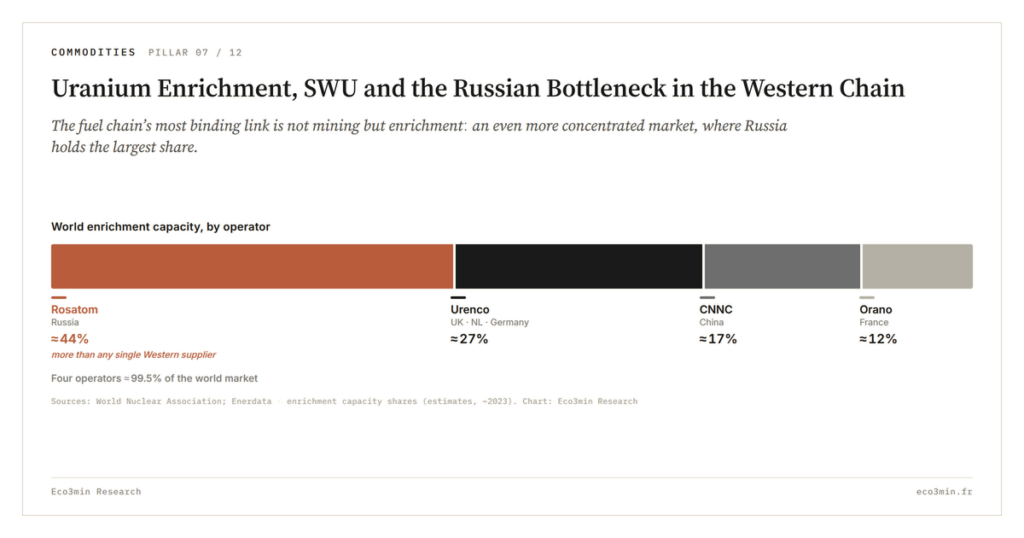
Not mining, but enrichment is the fuel chain’s most binding constraint: Russia holds the largest share, the SWU price has surged, and the West faces a shortfall before its capacity rebuild is ready.
TL;DR
Enrichment prices jumped about 167 percent after February 2022, and a 2024 US law bars Russian enrichment services from January 2028, squeezing utilities that still lean on Rosatom for fuel.
- Four operators, Rosatom, CNNC, Orano and Urenco, cover roughly 99.5 percent of capacity, with Rosatom holding about 44 percent, so the loss or restriction of any one cannot be quickly absorbed by the others.
- Analyses converge on a three-to-four-year non-Russian deficit between 2026 and 2028, met by drawing down strategic inventories that buy time rather than solve the gap, while Urenco's New Mexico expansion of 700,000 SWU a year is not due until 2027 and Centrus's order backlog already nears 2.3 billion dollars.
This page explains what enrichment is, why it is more concentrated than mining, why Russia dominates, and the 2028 cliff facing Western supply.
Enrichment, the decisive link
Uranium pulled from the ground holds only about 0.7 percent of the fissile isotope, uranium-235; nearly all reactors in service need fuel enriched to 3 to 5 percent. Enrichment is the operation that raises this concentration, separating isotopes by centrifuge. Its intensity is measured in separative work units, or SWU, which quantify the effort regardless of how much uranium is processed. This step sits between converting ore into gas and fabricating fuel, and is one of the links set out in the nuclear fuel chain.
The SWU price has staged a surge that conveys the scale of the strain. On data cited by Centrus, one of the two enrichers licensed in the United States, the price of enrichment services jumped about 167 percent since Russia’s invasion of Ukraine in February 2022, rising from a level on the order of 55 dollars a SWU to close to 200 dollars. That increase, sharper still than the ore’s over the same period, reflects a scarcity that lies not first in the ground, but in transformation capacity. The surge has two roots: a demand for enrichment that climbed as reactors restarted and lifespans extended, and a scramble by Western utilities, after 2022, to contract away from Russia, which thinned the pool of non-Russian SWU they were all chasing at once.
Enrichment has a substitution relationship with the ore that illuminates what follows. For a given fuel, an operator can trade off the amount of natural uranium it supplies against the amount of SWU it buys: enriching more extracts more fissile isotope from a given mass of ore, while enriching less requires more uranium as input. What is discarded, the depleted tails, still contains uranium-235, and the level of that residual content reflects the trade-off chosen. It is precisely this flexibility that will later make overfeeding possible when SWU becomes too expensive.
Even more concentrated than the mine
If uranium mining is among the most concentrated of all production, enrichment is more so still. Four players supply most of the world’s capacity: Russia’s Rosatom, China’s CNNC, France’s Orano and the Urenco consortium, owned by the British and Dutch governments and German utilities. Between them, they cover almost the entire market, on the order of 99.5 percent of SWU produced worldwide. Where oil counts dozens of significant producers, enrichment rests on a handful of operators. Such a structure leaves little slack: with four operators covering essentially the entire market, the loss or restriction of any one of them cannot be quickly absorbed by the others.
Within this club, Russia holds first place. Rosatom controls the largest share of world capacity, about 44 percent on capacity estimates (WNA, Enerdata), greater than that of any single Western supplier. Capacity estimates put Urenco around 27 percent, CNNC around 17 percent and Orano around 12 percent, with the balance going to the Russian operator. This dominance extends, at the transformation stage, the dependence already described for the geography of mine supply: the chain does not diversify downstream, it tightens.
This map is not fixed. China has set a goal of enrichment self-sufficiency and is building capacity at a brisk pace as its reactor fleet expands; SWU demand is expected to shift toward Asia over the coming decades, against a Europe and North America where the number of large reactors moves more slowly. Part of Chinese capacity could eventually open to export, but it does nothing to resolve the immediate Western dependence, which plays out before the end of the decade.
Russian dependence and the 2028 cliff
Russia’s position is a technological inheritance. The Soviet Union and then Russia developed an early lead in centrifuge technology, which made Rosatom the cheapest and highest-capacity supplier, to the point that many Western utilities still depend on its services. Since 2022, that dependence has become a strategic risk of the first order. The same services that once looked like a cheap, reliable utility now read as a single point of leverage in the hands of a geopolitical rival, to be priced and rationed at will.
The United States has legislated to end it. The Prohibiting Russian Uranium Imports Act, passed by Congress in 2024, bans imports of Russian uranium and enrichment services from 1 January 2028. Yet to date Centrus still sources most of the enriched uranium it sells to US utilities from Russia. The company’s chief executive warned in early 2026 of the risk of a shortage of enrichment services, capable of threatening US nuclear expansion: rising demand from existing reactors, combined with the ban on Russian imports, raises the prospect of a shortfall before new domestic capacity is ready. If Western demand exceeds non-Russian supply before new capacity ramps up, the gap will have to be met by drawing down strategic inventories. Those inventories are a bridge, not a solution: drawing them down buys time but leaves the West more exposed once they thin, precisely the dynamic that makes the timing of new capacity so consequential.
The dependence is not confined to the United States. In Europe too, many utilities sought after 2022 to diversify their supply or cancel Russian deliveries, without being able to break free quickly. Centrus’s order backlog, on the order of 2.3 billion dollars in enriched uranium in early 2026, illustrates the demand piling up in wait of non-Russian supply: utilities are trying to source outside Russia, but Western capacity is not yet there to serve them.
Believing that securing the ore is enough to secure the fuel ignores the real bottleneck. A country can hold all the uranium it wants and remain reliant on Russia to enrich it: the choke point lies downstream of the mine, at the transformation stage. Nuclear supply security turns as much on enrichment capacity as on access to ore.
The Western rebuild and its lead times
Western players have launched a rebuilding effort, but one measured in years. Urenco has begun expanding its capacity, with a first tranche of 700,000 SWU a year at its New Mexico site, due for completion in 2027, and a program to add on the order of 2.5 million SWU by 2030 at its Almelo site in the Netherlands. Orano, for its part, is studying an increase in its capacity. US public authorities support the move, with the Department of Energy having awarded on the order of 3.4 billion dollars of long-term enrichment contracts to several suppliers and committed billions more to accelerate a domestic chain. But installing centrifuge cascades takes time, and the schedule for this capacity remains tight against the 2028 deadline. A new enrichment plant is a multi-year, multi-billion-dollar undertaking, and customer commitments often must come first, so capacity tends to follow demand with a long lag rather than anticipate it.
Enrichment is not, moreover, the only tight link in transformation. Conversion, the step that turns mined concentrate into gaseous uranium hexafluoride before enrichment, also rests on a very small number of facilities worldwide, and has had its own price surge since 2022. Rebuilding a self-standing Western chain therefore means clearing several successive bottlenecks, conversion then enrichment, whose lead times add up. The vulnerability lies not in a single point, but in a string of narrow steps where each link depends on the one before.
One segment crystallizes the constraint in particular: high-assay low-enriched uranium, or HALEU, enriched to a level above that of conventional reactors, which much of the fuel for small modular reactors requires. Until recently, only Russia had commercial HALEU capacity; Centrus is its nascent US producer, with a few hundred kilograms delivered in 2024. Enriched well above conventional reactor levels, HALEU also draws heightened regulatory scrutiny, its assay bringing it closer to more sensitive thresholds. As long as that capacity stays embryonic, advanced-reactor deployment runs into an additional upstream dependence.
The scarcity of enrichment finally produces a feedback onto the mine. When SWU becomes expensive and scarce, operators resort to overfeeding, using more natural uranium per unit of enrichment to save separative effort. This behavior, now durable in the face of shortage, mechanically raises ore demand: the transformation bottleneck rebounds upstream onto uranium consumption, closing a dependence that runs the length of the chain. It shows that the chain’s constraints do not merely add up, they reinforce one another: a downstream bottleneck swells upstream demand, worsening an already acute strain on ore. It is one of the least visible drivers of the broad uranium market dynamic, and it places enrichment at the heart of the geopolitics of energy as much as of the geopolitics of strategic resources, where command of a technology sometimes weighs more than access to the material.
Last updated — 7 October 2026
Disclaimer – Financial and Legal Information: The analyses, commentary, and content published on eco3min.fr are provided for informational and educational purposes only. They do not constitute investment advice or a solicitation to buy or sell financial instruments. Past performance is not indicative of future results. All investment decisions involve risk and are the sole responsibility of the reader. Data, charts and calculated series are provided as is and may contain errors or lag behind their source: check any figure against the primary source cited before relying on it. Content describing laws, regulations or contracts reflects the law as of its publication date and does not constitute legal or tax advice; applying it to a specific situation requires a qualified legal or tax professional.
Read next
Full pillar →Uranium: The First Commodity Whose Cycle Is Driven by Compute, Not Industry
Uranium briefly crossed 100 dollars a pound in January 2026, pushed not by an industrial cycle but by…
Reading the refinery utilisation rate: the threshold, the season, the turnarounds
A refinery runs full near ninety percent, not a hundred: the last slice of nameplate capacity is a…
The 2022–2023 refining golden age: anatomy of an episode
In 2022, refined fuel prices climbed faster than crude. That gap, measured by the 3-2-1 crack spread, reached…