The Black Sea Breadbasket: Export Concentration as a Structural Chokepoint

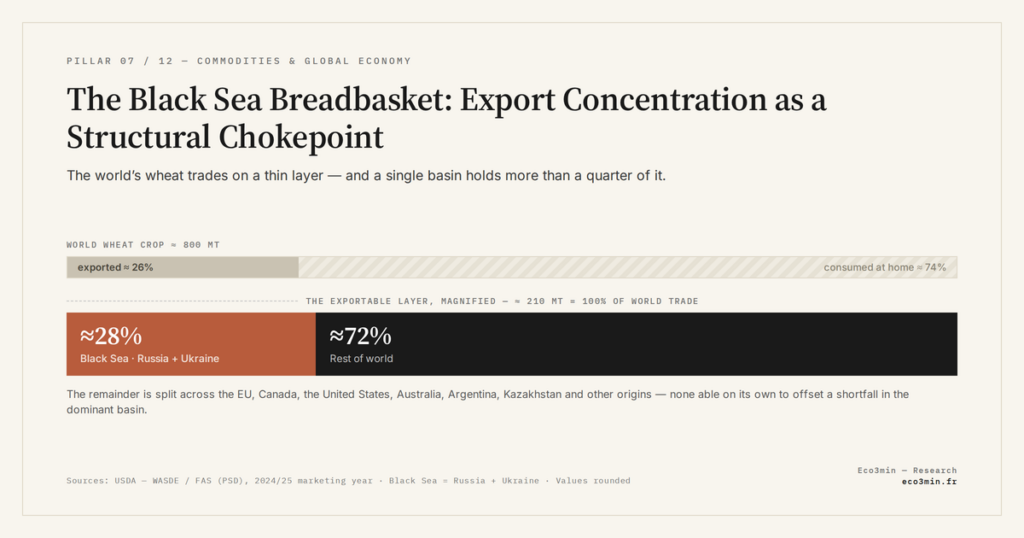
Over two decades, the Black Sea has become the decisive breadbasket of the world wheat market. That ascent lowered prices for importers, but it also concentrated risk in a single basin exposed to war, drought and political decisions.
TL;DR
Diversifying away from the Black Sea takes years of new production, storage and port capacity, so the basin's grip on exportable wheat cannot be undone by a single good harvest.
- Concentration makes the market more reactive to feared shocks, not only realised ones: bad news about the dominant basin tends to move the price more than good news of comparable scale.
- Importers can adjust only at the margin (diversifying suppliers, holding larger reserves, securing long-term contracts), none of which removes the underlying dependence quickly.
This article examines how Black Sea export concentration shifted from a source of abundance to a structural fragility, and why limited diversification of supply turns a local disruption into a global one.
The concentration of exportable supply is the central mechanism that makes the price of wheat such a sensitive signal, as the analysis of wheat prices and instability establishes. That mechanism now sits in one specific basin: the Black Sea, whose rise has reshaped the map of exporters without the vulnerability it introduces always being recognised.
The rise of a decisive breadbasket
The transformation of the Black Sea into a central supplier of the world market is one of the structural facts of the past two decades on agricultural markets. Russia has risen to become the leading world wheat exporter, and Ukraine ranks among the main suppliers, to the point that the two together accounted for a large share of world exports before 2022 (USDA, 2021). This ascent rested on competitive production costs, geographic proximity to the major importers of the Mediterranean rim and the Middle East, and port logistics geared toward export.
This rise complements, through a tighter lens, the overall map of the market presented in the map of wheat exporters. For importing countries, the arrival of additional, cheap supply was long good news: it widened the choice of suppliers, compressed prices and improved short-term security of supply. It was in this context that the growing concentration of supply on the Black Sea was first read as a source of abundance, not as a source of risk.
Several factors fed this ascent. Extensive grain land, moderate labour and input costs, and access to deep-water ports gave the region a price advantage over competing basins. Its geographic position, close to the major importers of the Mediterranean rim, the Middle East and the Horn of Africa, reduced transport distances and freight costs relative to more distant origins. For many buying countries, the Black Sea thus became the reference supplier, sometimes the largest by volume. This dependence settled in gradually and without friction, which helped mask its flip side: as an importer concentrated its purchases on a single origin, its own exposure to a disruption of that basin rose, without that growing vulnerability translating into a visible signal as long as supply remained smooth. At the market level, the region has often functioned as the marginal supplier whose availability sets the tone of world prices: when the Black Sea exports abundantly, the price stays contained; when its flows shrink, the whole market tightens, lacking an immediate alternative of comparable scale.
This is precisely where the misunderstanding lies. The same concentration that lowered prices also shifted a growing share of world exportable supply toward a single basin. Yet abundance and fragility are not contradictory: a system can be both more efficient and less resilient. The competitiveness of the Black Sea made the world market more dependent on one region, and that dependence, invisible while everything works, becomes decisive at the moment of a shock. Yesterday’s abundance and today’s fragility are two sides of the same movement.
Why concentration creates fragility
The shift from abundance to fragility is not a question of volume produced, but of the structure of supply. A market whose exports are spread across many origins has a capacity for substitution: if a harvest fails in one basin, others can partly compensate, which cushions the shock on the world price. As exportable supply concentrates on the Black Sea, this capacity for substitution recedes, because there is no longer, in the short run, a cushion of alternative origins large enough to fill a major deficit of the dominant basin.
The consequence is a mechanical amplification of shocks. The same incident — a regional drought, an export restriction, a conflict disrupting ports — produces a price effect all the larger when the share of supply concerned is high and hard to replace. The basin becomes a critical passage point of the world food system: its failure, even partial, does not stay local but transmits to all importers that depend on it. Concentration thus turns a regional risk into a systemic one.
This amplification combines with a feature specific to the wheat market: the share genuinely available for export is thin relative to total production, since most of the world harvest is consumed locally. When this exportable layer, already narrow, additionally depends mostly on a single basin, two effects compound. The first stems from the thinness of the tradable market, which reacts strongly to any imbalance; the second from geographic concentration, which deprives that market of substitution sources. A deficit in the dominant basin therefore hits an exportable supply that is both thin and undiversified, which explains the disproportionate scale of the price moves observed during strains on the region. The fragility of the Black Sea is not only that of a large supplier, but that of a large supplier whose output feeds a structurally narrow market. For importers, this double narrowness means that part of their food security rests on the precarious balance of a market that is both thin and concentrated, where the margin between comfortable supply and strain can be crossed quickly. Further detail: the rate-of-change food-price signal.
This logic found its clearest illustration when a major conflict struck the basin directly and blocked part of its flows, confirming after the fact the fragility that concentration had installed; that episode is reconstructed in the 2022 Black Sea blockade. The structural lesson, however, goes beyond that particular episode: what matters is not the specific nature of the shock, but the fact that the system had concentrated its exposure to the point where a disruption in a single region propagates globally. The fragility predated the shock; the shock merely revealed it.
- The rise of the Black Sea lowered prices for importers but shifted a growing share of world exportable supply toward a single basin.
- Concentration reduces the market’s capacity for substitution: a localised shock can no longer be offset by other origins and transmits to the world price.
- Fragility stems from the structure of supply, not the volume produced; it predates shocks, which only reveal it.
Concentration of decisions, not only of geography
The basin’s fragility is not reducible to a natural hazard. To geographic concentration is added a concentration of decisions: a small number of exporting states hold a capacity to influence the world market that exceeds their economic or demographic weight. A decision taken to protect a domestic market — restricting or suspending exports, introducing quotas or taxes — withdraws supply available to others and can be enough to destabilise the supply of dozens of countries.
This institutional dimension is what distinguishes wheat concentration from a simple climatic exposure. A basin could be concentrated yet relatively predictable if its trade policies were stable and its risk of rupture low. Fragility worsens when concentration falls on origins liable to change their export rules abruptly, because to the physical risk of a poor harvest is added the political risk of a sudden decision. The market must then contend not only with uncertainty over volumes, but with uncertainty over behaviour.
This double exposure is reflected in how the market prices risk. Dependence on a single origin introduces, into price formation, a premium tied to uncertainty over the volumes and the political decisions of that origin. The stronger the concentration, the more sensitive this premium becomes to news concerning the dominant basin — harvest conditions, diplomatic tensions, signals of possible restrictions. The price of wheat thus integrates not only the physical state of supply, but the perceived probability of an interruption of the key basin’s flows. This is one reason markets sometimes react before a shock materialises: the anticipation of a possible rupture, on a concentrated supply, is enough to move the price. Concentration therefore makes the market not only more vulnerable to realised shocks, but more reactive to feared ones. This reactivity introduces an asymmetry: bad news about the dominant basin tends to move the price more than good news of comparable scale, because uncertainty weighs more heavily when substitution sources are lacking.
This concentration is part of a broader trend of geopolitical fragmentation of supply chains, in which dependence on a small number of origins becomes a strategic stake, a frame illuminated by geopolitical supply fragmentation. Wheat offers a version in which the stake is not only industrial or financial, but alimentary: the concentration of an input as vital as the grain of bread gives a few decision-makers direct influence over the food security of a large part of the world. This particular position of the basin sits within the broader frame of the agricultural commodities pillar, of which wheat is one of the most sensitive markets.
This fragility is not easily undone. Diversifying away from a dominant basin takes years: it requires expanding production in other origins, building the storage and port capacity to export it, and rerouting the trade relationships importers have built around the cheapest supplier. In the meantime, the concentration persists, and with it the exposure. Importing countries can adjust at the margin — diversifying suppliers, holding larger reserves, securing long-term contracts — but none of these removes the underlying dependence quickly. The structural nature of the concentration is precisely what makes it durable: it cannot be reversed by a single good harvest, only by a slow rebalancing of where the world’s exportable wheat is grown and shipped.
The Black Sea thus illustrates a two-stage fragility: geographic, because a major share of exportable supply flows through a single region; institutional, because the decisions of a small number of actors transmit there on a global scale. It is the combination of these two concentrations — of flows and of decisions — that shifted the basin from an engine of abundance to a structural point of fragility in the world wheat market.
Last updated — 12 July 2026
Disclaimer – Financial Information: The analyses, commentary, and content published on eco3min.fr are provided for informational and educational purposes only. They do not constitute investment advice or a solicitation to buy or sell financial instruments. Past performance is not indicative of future results. All investment decisions involve risk and are the sole responsibility of the reader.
Read next
Full pillar →Reading the refinery utilisation rate: the threshold, the season, the turnarounds
A refinery runs full near ninety percent, not a hundred: the last slice of nameplate capacity is a…
IMO 2020: the regulatory shock that rewrote product spreads
An environmental rule on marine sulfur can move a refining spread more than a swing in crude. IMO…
The 2022–2023 refining golden age: anatomy of an episode
In 2022, refined fuel prices climbed faster than crude. That gap, measured by the 3-2-1 crack spread, reached…