Ukraine War 2022: The Grain Corridor and the Wheat Supply Shock

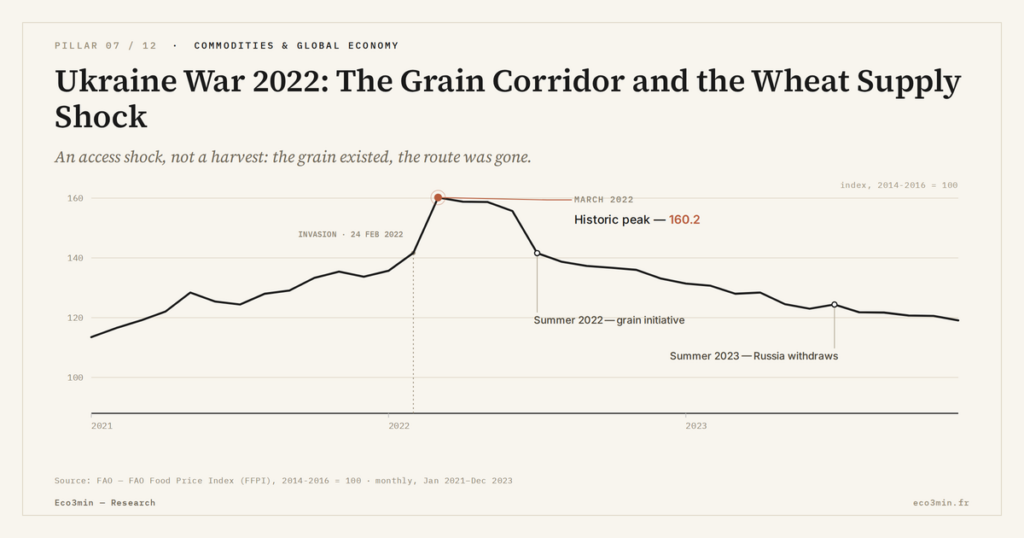
The invasion of Ukraine in February 2022 blocked the Black Sea grain ports and deprived the world market of one of its main wheat suppliers. The shock fell less on harvests than on the ability to export them.
TL;DR
In 2022 a closed Black Sea corridor immobilised a decisive share of world wheat exports: grain that existed in Ukrainian silos but had lost its route to market.
- The FAO Food Price Index hit a historic peak in March 2022, driven notably by cereals (FAO, 2022).
- Because it struck export access rather than harvests, the blockade opened open-ended uncertainty over its duration, amplifying the risk premium far more than a measurable harvest deficit would; wheat being seasonal, no producer could replant mid-season.
- Several countries restricted or suspended grain exports, repeating the defensive reflex of the 2007-2008 crisis fourteen years earlier and deepening the strain on importers with no output of their own.
- The Black Sea Grain Initiative, negotiated under the UN and Turkey in summer 2022, eased prices and restored part of the flows; Russia's withdrawal in summer 2023 brought the corridor's uncertainty back.
This article reconstructs the 2022 wheat shock: the blockade of the export corridor, the price surge, its transmission to dependent importers, and the partial response that the grain initiative represented.
The 2022 episode is the most recent and clearest of the shocks in which a localised rupture propagated to the world wheat market. It offers a full-scale illustration of the mechanism described in wheat and geopolitical shocks. Its distinctive feature lies in the nature of the shock: it was not a failed harvest, but access to the export routes themselves that broke down.
The blockade of a vital corridor
Most of the region’s wheat exports pass through the Black Sea ports. The February 2022 invasion interrupted this route: navigation hindered, ports closed or inaccessible, maritime insurance turned prohibitive. Overnight, a large share of world exportable supply was immobilised — not for lack of grain, but for lack of a way to move it out.
This distinction is central. The wheat existed, stored in Ukrainian silos or waiting to be loaded; what was missing was the path to carry it to markets. The 2022 shock was therefore not a production shock in the classic sense, but a logistical and access shock: the rupture of a corridor through which a decisive fraction of world grain trade flowed. This particular nature explains the violence of the price reaction, without waiting for any confirmation about the actual state of the harvests.
The episode validated, in practice, the structural vulnerability that supply concentration had installed, analysed in the Black Sea basin’s fragility. Because a major share of exportable supply depended on a single basin, and because there was no cushion of alternative origins able to fill the deficit quickly, the rupture of one corridor was enough to destabilise the supply of dozens of countries. Geographic concentration, theoretical while everything worked, became a very real exposure at the moment of the rupture.
This difference between a production shock and an access shock has direct consequences for the scale of the reaction. A harvest deficit can be measured and bounded: one knows, roughly, how much grain is missing. A corridor rupture, by contrast, opens an uncertainty over the duration and extent of the blockade, which may depend on the course of a conflict impossible to anticipate. The market then reacts not to a known volume but to a range of scenarios, which tends to amplify the risk premium embedded in the price. Moreover, since world exportable supply is structurally thin relative to total production, the withdrawal of a large exporter cuts into tradable commerce far more than into physical output: it was precisely this already-narrow exportable layer that the closure of the corridor abruptly reduced.
A powerful anticipation effect was added to the physical rupture. As soon as the blockade was announced, operators priced in the prospect of a prolonged shortage, and importers sought to secure supplies from other origins, intensifying the strain on an already tight market. As often on narrow-supply markets, the fear of a deficit preceded and amplified the deficit itself. The price reflected not only the grain actually lost, but the perceived probability that the rupture would persist.
The market’s inability to quickly reroute around the blockage compounded the shock. Wheat is a seasonal crop: a basin that loses access mid-season cannot be replaced by simply asking other producers to grow more, since planting and harvest decisions are fixed months in advance. The only short-term adjustment available was to draw down existing stocks elsewhere and to redirect cargoes already in transit — a limited buffer against the withdrawal of a major exporter. This rigidity of supply in the short run is what gives grain-corridor disruptions their particular severity: unlike many traded goods, additional wheat cannot be conjured within a quarter to offset a sudden loss. The world had to absorb the disruption with the grain it already had, and to ration the adjustment across importers through price. The speed of the price reaction was, in part, the market’s way of allocating a fixed near-term supply among buyers who could no longer all be served from the usual source.
The surge and its transmission
The price reaction was immediate and large. The FAO Food Price Index reached a historic peak in March 2022, driven notably by cereals (FAO, 2022). This surge spread well beyond futures markets: it transmitted, through the supply chain, to the countries that depend on imports to feed their population.
The transmission did not strike uniformly. The most exposed countries were those combining heavy dependence on wheat imports, a high share of food in household budgets and limited budgetary room to cushion the rise. For these economies, dearer wheat was not one market adjustment among others, but a direct threat to the stability of staple-food supply. This geography of exposure is analysed in the exposed importing nations, which shows how the same global shock translates into very unequal strain across countries.
The transmission channel here is purely alimentary. The rise in the price of imported wheat feeds through to the cost of flour, then of bread and staple products, until it weighs on the budgets of the most constrained households. In countries where the state subsidises bread to guarantee access, it is the public bill that swells, putting pressure on already fragile finances. The shock on a distant world market thus materialises, at the end of the chain, into a very concrete question: the cost and availability of the staple food. Related work: the failure of price thresholds.
The shock also triggered, among other actors, reactions that amplified the strain. Fearing for their own supply, several countries tightened or suspended their grain exports, reproducing the defensive reflex already seen during the 2007-2008 crisis. Each of these decisions, rational from the standpoint of a government concerned with its domestic market, withdrew supply from the world market and worsened the position of importers with no production of their own. The collective-action trap played out again: individual caution, summed up, deepened collective insecurity. This repetition, fourteen years apart, underscores a persistent trait of the wheat market: a supply shock is not confined to its initial physical effect, but sets off a second round of political reactions that can multiply its scale. Related material: The Global Wheat Market: Breadbaskets, Exporters and Dependent Importers.
- The 2022 shock fell on access to export routes, not on harvests: the grain existed, but could no longer be shipped.
- Supply concentration on the Black Sea turned the rupture of a single corridor into a global shock, lacking quick substitution origins.
- Transmission was very uneven: only countries combining import dependence and thin budgetary room tipped into strain.
The grain initiative: a partial response
Faced with the risk of a large-scale food crisis, a diplomatic initiative made it possible to partly reopen the export corridor. Negotiated under the auspices of the United Nations and Turkey in the summer of 2022, the Black Sea Grain Initiative established a framework allowing grain-laden ships to leave Ukrainian ports despite the conflict. Its implementation helped ease prices and restore part of the flows toward importing markets.
But this response remained fragile by nature. Resting on an agreement between belligerents, its durability depended on the parties’ willingness to renew it. Russia withdrew from the initiative in the summer of 2023, ending the negotiated framework and bringing uncertainty back to the corridor’s flows. This fragility illustrates a limit of diplomatic responses to a structural shock: they can ease the strain, but do not remove the underlying dependence on a single basin and a single export route.
The episode also exposed the limits of the available defences. Building strategic reserves offers a cushion, but a costly one to maintain and quickly exhausted against a prolonged rupture. Diversifying suppliers reduces dependence on one origin, but assumes other basins hold spare capacity that can be mobilised quickly, which is not guaranteed when exportable supply is thin. Securing long-term contracts protects a given buyer, but creates no additional grain at the world scale and may shift the shortage toward the least-endowed buyers. None of these responses removes the underlying vulnerability: as long as a decisive share of exportable supply flows through a single basin and corridor, the rupture risk remains, and mitigation devices only soften its effects.
The episode is a reminder that a corridor’s vulnerability is not specific to wheat. Other routes of world trade can come under comparable strain, as illustrated by another trade corridor under strain, where the disruption of a strategic maritime passage ripples across entire flows. The lesson is transversal: when a decisive share of a trade depends on a single passage point, that point becomes a systemic risk factor, whose failure transmits well beyond the region concerned.
The 2022 shock thus holds a singular place in the chronology of wheat crises. It confirmed, on a recent and documented case, that supply concentration and dependence on a single corridor expose the world market to abrupt ruptures, and that responses, however rapid and coordinated, remain suspended on the will of the actors who control the passage. Above all, it showed that a shock can strike the world market without any harvest failing, through the mere closure of a route — a form of shock, logistical and political rather than physical, that is harder to anticipate than production deficits, because it is read not in agricultural balances but in the geography of trade routes. This structural dependence, more than the episode itself, is what places wheat among the markets where a regional strain becomes a global affair, within the agricultural commodities market.
Last updated — 12 July 2026
Disclaimer – Financial Information: The analyses, commentary, and content published on eco3min.fr are provided for informational and educational purposes only. They do not constitute investment advice or a solicitation to buy or sell financial instruments. Past performance is not indicative of future results. All investment decisions involve risk and are the sole responsibility of the reader.
Read next
Full pillar →Reading the refinery utilisation rate: the threshold, the season, the turnarounds
A refinery runs full near ninety percent, not a hundred: the last slice of nameplate capacity is a…
IMO 2020: the regulatory shock that rewrote product spreads
An environmental rule on marine sulfur can move a refining spread more than a swing in crude. IMO…
The 2022–2023 refining golden age: anatomy of an episode
In 2022, refined fuel prices climbed faster than crude. That gap, measured by the 3-2-1 crack spread, reached…