
Artificial Intelligence ETFs: The Risks Investors Tend to Overlook
Artificial intelligence ETFs attract massive flows, but conceal risks that are often underestimated: high concentration on a few names, sensitivity to real rates and an amplifying effect of capital flows when sentiment turns.

Artificial intelligence ETFs are gaining traction with investors, carried by the promise of simple exposure to a technology presented as structurally reshaping the global economy. But behind the headline performance and the dominant narrative, these products carry specific risks that are often underestimated.
TL;DR
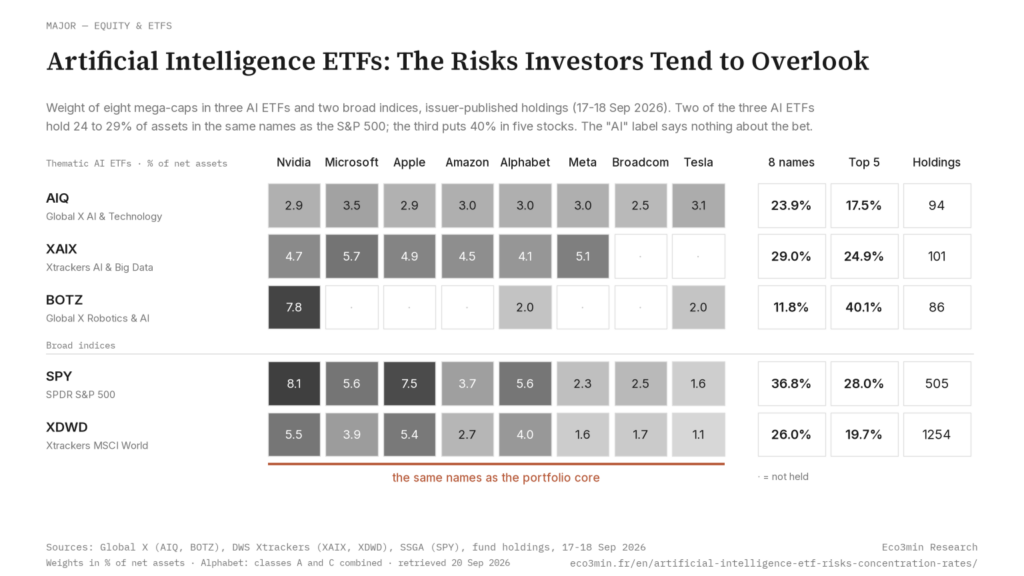
Depending on the fund, the top five holdings of an artificial-intelligence ETF weigh from 17.5% to 40.1% of net assets (Global X AIQ and BOTZ, holdings as of 18 September 2026), and two AI ETFs out of three hold 24% to 29% of assets in the same eight mega-caps as the S&P 500: a basket sold as diversified becomes a concentrated bet.
- A single earnings slowdown, regulatory change or downgrade on those dominant names can move the entire fund disproportionately.
- Valued on long-dated expected cash flows, the underlying companies are highly sensitive to real interest rates: when rates stay elevated, present values fall and trigger rapid valuation adjustments without any operating deterioration.
- Thematic flows cut both ways: subscriptions mechanically support the underlying stocks when the theme is popular, while outflows amplify drawdowns in an already concentrated, less liquid segment.
Before getting into the detail, it is essential to understand that AI ETFs do not behave like classic equity ETFs. They concentrate sectoral, technological and macroeconomic bets that profoundly alter their risk profile.
A complete analysis of flow mechanics, valuation and index construction is available here: Thematic AI ETFs: flows, valuations and hidden risks .
Why AI ETFs differ from traditional ETFs
Unlike broad indices (MSCI World, S&P 500), artificial intelligence ETFs are built on a narrow selection of companies directly or indirectly tied to AI: semiconductors, cloud infrastructure, software platforms or digital services.
This thematic approach creates a far more concentrated exposure, where performance depends more on a few dominant players than on the broader dynamics of equity markets. This concentration logic is the signature of dynamics explored in the Sectors and themes sub-pillar.
Risk #1: high concentration on a few key names
The first risk of artificial intelligence ETFs lies in their level of concentration. Depending on the product, the top five holdings weigh from 17.5% (Global X AIQ, 94 holdings) to 40.1% (Global X BOTZ, 86 holdings) of net assets, and 24.9% for the Xtrackers AI & Big Data ETF (XAIX), according to holdings published by the issuers on 17 and 18 September 2026. More to the point, two of these three ETFs hold 24% to 29% of their assets in the same eight mega-caps (Nvidia, Microsoft, Apple, Amazon, Alphabet, Meta, Broadcom, Tesla) that make up 36.8% of the S&P 500. Related reading: our reading of the AI exposure paths.
In that case, the ETF behaves less like a diversified basket than as an indirect bet on a handful of large-cap technology names. A slowdown in earnings, a regulatory change or a downward revision of prospects on these companies can have a disproportionate impact on the entire fund. Further reading: the price question behind AI ETFs.
Risk #2: heightened sensitivity to interest rates
Companies exposed to artificial intelligence are generally valued on the basis of expected long-dated cash flows. This makes them particularly sensitive to movements in real interest rates.
When rates remain elevated, the present value of those future cash flows declines, which can trigger rapid valuation adjustments even in the absence of any immediate deterioration in operating activity.
The risks tied to artificial intelligence ETFs cannot be properly assessed without placing them within their broader macroeconomic environment, where monetary conditions, the cost of capital and liquidity regimes directly influence the valuation of growth themes, as detailed in the analysis of macroeconomics and geopolitics, which sheds light on the regime shifts affecting financial markets.
Risk #3: the amplifying effect of capital flows
A more discreet but central risk concerns the role of capital flows. Thematic ETFs attract subscriptions when the theme is popular, which mechanically supports the prices of the underlying stocks. This mechanism illustrates, at the thematic level, the broader dynamic of passive and index-based investing.
This mechanism, however, runs both ways. When sentiment turns, outflows can amplify drawdowns, particularly in markets that are already concentrated and less liquid than the major global indices. Related analysis: our sub-pillar on how Financial Markets Form Expectations and Price Risk.
How investors can read these risks
Artificial intelligence ETFs are not necessarily products to avoid. They can play a role within an allocation, but should be understood as high-risk thematic exposures, not as a substitute for a diversified portfolio core.
Their relevance depends heavily on the macroeconomic context, the structure of the underlying index and the investor’s capacity to absorb sharper volatility in the event of a market regime shift. Underneath the index sits a small set of balance sheets whose cash generation can be read quarter by quarter in operating cash flow minus capex for six large US tech firms since 2017.
The takeaway
The risks of artificial intelligence ETFs stem less from the technology itself than from how risk is concentrated, valued and amplified by financial flows.
Understanding these mechanisms helps avoid a naive reading of past performance and frames these products with a more robust analytical lens, suited to a more demanding market environment. This reading fits within the framing proposed by our Equities and ETFs pillar.
Last updated — 20 September 2026
Disclaimer – Financial and Legal Information: The analyses, commentary, and content published on eco3min.fr are provided for informational and educational purposes only. They do not constitute investment advice or a solicitation to buy or sell financial instruments. Past performance is not indicative of future results. All investment decisions involve risk and are the sole responsibility of the reader. Data, charts and calculated series are provided as is and may contain errors or lag behind their source: check any figure against the primary source cited before relying on it. Content describing laws, regulations or contracts reflects the law as of its publication date and does not constitute legal or tax advice; applying it to a specific situation requires a qualified legal or tax professional.
Read next
Full pillar →Global Equity ETFs: When the US Weight Outruns the US Economy
US issuers made up 61.4% of a fund tracking the MSCI ACWI in July 2026, against 48.8% of…
Equal-Weight ETFs: The Quiet Signal Behind Rising Indices
Equal-weight ETFs reveal the true health of the equity market behind mega-cap-driven indices. Their gap with cap-weighted ETFs…
Smart Beta ETFs: The Risk Lies in the Gap Between Factors
Over the eighteen months to August 2026, value gained 8.2% and profitability lost 17.7%: stacking factor ETFs adds…