
How REIT prices track cap rates and net asset value

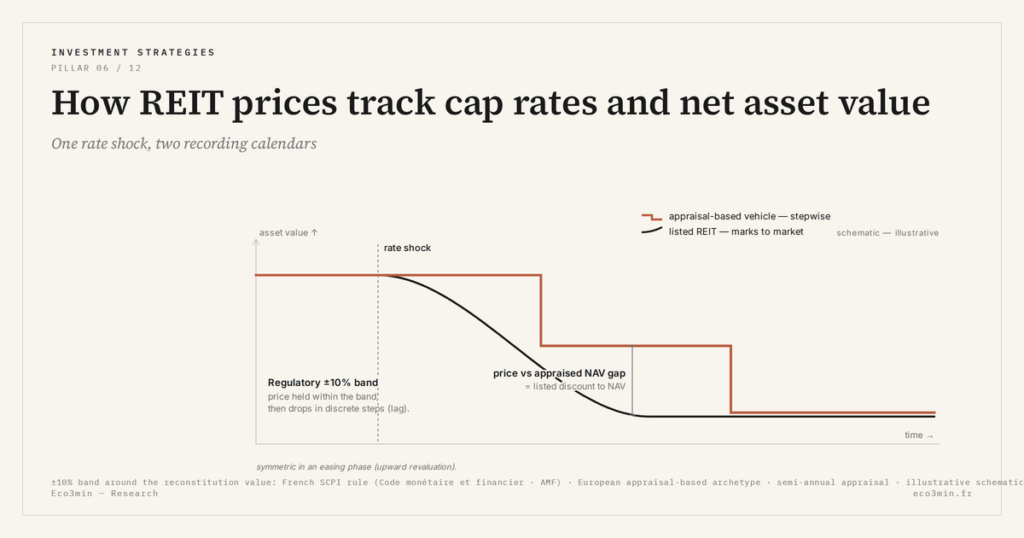
A REIT’s market price moves continuously, but the value beneath it rests on one engine: net operating income divided by a capitalization rate gives the asset value, and net asset value per share once debt is netted out. The rate cycle enters through the cap rate.
TL;DR
A REIT's discount to NAV measures a live quote against a stale anchor: the reported NAV was struck at a past appraisal date, so the gap is a timing signal.
- Net operating income divided by the cap rate gives asset value; subtracting debt gives NAV per share, and because leverage concentrates the cap-rate move on the equity slice, a given rise in cap rates lowers NAV more than proportionally.
- European listed real estate reports NAV under standardized EPRA conventions (net tangible assets, net reinstatement value, net disposal value), each adjusting balance-sheet equity for items such as deferred tax or the fair value of debt.
- Through 2022 and 2023 many listed REITs traded at wide discounts to NAV, the public market pricing the markdown it expected appraisers to make later as they caught up with the rate shock.
REIT valuation is not a mystery of the stock market. It follows a chain — rents, cap rate, gross asset value, net asset value — and then a gap opens between that chain and the live quote.
A REIT’s price is a market price, set continuously on the exchange, but the value underneath it rests on the same engine as any property: net operating income divided by a capitalization rate, which yields the asset value, and net asset value per share once debt is netted out. Understanding REIT valuation means following that chain — rents, cap rates, gross asset value, net asset value — and then noting where the listed price diverges from it. Because the market reprices the cap-rate assumption instantly, a REIT can trade at a discount or a premium to its last reported net asset value long before appraisers catch up. That gap, not the headline yield, is where the rate cycle shows up first. This article sets out the valuation mechanics, cold, as the conceptual base for the rest of the cluster; it details the central link of property and the rate cycle.
The valuation chain, from rent to net asset value
Everything starts with the building. Each asset a REIT holds produces a rental income; net of operating costs, that figure is the net operating income, or NOI. Divide the NOI by the capitalization rate the market demands on that kind of property, and you obtain the asset’s value. A warehouse generating a given net rent is worth more when the applied cap rate is low and less when that rate is high — the same arithmetic that governs every piece of investment property. Sum the values of all the buildings, add any financial assets, and you have the gross asset value of the portfolio.
From gross asset value, subtract the debt and you reach net asset value, or NAV. Divided by the number of shares, it gives NAV per share — the accounting anchor of what each share represents in underlying property, net of borrowing. This is the first brick of REIT valuation, and it already moves with the rate cycle, because the cap rate enters it directly: a rise in cap rates lowers asset values, lowers gross asset value, and, with debt fixed, lowers NAV more than proportionally, since leverage concentrates the move on the equity slice.
None of this is observed continuously on the underlying. The property values that feed NAV come from periodic independent appraisals, refreshed on a regulated calendar. The appraiser does not guess the market; they lean on recent comparable transactions and on rents in place. When transactions thin out — exactly what happens during a rate shock — the appraiser has fewer recent reference points, and the estimate tends to record the move cautiously, hence late. The first lag of the chain is born here, in the nature of appraisal itself, and it is the same lag that governs an unlisted vehicle’s reported value.
Reported NAV is itself a constructed figure, and listed REITs publish it under standardized conventions precisely because the raw number leaves room for judgment. European listed real estate, for instance, reports NAV measures defined by EPRA — a net tangible assets figure, a net reinstatement value, and a net disposal value — each adjusting balance-sheet equity for items such as deferred tax or the fair value of debt. The detail matters less than the principle: even the published NAV is an appraisal-based number, refreshed periodically, and therefore subject to the same lag as the property values that feed it. When a REIT trades at a discount to its last reported NAV, it is not trading at a discount to a live market value of the buildings; it is trading at a discount to a figure that was itself struck at a past appraisal date. This is why a discount can be large and persistent without implying mispricing: the market is comparing a continuous quote against a stale anchor. Grasping that the anchor itself lags is the key to reading the gap correctly, rather than treating reported NAV as a real-time truth from which the share price has somehow drifted. A companion piece: our reading of the REIT investment question.
For a listed REIT, the story does not stop at NAV, because the share does not trade at NAV. It trades at whatever price buyers and sellers agree on continuously, and that price can sit durably below the last reported NAV — at a discount — or above it — at a premium. The discount is not the market declaring the appraisal arithmetically wrong; it is the market declaring it stale, and pricing the markdown it expects appraisers to make later. Through 2022 and 2023, many listed REITs traded at wide discounts to NAV, the public market signaling that it expected reported property values to fall further as appraisals caught up with the rate shock.
The premium is the mirror image. In an easing phase, when the market expects appraisals to rise, REITs can trade above a NAV that still reflects yesterday’s lower property values. The width and sign of that gap are therefore a real-time, forward-looking read on where the recorded value is heading — information the appraisal, by construction, delivers only with delay. This is why the discount to NAV, not the dividend yield, is where the rate cycle first becomes visible on a listed vehicle. The mechanics of how a listed REIT is priced against its NAV are taken up in a dedicated satellite.
The practical upshot is that NAV and market price answer two different questions. NAV asks what the underlying property is worth on the latest appraisals; the market price asks what investors will pay today, given where they think those appraisals are going. In a stable regime the two sit close. In a rate shock they part, and the distance between them is the clearest single measure of how far ahead of the appraisal the public market has moved.
Why the appraisal-based vehicle runs on a lagging clock
An unlisted, appraisal-based vehicle — a French SCPI is the European archetype — has no continuous market price to leave the appraisal behind. Its share price is set off the reported value itself, within a regulated band, so it cannot diverge from the appraisal the way a listed quote does. For a French SCPI, the Monetary and Financial Code (Article L. 214-94) draws a band of plus or minus 10% around a reconstitution value derived from the appraisals: any wider gap between the subscription price and that value must be justified by the manager and notified to the AMF, the French market regulator. Since January 2026, AMF rules also require a variable-capital SCPI to have each building appraised in full at least every three years and the appraisal updated every half-year. As long as the price stays inside the band, the manager need not act; once falling appraisals push the gap past the threshold, holding the price means justifying it to the regulator, which is why crossing the threshold acts as the trigger for a markdown.
That band is why unlisted revaluations arrive in clean steps rather than continuously. For months, the reported value can erode under falling appraisals without the share price moving, because the gap stays inside the band; then, when the threshold is crossed, the markdown lands at once, sometimes several points deep. The holder sees a stable share for a long stretch, followed by an abrupt correction that seems to come from nowhere, when it is only catching up an accumulated lag. The same logic runs in reverse in an easing phase: rising appraisals lift the reconstitution value, and beyond a certain gap the manager can revalue the share upward, again in steps, with the same delay.
So the same portfolio, in a listed wrapper, leaves the appraisal continuously through the discount, while in an unlisted wrapper it tracks the appraisal in regulated steps. Neither escapes the cap-rate shock; they differ only in the date and the form of the recording. This valuation mechanism is the base that makes it possible to read a vehicle’s yield, liquidity, and leverage correctly — dimensions that only make sense once the formation of the share price is understood. How the same shock then played out concretely is the subject of the satellite on the 2022 value reset, and placing the vehicle in a regime-based grid belongs to the sub-pillar on choosing assets by regime.
- REIT value rests on a chain: net operating income divided by the cap rate gives asset value, and net asset value per share once debt is netted out — the cap rate, driven by the rate cycle, enters at the first step.
- Leverage concentrates the cap-rate move on the equity slice, so a given rise in cap rates lowers NAV more than proportionally.
- A listed REIT’s price leaves NAV continuously, trading at a discount or premium that prices where the market thinks appraisals are heading; that gap, not the yield, is where the rate cycle shows first.
- An appraisal-based vehicle cannot diverge that way: its price tracks the reported value within a regulated band, so revaluations arrive in steps, with the appraisal’s lag built in.
Last updated — 6 October 2026
Disclaimer – Financial and Legal Information: The analyses, commentary, and content published on eco3min.fr are provided for informational and educational purposes only. They do not constitute investment advice or a solicitation to buy or sell financial instruments. Past performance is not indicative of future results. All investment decisions involve risk and are the sole responsibility of the reader. Data, charts and calculated series are provided as is and may contain errors or lag behind their source: check any figure against the primary source cited before relying on it. Content describing laws, regulations or contracts reflects the law as of its publication date and does not constitute legal or tax advice; applying it to a specific situation requires a qualified legal or tax professional.
Read next
Full pillar →REITs and the rate cycle: how listed property reprices
One rate shock, two clocks: the listed market records it continuously (market value of US equity REIT shares,…
Target-Date Funds vs Self-Directed Portfolios: The Mechanics of a Delegated Glide Path
A target-date fund is sold as a simple, set-and-forget win. It is first something narrower: a delegated glide…
What Guaranteed Savings Products Have Paid: Fixed Annuity and Stable Value Yields Through the Rate Cycle
US guaranteed savings products credit a rate that trails the bond market rather than tracking it. Through the…