Real Estate Investment: A New Regime for Your Wealth
Real estate investment: why the end of free money is reshaping returns, credit, and the role of property within overall wealth allocation.

Real estate investment: why the end of free money is reshaping returns, credit, and the role of property in your wealth.
TL;DR
With 20-year European mortgage rates near 3.5–4.5%, up from about 1% in 2021, property becomes a cash-flow asset whose returns hinge on rental yield exceeding the cost of credit.
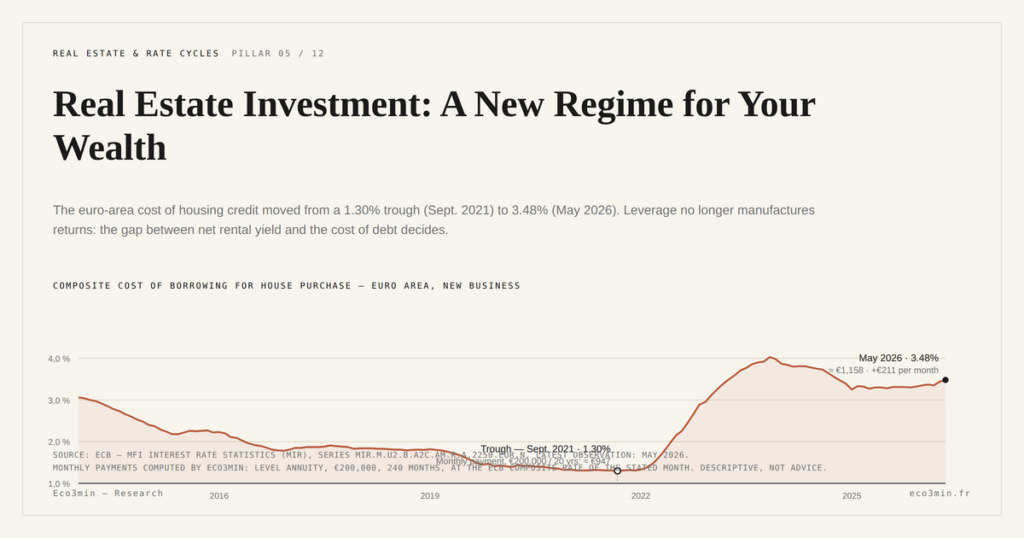
- On a €200,000 loan over 20 years, the monthly payment rose from about €920 to roughly €1,250 between 2021 and end-2025, mechanically compressing net returns.
- Since early 2023 transaction volumes fell 20–40% by country and prices dropped 5–10% in some urban segments, while rents climbed 6–8% over 2022–2025: a market correcting on capital while holding on flow.
- With euro-area inflation around 2.3–2.8% since mid-2024, property reads again as a shield against monetary erosion; professional investors are stretching horizons to 8–12 years rather than exiting.
For many, rising rates have “killed” real estate investment. The reality is subtler: property is simply entering a new regime. With 20-year mortgage rates at 3.5–4.5% in Europe in early December 2025, after roughly 1% in 2021, the leverage equation is unrecognisable. The counterpart for property investors is set out in the rate-cycle mechanics behind REITs. Understanding this shift is key to adjusting your overall allocation, in the same way as your 60-30-10 strategy or your portfolio allocation more broadly.
In short: property remains useful… but no longer at the same price, no longer with the same level of debt, and no longer for the same investor profiles.
The market in 4 key points
- End of “free” leverage: the monthly payment on a €200,000 loan over 20 years rose from about €920 to ≈€1,250 between 2021 and end-2025 → net returns mechanically compressed.
- Gross yields catching up: in several large cities, rents rose 6–8% between 2022 and 2025 while prices stagnated or fell slightly → gradual recovery of rental yields.
- Moderate but persistent inflation: with euro-area inflation around 2.3–2.8% since mid-2024, property is once again primarily a shield against monetary erosion, not a vehicle for rapid capital gains.
- Less “all-property” wealth: the cost of debt makes it more rational to rebalance towards cash, equities and real assets adjusted for inflation.
Decoding: what the data reveal
Part of the consensus already holds that real estate investment is “broken” until rates return towards 2%. This reading rests on the idea that performance comes mainly from price appreciation, fuelled by easy credit. That cycle is over, possibly for a long time. Related framing: Our analysis of the real estate credit cycle.
This shift is not explained by the level of rates alone, but by a deeper change in the financing regime for property. The in-depth analysis of the real estate credit cycle as the driver of prices shows how increased credit selectivity, well before visible price adjustments, durably redefines the profitability and risk profile of real estate investment.
This recomposition of property risk and return belongs to a broader frame in which real estate can no longer be analysed in isolation, but as an asset class strongly dependent on rate cycles, credit and macroeconomic dynamics. The reference page on real estate, rate cycles and the economy places these local adjustments (prices, rents, leverage) within a coherent reading of successive property regimes.
Empirically, since early 2023, a slow adjustment is visible: transaction volumes down 20–40% depending on the country, prices down 5–10% in some urban segments, but rents rising steadily. This indicates a market correcting on capital while holding on flow. An interesting point: professional investors are extending their horizons (8–12 years) rather than exiting.
This text adopts a different reading from the dominant scenario: rather than waiting for a “return to normal” on rates, the working hypothesis is that 3.5–4.5% on 20-year debt is becoming the new structural baseline. In that frame, real estate investment remains relevant, but only when net rental yield clearly exceeds the cost of credit, with a minimum risk premium of 2 points. Same ground, different entry — the gap between net yield and the cost of credit. Reference on the topic: our decoding of the real-estate question.
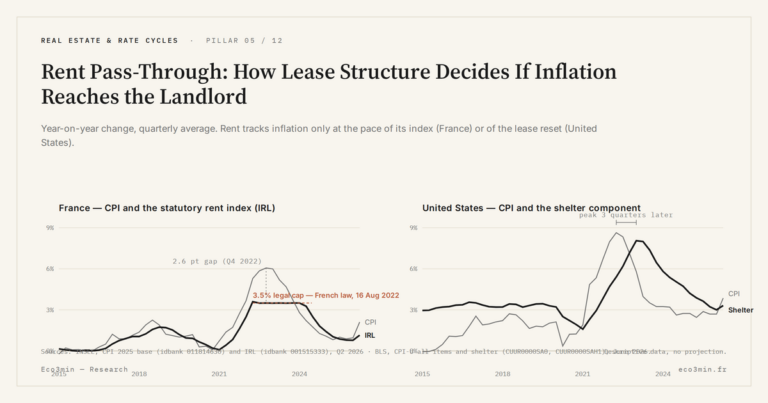
The detail many underestimate: the gradual rise in rents takes several years to materialise, while the rate increase is instantaneous. An investor looking only at year-1 economics concludes “everything is impossible”. One projecting to year 5–7 sees a very different picture.
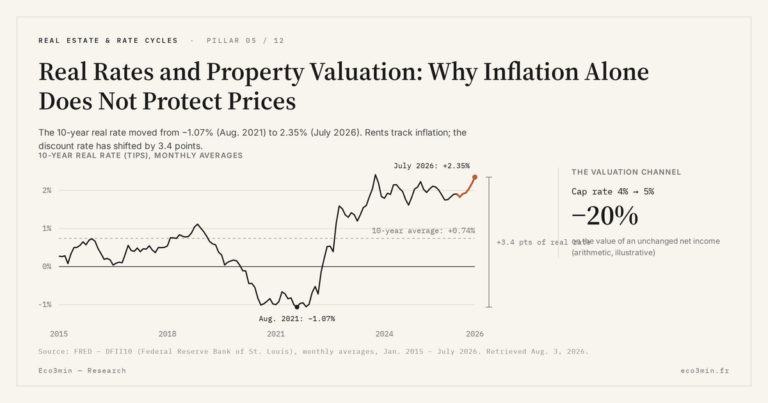
This reading requires thinking in terms of a rate cycle, not from a snapshot of current levels: the property constraint depends primarily on how long rates remain elevated and on the lag between the credit shock and the gradual adjustment of rents.
Concrete impacts: what is changing now
For an individual or a “patrimonial” investor, this new regime imposes a much stricter filter:
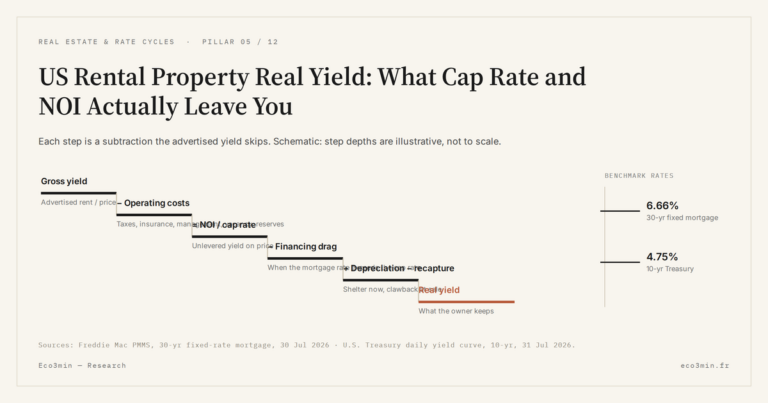
- Realistic net yields are scrutinised more closely: historically, deals where net-of-charges yield (excluding taxes) was at least 4.5–5% while credit cost stood at 3.5–4% offered a meaningful spread. Below that, holding cash or strengthening a diversified portfolio via liquid investment strategies has often been preferred.
- Lower leverage: down payments of 20–30% rather than 10% have become more common. The aim is to reduce the monthly payment and leave a margin in the cash flow. A frequently observed rule of thumb: when total monthly payments stay below roughly 30–35% of net income, financial resilience tends to be more robust.
- Different allocation patterns: in this context, an observed structuring approach for €100 of financial wealth places property (including primary residence) alongside liquid assets (equities/ETFs/bonds) and precautionary savings, in proportions that vary with risk tolerance and time horizon.
- Professionals/entrepreneurs: the trade-off between buying or renting business premises (offices, facilities) is now decided by comparing the implicit rental yield with the average cost of corporate debt.
Weak signals to monitor
- Rental yield / 20-year fixed-rate spread: as long as the net spread stays <2 points, prices remain under pressure. Above that threshold, buyers have historically returned.
- Share of variable-rate loans: a sharp rise increases the risk of stress on households in the event of a brutal monetary tightening.
- Household solvency indicators: average debt-service ratio of new borrowers, share of loans >25 years — drift in either is a sign of an artificially supported market.
- Flows into SCPIs and listed real estate vehicles: net subscriptions sharply down since 2023 still indicate caution; a sustained reversal over several quarters would mark a pivot.
Plausible medium-term scenarios
1. Central scenario (high probability): long rates broadly stable, inflation around 2–2.5%, rents continuing to rise faster than wages for 2–3 years. In that case, rental yields tighten further, prices stop falling but do not rebound strongly. Real estate becomes a yield asset, not a speculative one.
2. Accommodative scenario: if growth slows sharply and central banks ease rates more than expected, mortgage rates drift back towards ≈3% on 20-year debt. Pressure on prices eases, but the window is short — sellers adjust quickly, limiting bargains.
3. Stress scenario: inflation or budget shock, sudden rise in long rates above 5%, regulatory tightening (taxation, energy standards). This scenario would severely impair valuations, especially for energy-inefficient and highly leveraged assets. Some participants are already hedging via increased exposure to inverse rates and a lower property weight in their allocations, in favour of more liquid assets, as described in the barbell approach.
The key point of divergence with the consensus: part of the dominant projections counts on an almost automatic return of rising prices as soon as rates ease somewhat. The reasoning set out here holds, on the contrary, that demographics, the saturation of households already owning their home, and public budget constraints will limit any such rebound.
This scenario would be invalidated if rates fell again close to 1–1.5% on a sustained basis or if governments massively relaunched demand through subsidies and guarantees, artificially restarting an upward cycle.
What it tells us at a deeper level
At its core, real estate investment is no longer the single pillar of wealth, but one block among others, to be approached with the same discipline as an ETF portfolio or a bond sleeve. The real question is not “buy or not buy”, but at what yield, with what leverage, in what share of overall wealth. Tools for assessing real return after inflation become central in comparing property with other assets.
For investors who accept this new grammar, the 2025–2027 period may resemble a phase of patient portfolio construction in real estate, with more selective tickets, less glamour, but more solid cash flows. For those waiting for a return to a 1%-rates and 8%-annual-appreciation world, the wait is likely to be long.
Nothing is set in stone: depending on risk profile, some prefer to keep dry powder, others to advance in small steps. The essential point is no longer to reason by the reflex “property always wins”, but through a cold, quantified arbitrage against other asset classes.
We will revisit the picture tomorrow, in a market that may already look different.
3 takeaways
- With rates at 3.5–4.5%, property has become a cash-flow asset, not one driven by automatic capital gains. The spread between net yield and credit cost is the real arbiter.
- A balanced allocation has historically limited property to a measured share of total wealth, with the remainder split between liquid assets and safety, to retain flexibility.
- The market is still pricing a return to rising prices as soon as rates fall. The quiet risk is a long plateau in valuations, with performance coming mainly from rents.
Last updated — 25 July 2026
Disclaimer – Financial Information: The analyses, commentary, and content published on eco3min.fr are provided for informational and educational purposes only. They do not constitute investment advice or a solicitation to buy or sell financial instruments. Past performance is not indicative of future results. All investment decisions involve risk and are the sole responsibility of the reader.
Read next
Full pillar →US Rental Property Real Yield: What Cap Rate and NOI Actually Leave You
A rental listing leads with a yield. Divide the annual rent by the price and the number looks…
Cap Rate Spread: What Rental Yield Pays Over the 10-Year Treasury
A 5% cap rate sounds attractive. But 5% against what? A risk-free 10-year Treasury yields near 4.5% in…
Vacancy and Turnover: The Cost That Erodes a Landlord’s Real Return
A listing shows full rent, twelve months a year. The owner knows the gaps between tenants, the make-ready…