Safety Reserve: The Detail That Reshapes Cash Returns
Safety reserve: the detail that reshapes cash returns, between deposits, short-duration bond ETFs and still-unstable inflation.

Safety reserve: the detail that reshapes cash returns, between deposits, short-duration bond ETFs and still-unstable inflation.
TL;DR
With money-market and short-bond vehicles yielding near 3% in 2025 against 2–3% inflation, the safety reserve's vehicle now weighs on long-run wealth as much as its size.
- Cash at 0% erodes mechanically against inflation near 2–3%, while money-market funds and short-duration bond ETFs yield around 3% in autumn 2025.
- Compound-interest simulations associate an oversized cash share with 20–30% less final capital over ten years.
- The reserve's real value is staying-power: a buffer of the conventionally cited 3–6 months of expenses prevents forced risk-asset sales during stress.
In 2022–2023, sitting in cash was costly. In 2024–2025, with short-term rates still elevated (often between ≈2.5% and ≈3.5% in Europe since mid-2024) and inflation back near ≈2–3%, the safety reserve question has regained strategic weight. Yet many households continue to park their precautionary savings in a current account at 0%. Bad timing. A poorly managed reserve costs years of return on the entire portfolio. Allocation simulation tools show this very quickly.
What markets are really watching today is no longer just equities, but the risk-return profile of highly liquid instruments: deposits, money-market funds, short-duration bond ETFs. our side-by-side of bond ETFs and the rate cycle sets this observation in the cycle. The good news: for the first time in more than a decade, a safety reserve can earn a yield without exposing the saver to high volatility. The trap: feeling “safe” while inflation quietly erodes purchasing power.

Three Key Takeaways
- Total cash is no longer neutral: at 0%, the holder loses almost mechanically against inflation still close to 2–3% in 2025 → slow but certain erosion.
- Short-term rates have become a real asset class again: money-market and short bonds offer around ≈2.5–3% in early 2025 → the new defensive base layer.
- Excess safety penalizes the long term: moving from 10% to 40% cash, over 10 years, can cut final capital by 20–30% according to compound interest simulations.
Decoded: What the News Is Saying
Since mid-2024, the macro framework has shifted: major central banks began cutting rates after the 2023 peak, but cautiously. The result: yields on short-term instruments remain attractive relative to moderate inflation. On some money-market funds and ETFs, annualized yields hover near ≈3% in autumn 2025, while 12-month rolling inflation runs closer to 2–2.5% in the euro area.
Part of the consensus still recommends keeping a large cash buffer to take advantage of potential equity corrections. The reading is understandable but incomplete. The real question is not just the size of the safety reserve, but its vehicle: current account, savings deposit, money-market fund, short-duration bond ETF. The analysis here diverges by treating the fine-tuned arbitrage between these vehicles as carrying as much weight as the cash percentage itself on 5-to-10-year performance. A closer look: how the after-price return on cash depends on the cycle.
Notably, for households, the primary financial risk is not the next equity crash, but a liquidity shortfall in case of a hard hit (job loss, large health expense). The corresponding framing appears in early access before retirement age. It is concrete microeconomics, but directly affected by macro: tighter credit conditions, less fluid labor market, still-high services inflation. Without a properly sized safety reserve, the saver is forced to sell risk assets at the worst time.
This is precisely where the notion of personal financial resilience takes its full meaning. Beyond the reserve’s yield, the real question is whether the household financial structure can absorb a prolonged shock without forcing risk-asset sales or unfavorable borrowing. To explore this concretely, the Eco3min financial resilience simulator tests realistic scenarios — persistent inflation, income drop, lasting unexpected expense — to assess whether liquidity and safety margins effectively act as shock absorbers.
This logic extends beyond the choice of vehicle: it points to the order in which financial decisions are made. The in-depth analysis of structuring financial decisions over time shows that the safety reserve is effective only when it precedes any risk exposure; otherwise it stops being a shock absorber and becomes a poorly remunerated refuge.
Managing an effective safety reserve is not just about choosing the right vehicle, but about a clear understanding of priority order — liquidity, protection, then risk exposure — a framework that fits directly within structured financial education, essential to prevent short-term prudence from penalizing long-term wealth trajectory.
Short-Term Risks and Opportunities
- Calibrating reserve size
Conventional benchmarks: 3 to 6 months of current expenses for stable salaried profiles, extending toward 12 months for self-employed or highly cyclical incomes. A monthly savings calculator helps plan reserve build-up over 12–24 months. - A safety basket, not a single product
Allocations historically observed in diversified safety reserves cluster around 50% in highly liquid guaranteed deposits, 40% in money-market or short-duration bond funds, and 10% in slightly higher-yielding but still defensive instruments. This 50/40/10 structure absorbs occasional inflation surprises better than a single-product setup. - Avoiding the “permanent cash” trap
Safety reserves observed in retail portfolio surveys typically fall within an 8–15% range of total wealth. Beyond that range, automated monthly transfers toward an investment portfolio (equities, diversified ETFs) have historically smoothed cash drag, consistent with a 60/30/10 allocation framework. - Counter-argument worth keeping in mind
Should monetary policy tighten again more than expected (inflation rebounding above 3–3.5% for several quarters), even short-duration bond ETFs could suffer. In that case, pure cash on guaranteed deposits would temporarily regain attractiveness.
The Quiet Signals to Watch
- Short-rate vs inflation gap: as long as the net yield on the reserve exceeds inflation by at least 0.5 point, purchasing power is broadly protected. Below that threshold, erosion runs silently.
- Equity volatility evolution (VIX-type indices or European equivalents): if it spikes, modestly increasing cash share can be justified, but always within the predefined target range.
- Short-term credit spreads: a rapid widening over 1–3 months signals stress on issuers. In that case, ultra-safe money-market vehicles tend to be preferred over corporate bonds, even short-duration.
- Flows into money-market ETFs: massive inflows can signal excess overall caution. Useful for calibrating risk-taking elsewhere, especially if equity ETF appetite simultaneously fades.
Plausible Medium-Term Scenarios
Scenario 1 — Confirmed soft landing (central case)
Inflation stays close to 2–2.5%, global growth runs around 2–3% in 2026, policy rates step lower but stay positive in real terms. Yields on safety-reserve vehicles stabilize between 2 and 3%. In that case, holding 10–15% of wealth in interest-bearing reserve vehicles remains internally consistent, while the rest can be deployed in more dynamic strategies. A companion question: our breakdown of the soft landing.
Scenario 2 — Inflation rebound
If prices rise above 3.5–4% for several quarters (energy, wages, geopolitics), central banks could pause cuts or even raise rates again. Short duration limits the damage, but attentive investors then tend to favor guaranteed cash, waiting for bond yields to reset higher.
Scenario 3 — Sharp slowdown
A sharp rise in unemployment or a confidence shock would push central banks to cut faster, compressing money-market yields below 1.5–2%. The safety reserve would yield less, but historically has provided dry powder to acquire risk assets at distressed valuations. Indicators to monitor: unemployment rate, household confidence indices and monetary policy decisions over 3 to 6 months. More on this: the Eco3min study of everyday financial trade-offs.
Conclusion
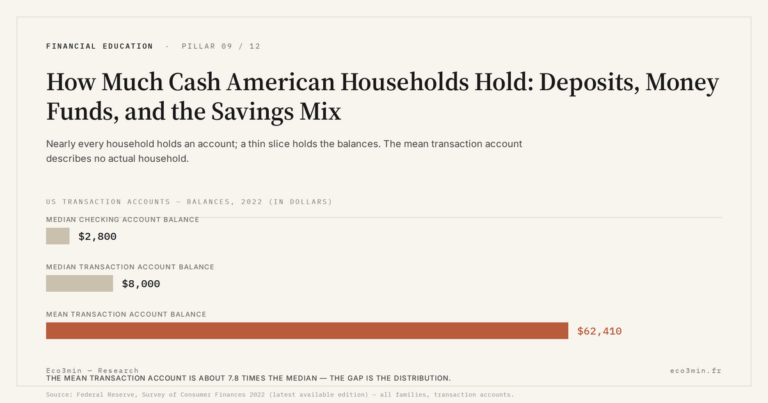
The safety reserve is no longer an “administrative detail” set once and forgotten. Between less violent inflation, still-elevated rates and persistent volatility, it has become a real allocation decision. For investors, fine-tuning this sleeve can change the wealth trajectory over 10 years. For both companies and households, it also acts as a shock absorber against a more uncertain economic cycle. The composition of US household savings takes up the question from another angle. Markets do not always reward this intelligent prudence, but it offers rare freedom of action when conditions deteriorate. Reassessment due tomorrow with a market that may look different.
Three Key Takeaways
- A 100% cash safety reserve at 0% is a costly luxury when inflation hovers around 2–3%: it too needs to earn a yield.
- Conventional benchmark: 3–6 months of expenses, allocated across deposits, money-market funds and short bonds, with a target range of 8–15% of wealth.
- The real power of the safety reserve is not the annual yield, but the ability not to sell risk assets in the middle of market stress.
Last updated — 12 July 2026
Disclaimer – Financial Information: The analyses, commentary, and content published on eco3min.fr are provided for informational and educational purposes only. They do not constitute investment advice or a solicitation to buy or sell financial instruments. Past performance is not indicative of future results. All investment decisions involve risk and are the sole responsibility of the reader.
Read next
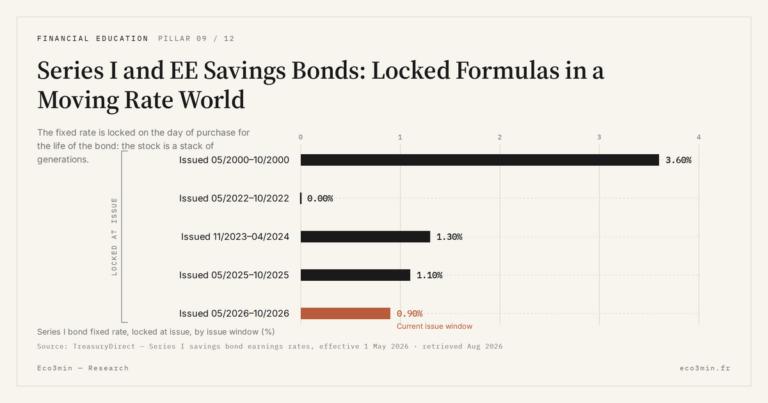
Full pillar →Series I and EE Savings Bonds: Locked Formulas in a Moving Rate World
US savings bonds lock a rate formula at the moment you buy them, for the life of the…
Where the Livret A’s Money Goes: The Caisse des Dépôts Circuit and Social-Housing Finance
The savings held on Livret A accounts do not sit idle. A regulation-set share is centralised at the…
France’s LEP vs the Livret A: A Means-Tested Higher Rate, Explained
France’s Livret d’épargne populaire is often described as "the Livret A, only better". The description misleads: the LEP…