Uranium Financialization: Physical Funds and Spot Distortion

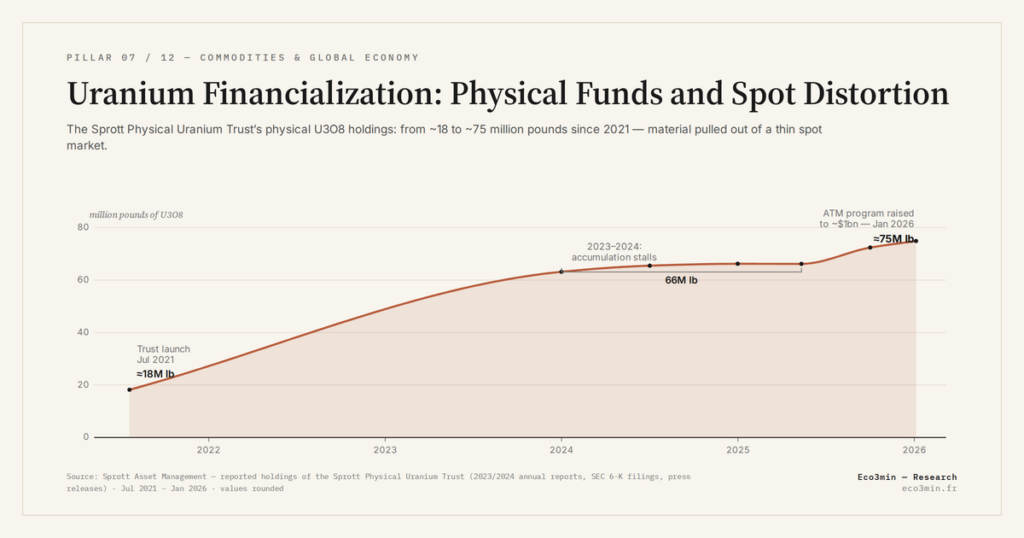
Funds buy physical uranium and store it, removing it from an already-thin cash market; their flows can inflate a rally as easily as deepen a pullback, making spot a partly financial signal rather than a purely industrial one.
This page explains uranium’s financialization, how funds such as Sprott’s trust distort the cash price, the reflexive mechanism that amplifies cycles, and why the contract price remains the cleaner signal.
Funds that store the metal
Uranium has, in recent years, become accessible to direct financial exposure through listed vehicles that hold the material itself. The two best known are the Sprott Physical Uranium Trust and Yellow Cake plc, closed-end structures that acquire uranium in its concentrated form, U3O8, and keep it in specialized warehouses. The investor thus gains exposure to the commodity’s price without holding mining shares or dealing in futures. These are not the first physical commodity funds, but uranium’s particular thinness gives them an influence that comparable vehicles lack in deeper markets. Related analysis: the cross-commodity view of oil, copper and strategic minerals.
The appeal lies in the purity of that exposure. A mining share carries company-specific risks, operational and financial; a futures contract requires managing expiries and rolling positions. The physical fund tracks the material’s price as closely as possible, without those intermediate layers. The arrival of Sprott’s trust in 2021, by taking over a pre-existing structure, marked a turning point: for the first time, a large vehicle could raise capital and buy physical uranium at a pace capable, on its own, of weighing on a cash market accustomed to modest volumes. Its reported holdings rose from about 18 million pounds of U3O8 at launch, in July 2021, to 66 million at end-2024, then to about 75 million in January 2026 (Sprott Asset Management): that much material withdrawn from a thin spot market.
The decisive point is what these funds do with the uranium they acquire: they buy it and store it, withdrawing it durably from the available market. As they grow, tens of millions of pounds leave circulation for vaults. On a cash market already thin, where a few million pounds suffice to move the price, this withdrawal of material has a mechanical tightening effect, independent of any consumption by reactors. That immobilized stock could, in theory, return to the market one day if the funds sold; but as long as they accumulate, it acts as additional demand layered on top of utilities’, and competing with it.
The at-the-market mechanism and the reflexive loop
The ingenuity, and the fragility, of the arrangement lie in how it is financed. Sprott’s trust issues new units on a rolling basis, under what is called an at-the-market program, to raise capital it immediately devotes to buying more physical uranium; in January 2026, that program was raised to one billion dollars of potential issuance. When the unit trades above the value of the underlying asset, issuance is advantageous: the fund sells units, buys uranium, and this new purchase supports the cash price, which lifts the asset’s value and sustains the premium, permitting a further issuance.
This self-reinforcing loop was the engine of the 2021 rally, when the arrival of Sprott’s trust helped propel the spot price. The pattern replayed in early 2026, the fund having acquired more than five million pounds in the first quarter, helping push the cash price briefly toward one hundred dollars, before it fell back as that buying dried up. But the mechanism works both ways: when the premium disappears, because the price has fallen, issuance stops and the buying support evaporates. The same device that amplifies the rise can therefore withdraw its support at the worst moment. The figures make the loop concrete rather than abstract: a billion-dollar issuance program translated into millions of pounds of physical buying is enough, on this market, to set the marginal price for a time.
The fund’s closed-end structure compounds this asymmetry. Unlike an open-end fund, which creates and destroys units as demand dictates, a closed-end trust sees its unit drift from the value of the underlying asset: a premium in periods of enthusiasm, a discount in periods of disaffection. It is the premium that makes issuing new units worthwhile and feeds the buying; at a discount, the engine stalls, and the fund has no reason to buy. The pace at which these vehicles acquire uranium therefore tracks the market’s mood, which makes them pro-cyclical: they buy when the price rises and stop when it falls, the opposite of a counter-cyclical buyer that would steady the market. Other commodities have comparable physical funds, but the effect is outsized here: on a market as thin as uranium’s, a single buyer of this size can leave its mark on the price, as it could not on oil or gold. What looks like steady accumulation is therefore conditional: it depends on a premium that the market grants only while confidence holds.
A spot that has become partly financial
The consequence is that uranium’s spot price is no longer a pure industrial signal. It aggregates, without distinguishing them, utility demand and financial flows, so that a rise in the cash price poses a permanent question: does it reflect real scarcity, or the effect of financial buying on a shallow market? The funds’ withdrawal of material is certainly not fictitious and tightens an already-strained market, which uranium’s structural supply deficit only prolongs; but it makes the cash price less legible as a mirror of consumption. This ambiguity is novel at this scale: before these funds rose, the cash price, thin as it was, answered mainly to utilities’ needs and to producers’ flows of material. An observer reading the spot alone can no longer tell, in real time, how much of a move belongs to reactors and how much to capital, at least until the flows reverse and the answer becomes obvious in hindsight.
This is precisely why the long-term contract price is a more reliable benchmark. Because it reflects the commitments of utilities reasoning over time, rather than the flows of a narrow market, it is less exposed to the funds’ influence. The distinction is developed in connection with the contract price as a cleaner signal: when the cash price surges under financial buying, the contract follows a more measured path, and it is the contract that best reports the underlying tension. The gap between the two signals showed itself recently: in 2025, the cash price stayed broadly flat even as mining equities and long-term demand indicators strengthened, a reminder that no single quote summarizes the market.
- Physical funds such as Sprott’s trust or Yellow Cake buy uranium and store it, removing tens of millions of pounds from an already-thin cash market, with a real tightening effect.
- At-the-market financing creates a reflexive loop: the premium on the asset allows issuing units, buying uranium and supporting the price, which sustains the premium; the mechanism reverses on the way down.
- The spot price aggregates industrial demand and financial flows: it is less legible than the contract price, which remains the cleaner structural signal. Whether this financialization is durable or temporary stays an open question.
Distortion or price discovery? The debate
This financialization lends itself to two opposing readings, and it would be reductive to settle it in a word. For its critics, the funds create a partly artificial scarcity, amplify volatility and detach the cash price from fundamentals: a price pushed by unit issuance says little about the real physical balance. For its defenders, these vehicles merely express a legitimate view on a deficit that is quite real, and bring transparency and liquidity to a historically opaque market; the cash price was always thin, and the funds add a form of price discovery. That defense is not without force: financial demand is not fictitious demand, and uranium bought by a fund is as genuinely unavailable as uranium consumed by a reactor. The line between speculation and the anticipation of a real scarcity is, here, blurrier than it appears. The spot’s opacity, moreover, long predates these funds: for years it was a quoted price resting on very few transactions, and added participation, whatever its motive, arguably reveals more information than it obscures.
Neither reading exhausts the subject, and the question of whether financialization is a durable structural feature or a temporary phenomenon remains without a settled answer. A fund that accumulated material in the upswing could, in a prolonged downturn, become a seller and deepen the decline, as the sequence of uranium’s past booms and busts has shown. Even without the forced redemptions specific to open-end funds, a closed-end trust at a prolonged discount loses any incentive to buy and could, under pressure, dispose of part of its holdings, adding supply at the worst moment. The risk is thus asymmetric: the same flows that cushioned the rise could turn into pressure precisely when the market can least absorb it. The caution to keep is therefore less a judgment on these vehicles than an observation: a cash price supported partly by financial flows is more fragile than one carried by industrial demand alone. This dynamic sits within the general dynamic of the uranium market, falls under the geoeconomics of resource markets, and illustrates a broader phenomenon, price formation driven by financial flows, that reaches well beyond uranium into other physical markets opened to financial capital.
Last updated — 22 September 2026
Disclaimer – Financial Information: The analyses, commentary, and content published on eco3min.fr are provided for informational and educational purposes only. They do not constitute investment advice or a solicitation to buy or sell financial instruments. Past performance is not indicative of future results. All investment decisions involve risk and are the sole responsibility of the reader.
Read next
Full pillar →Reading the refinery utilisation rate: the threshold, the season, the turnarounds
A refinery runs full near ninety percent, not a hundred: the last slice of nameplate capacity is a…
IMO 2020: the regulatory shock that rewrote product spreads
An environmental rule on marine sulfur can move a refining spread more than a swing in crude. IMO…
The 2022–2023 refining golden age: anatomy of an episode
In 2022, refined fuel prices climbed faster than crude. That gap, measured by the 3-2-1 crack spread, reached…