VIX history: the seven major volatility spikes 1990-2026 and their macro contexts


Since 1990, the VIX has crossed 30 twenty-four times, 50 eight times, and 80 three times. Each spike documents a specific market dislocation; none repeats identically.
TL;DR
The 2008 crisis remains the VIX's absolute record at 89.53 intraday, yet post-spike resolution has accelerated sharply since 2018, now measured in weeks rather than months. The empirical extension sits in our analysis of systemic risk indicators.
- The GFC stands apart on duration: VIX backwardation lasted more than four months while the S&P 500 fell 57% from its October 2007 peak to the 9 March 2009 trough.
- Volmageddon on 5 February 2018 was structurally triggered: Credit Suisse's XIV lost 96% in one session, forcing dealers to unwind short-vol hedges while the S&P 500 fell only 10%.
- Resolution has compressed across episodes: the 1998, 2008 and 2011 spikes took months to fade, whereas 2018, 2020 and 2024 cleared in weeks.
The empirical catalog that follows covers the seven major episodes from 1990 to 2026 — from LTCM 1998 to the yen carry trade unwind 2024 — with macro context, spike magnitude, resolution duration, and associated S&P 500 drawdown.
1. Selection methodology
A major VIX spike in this inventory is a breach of the 40 threshold on official close, accompanied by persistence of at least three sessions above that level. This criterion selects seven episodes over 1990-2026, excluding one-day transient peaks (May 2015 on Grexit, August 2015 on yuan devaluation) that touched 40 without holding.
For each episode, the documented variables are: the date of initial 30 breach, the intraday peak and closing peak, the spike duration (days above 30), the associated S&P 500 drawdown, and the macro context of the trigger. Data comes from the VIXCLS series published by FRED based on CBOE quotes, and from CBOE intraday history for peaks not captured at close. A variation on the same theme appears in VIX meaning, VIXCLS ticker and calculation from S&P 500 options.
2. LTCM, Russia, and the VIX’s installation as a barometer (1998)
The first major modern VIX spike comes in September-October 1998. Russia’s surprise ruble devaluation on 17 August 1998 and the Long-Term Capital Management (LTCM) hedge fund collapse in mid-September triggered a major cross-asset dislocation: credit spreads, swap spreads, OTM option premiums, all widened simultaneously. The VIX crossed 30 on 31 August, peaked at 49.53 intraday on 8 October 1998, and stayed above 30 for eight weeks.
The S&P 500 drawdown reached -19.3% from the 17 July peak to the 8 October trough. The coordinated intervention of Wall Street dealers to take over LTCM’s positions, under the New York Fed’s auspices, stabilised the market from mid-October. The VIX dropped back below 30 in late November. The episode durably installed the VIX in risk desks’ radar: it is the first episode where the index functioned as a recognised systemic stress indicator and not merely as a statistical curiosity.
3. Dot-com and 11 September 2001 (2000-2002)
The dot-com bubble bursting from March 2000 produced a progressive compression without a single characteristic spike. The VIX traded durably between 25 and 38 for two years, with a peak at 42.1 in April 2000 and several rebounds to 35-40 through mid-2002. The S&P 500 drawdown reached -49% from the March 2000 peak to the October 2002 trough — drawdown comparable to the GFC but spread over 30 months.
11 September 2001 produced an isolated spike within this phase. The VIX, closed during the 11 to 17 September market suspension, reopened at 41.8 and peaked at 43.7 on close on 20 September. The S&P 500 drawdown from 10 September reached -14% in two weeks, followed by a quick rebound. The episode is atypical for its exogenous nature and the rebound speed; it has served as reference for acute geopolitical shocks ever since.
4. The GFC, absolute reference of the series (2008-2009)
The global financial crisis produced the largest episode of the 1990-2026 VIX series. The VIX crossed 30 on 15 September 2008 (Lehman Brothers bankruptcy day), reached 89.53 intraday on 24 October 2008, and closed at 80.86 on 20 November 2008 — absolute records to this day. Persistence above 40 lasted more than eight months (September 2008 to May 2009), itself unprecedented duration.
The S&P 500 drawdown reached -57% from the October 2007 peak to the 9 March 2009 trough. The nature of the crisis — forced deleveraging, interbank dislocation, massive US Treasury intervention — explains the spike duration. This spike takes its place among the others in the dated sequence of volatility crises read by regime. Contrary to the usual pattern where backwardation resolves in weeks, the VIX curve stayed in total backwardation for more than four months, a period during which long-vol ETPs recorded their best historical performances but the S&P 500 kept falling.
5. Flash Crash, eurozone and fiscal cliff (2010-2012)
The post-GFC period produced three spike episodes without reaching 2008 levels. The Flash Crash of 6 May 2010, triggered by a poorly calibrated algorithmic sell order on e-mini S&P 500 futures, saw the VIX leap to 45.8 intraday before returning below 30 in two days. The S&P 500 drawdown that day reached -9% intraday before rebounding, but the index continued falling for two months to -16% below the April 2010 peak.
The European sovereign debt crisis of August-October 2011 produced a more durable spike. The VIX crossed 30 on 4 August 2011 (day of S&P’s downgrade of US sovereign debt to AA+), peaked at 48.0 on 8 August, and stayed above 30 until mid-October. The S&P 500 drawdown reached -19% between 22 July and 3 October 2011. Final resolution coincided with Mario Draghi’s whatever it takes declaration in July 2012, but the VIX had already dropped back below 20 by December 2011.
The late-2012 fiscal cliff produced a third, more moderate spike (peak at 22.7), which resolved within a few sessions after the US Congress agreement on 2 January 2013.
6. Volmageddon and post-2017 stress (2018-2019)
5 February 2018 produced an atypical episode in VIX history. After months of record compression (annual average VIX 11.1 in 2017, closing low 2017 at 9.14), the VIX leapt from 17.3 to 37.3 in a single session, then peaked at 50.3 intraday on 6 February. The immediate cause was the implosion of several short-volatility ETNs — notably Credit Suisse’s XIV, which lost 96% of its value in one session — which forced massive unwinding of short-vol positions by market-makers hedging these products.
The S&P 500 drawdown remained relatively contained (-10% between 26 January and 8 February), and the VIX dropped back below 20 by end-February. The episode is documented in detail by the SEC staff report published in 2019, which points to the procyclicality of short-vol structured products and the opacity of their systemic impact. It has served as reference for configurations where VIX structural compression precedes a sudden repricing.
Late 2018 produced another episode (peak at 36 in December 2018, S&P 500 drawdown of -19%), linked to the Fed’s tightening cycle and US-China trade tensions.
7. COVID and yen carry trade unwind (2020-2024)
The COVID crash of March 2020 produced the second-largest spike of the series. The VIX crossed 30 on 24 February 2020, peaked at 82.69 on close on 16 March 2020 — post-GFC record —, and stayed above 30 for five months. The S&P 500 drawdown reached -34% between 19 February and 23 March, the fastest drawdown in modern history (33 sessions). The resolution itself was atypically rapid thanks to coordinated Fed (0% rates, unlimited QE, liquidity programmes) and Treasury (CARES Act) intervention. The Eco3min catalogue of historical market crises places them on a common timeline.
The 5 August 2024 episode remains one of the most instructive of the decade. The VIX, at 17 on 1 August, leapt to 65.73 intraday on 5 August — third-highest historical print. The trigger was the forced unwind of the yen carry trade, itself caused by the Bank of Japan’s surprise rate hike on 31 July and a weaker-than-expected US employment report on 2 August. The Nikkei lost 12.4% on 5 August, the largest single-day drop since 1987. The S&P 500 limited the drop to -3% the same day, but the VIX reacted as to a major crash. The resolution was quick: the VIX dropped back below 25 within five sessions and below 18 within two weeks. The episode illustrates how a cross-asset shock (FX, futures, equity) can produce a VIX spike without a corresponding equity crash. Read alongside: VIX contrarian thresholds and historical equity rebounds.
8. Recurring patterns and historical-analysis limits
Three recurring patterns appear in the catalog. First: post-spike resolution speed has accelerated since 2018. The 1998, 2008, 2011 spikes took months to resolve; those of 2018, 2020 (on VIX terms, not on drawdown terms), 2024 take weeks. The SPX options market maturation, deeper liquidity, and faster central bank intervention explain this acceleration.
Second: the VIX intraday / VIX close ratio has stretched since 2010. Recent spikes capture more intraday than at close, making comparisons on daily series less informative than on intraday series. The full series of threshold breaches and post-spike returns documents this stretch.
Third: none of the seven episodes repeats identically. The GFC is unique in its duration, 9/11 in its pure exogenous nature, Volmageddon in its structural trigger, the yen carry trade unwind in its cross-asset concentration. Mechanical extrapolation from a past episode to a future one is the most frequent reading error. The general analytical framework for reading the VIX documents this epistemological limit.
- Seven major episodes structure the 1990-2026 VIX series: LTCM 1998, dot-com / 11 September 2001, GFC 2008-2009, eurozone 2011, Volmageddon 2018, COVID 2020, yen carry trade unwind 2024.
- The historical record remains the GFC: intraday VIX 89.53 (24 October 2008), close 80.86 (20 November 2008), persistence above 40 for more than eight months.
- Post-spike resolution speed has accelerated since 2018: SPX options market maturation, liquidity depth, and faster central bank intervention explain this shortening.
- No episode repeats identically: mechanical extrapolation from a past precedent is the most frequent reading error of historical VIX.
Last updated — 12 July 2026
Disclaimer – Financial Information: The analyses, commentary, and content published on eco3min.fr are provided for informational and educational purposes only. They do not constitute investment advice or a solicitation to buy or sell financial instruments. Past performance is not indicative of future results. All investment decisions involve risk and are the sole responsibility of the reader.
Read next
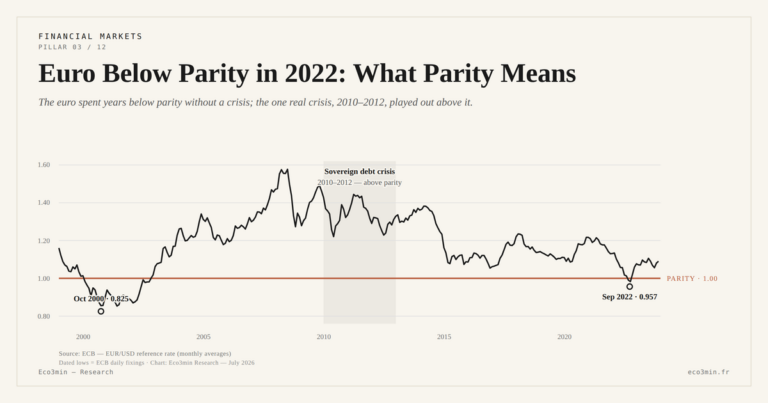
Full pillar →Euro Below Parity in 2022: What Parity Means
In September 2022, the euro fell below parity with the dollar, to around 0.95, a low not seen…
Eurozone Fragmentation: Sovereign Spreads and the Euro
The euro is issued by a monetary union without a complete fiscal union: nineteen sovereign debts coexist under…
The Euro’s Energy Import Bill: the Gas Shock and the Currency
In 2022, the surge in gas prices turned the euro area's historic current-account surplus into a deficit and…