LNG as a Partial Connector: Linking TTF, Henry Hub and JKM

Liquefied natural gas links regional markets through arbitrage: a cargo sails toward the region paying most, which narrows prices without ever equalizing them, for lack of sufficient transport capacity.
TL;DR
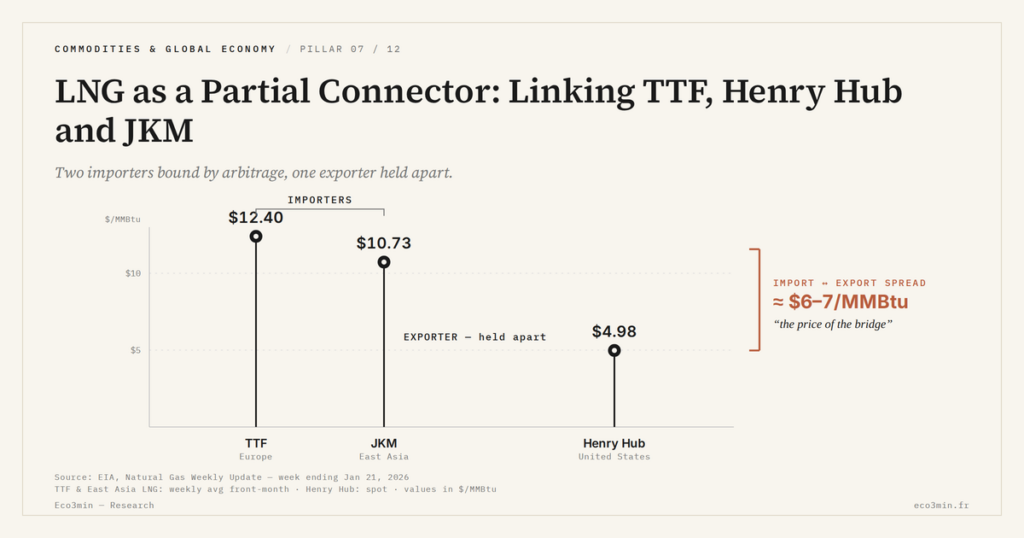
In early 2026, LNG to East Asia and European TTF both traded near $10-12/MMBtu while US Henry Hub sat at $3-5, importers bound together and the exporter held apart.
- The connection stays partial because every link is a bottleneck: a finite carrier fleet, capped regasification terminals, and long-term contracts that lock up volumes leave only the spot fraction free to arbitrage.
- Arbitrage is asymmetric: it redeploys existing supply but adds no liquefaction capacity short-term, so a demand jump lifts both importing basins as Europe and Asia compete for the same mobile gas.
This mechanism explains why gaps narrow without vanishing. This piece describes LNG arbitrage, its physical and contractual limits, and the slow transition it traces.
LNG arbitrage: the connecting mechanism
A carrier leaving the Gulf of Mexico can, depending on the day’s prices, head for Rotterdam or for Tokyo. That choice — sending the cargo toward the region paying most — is the mechanism by which LNG links otherwise separate gas markets. When a price gap opens between two zones, available cargoes tend to converge toward the dearer one: that additional flow lowers the price where it was high and raises the one in the origin zone, narrowing the gap. It is classic arbitrage, applied to a molecule made shippable by sea.
This mechanism connects three major regional prices. The European benchmark price, TTF, and the North American benchmark price, Henry Hub, frame the Atlantic; in Asia, the Asian LNG price (JKM) reflects peak demand in Japan and South Korea. Arbitrage relates these three prices, but the nature of that relation deserves stating precisely: it is real, and yet partial.
A recent empirical fact illustrates it well. In early 2026, according to EIA data, LNG delivered to East Asia traded around $10 to $11/MMBtu and European TTF around $12/MMBtu, both well above a Henry Hub on the order of $3 to $5/MMBtu. The two importing markets — Europe and Asia — thus stood at neighboring levels, because they compete for the same cargoes; the American exporting market stayed apart, separated by the cost of the chain. Arbitrage tightly links those who buy, without aligning them on the one who sells.
This pattern — importers tightly linked, the exporter held apart — is the signature of partial connection. If arbitrage were complete, all three prices would converge on a single world level net of transport. If it were absent, the three would move with no relation at all. What the data show is the intermediate case: enough mobile supply to bind the buyers together, not enough to pull the seller’s market up to theirs. The spread between import and export prices is, in effect, the visible price of the bridge — and its width tells you how far the connection has, and has not, progressed.
Why the connection stays partial
If arbitrage worked unimpeded, it would close the gaps. It does not, because transport capacity is bounded. Each link of the chain is a bottleneck. The number of liquefaction terminals is limited, and building one takes years and tens of billions. The carrier fleet is finite, and each crossing takes weeks. Regasification terminals, at the receiving end, have a capped intake capacity, sometimes saturated at peak. As long as that capacity does not expand, the volume of gas that can actually redirect stays constrained.
That is why gaps narrow without vanishing. Arbitrage pulls prices together up to the point where available capacity is fully mobilized; beyond that, it can no longer operate, and the differential persists. This physical limit radically distinguishes gas from a financial market, where arbitrage is near-instant and unlimited. Here it advances at the pace of a heavy, inert logistics, which directly recalls the regionalization of gas: LNG loosens the regional constraint without abolishing it.
The consequence is that LNG transforms the nature of the fracture without removing it. Before its rise, markets were nearly sealed, linked by a few pipelines. LNG opens a sea route that pulls prices together, but that route stays narrow. The fracture becomes measurable — the gap can be read, tracked, compared — while remaining durable, because the bridge that narrows it lacks the width to close it.
Long-term contracts and the spot market
Physical capacity is not the only limit to arbitrage. The contractual structure of LNG is another, just as decisive. A large share of global volumes moves under long-term contracts, often signed for fifteen or twenty years, that commit a buyer and direct cargoes to predefined destinations. These volumes do not take part in arbitrage: they follow their contract, whatever the momentary price gaps.
Only the uncommitted fraction — the spot market — can redirect freely toward the highest bidder. It is this mobile share that ensures the connection between markets. The smaller it is, the less effective the arbitrage, and the more regional gaps can settle in. The system’s flexibility therefore depends as much on the proportion of spot volumes as on the number of ships. A market that is mostly contracted is, by construction, more segmented than one where spot dominates.
This dependence on contracts partly explains Asia’s behavior. A large share of its demand is covered by long-term contracts, which stabilizes its base supply; but when that base is not enough, Asia turns to spot and competes directly with Europe for the same cargoes. It is in these moments that JKM flares and pulls TTF with it — not through abstract contagion, but because the two regions draw on the same limited pool of mobile gas.
The spot share is not fixed. The growth of US exports has raised the proportion of destination-flexible cargoes — those free to redirect mid-route toward the highest-paying market. This added flexibility is one reason the importing markets have tightened toward one another in recent years: the larger the mobile share, the greater the reach of arbitrage. The connection stays partial, but it strengthens as the contractual structure shifts toward more flexibility.
The asymmetry of arbitrage
A property of the mechanism deserves emphasis, because it is often overlooked: LNG arbitrage is asymmetric. A cargo can redirect toward Europe when European prices rise, but no market decision makes new liquefaction capacity appear, on the spot, where it is missing. Flexibility runs one way — redeploying existing supply — and not the other — creating more of it in the short run.
This asymmetry bears directly on prices. When demand jumps in an importing basin, it does not summon additional gas: it simply intensifies the competition for the same mobile volume. As a result, prices rise in both basins at once, since Europe and Asia compete for a pool that does not widen. It is the opposite of a market where supply adjusts quickly: here, in the short run, it is competition for a fixed supply that intensifies, not the supply itself. For more detail: how the gas shock weighed on the euro.
This asymmetry illuminates an apparent paradox. A country that develops its LNG exports can see its own domestic price rise: by linking its home market to global demand, exporting imports part of the outside strain. Local abundance is no longer fully sheltered from scarcity elsewhere. The bridge runs both ways — it exports gas, but also, in part, the price of global competition.
A slow transition toward a seaborne market
Over the longer term, LNG sets global gas on a path of gradual integration. As new liquefaction capacity comes online and new carriers are launched, the bridge between markets widens, the mobile fraction of gas grows, and arbitrage gains effectiveness. The system migrates slowly from a world of regional pipes toward a more connected seaborne market.
But that movement is counted in years, not quarters, and it depends on heavy investment decisions. The ramp-up of exports itself rests on abundant upstream production: that is the whole role of the upstream supply behind exports from the US. As long as transport capacity grows more slowly than global LNG demand, convergence will stay incomplete. The market moves closer without reaching unity — which keeps gas in the category of physical resource markets where geography still weighs. It is this partial and growing connection that characterizes the current system, and that underpins the whole argument about three loosely linked markets.
- LNG links gas markets through arbitrage: an available cargo sails toward the highest bidder, which pulls regional prices together without equalizing them.
- The connection stays partial because transport capacity is bounded — liquefaction and regasification terminals, the carrier fleet, long-term contracts that lock up part of the volumes; only the spot fraction arbitrages freely.
- Arbitrage is asymmetric: it redeploys existing supply but does not create capacity in the short run, so a demand jump lifts prices in the importing basins at once (Europe and Asia compete for the same mobile gas).
- Over the long run, capacity expansion widens the bridge and pulls markets closer; as long as it does not outpace demand growth, convergence stays incomplete and the fracture persists in a milder form.
LNG is thus the link that makes the gas fracture both measurable and durable. Measurable, because by connecting the markets it creates a readable, tracked price gap; durable, because that link stays too narrow to close the gap. Understanding global gas today means grasping this tension: a market on the way to seaborne integration, but one that has not yet crossed the threshold beyond which it would have only a single price.
Last updated — 12 July 2026
Disclaimer – Financial Information: The analyses, commentary, and content published on eco3min.fr are provided for informational and educational purposes only. They do not constitute investment advice or a solicitation to buy or sell financial instruments. Past performance is not indicative of future results. All investment decisions involve risk and are the sole responsibility of the reader.
Read next
Full pillar →Reading the refinery utilisation rate: the threshold, the season, the turnarounds
A refinery runs full near ninety percent, not a hundred: the last slice of nameplate capacity is a…
IMO 2020: the regulatory shock that rewrote product spreads
An environmental rule on marine sulfur can move a refining spread more than a swing in crude. IMO…
The 2022–2023 refining golden age: anatomy of an episode
In 2022, refined fuel prices climbed faster than crude. That gap, measured by the 3-2-1 crack spread, reached…