Why Natural Gas Has No Single World Price

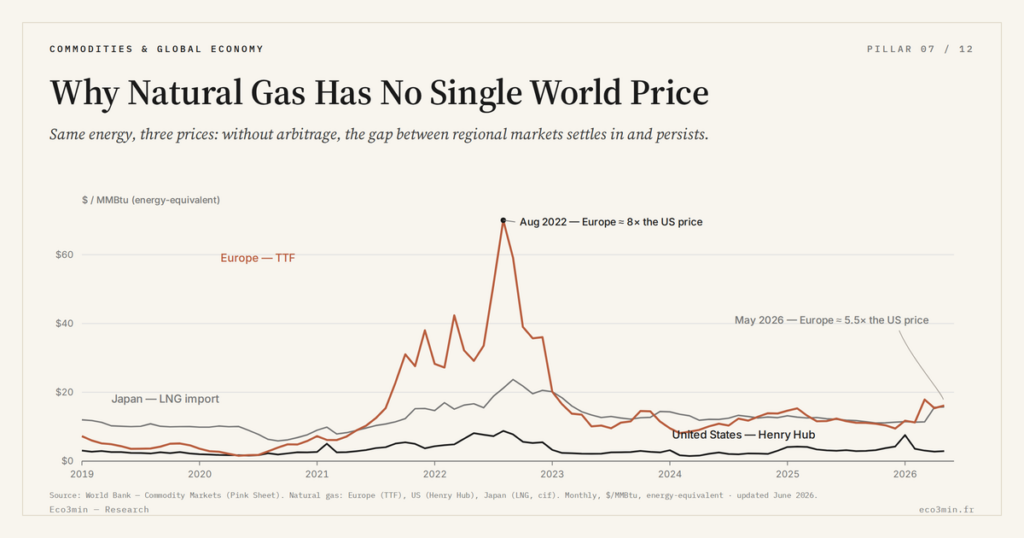
Natural gas has no single world price: its molecule, hard to move from one continent to another, stays captive to regional markets whose prices can diverge for long stretches.
TL;DR
Gas splits into regional markets because its molecule travels only through a costly liquefaction chain, which lets Europe pay several times the US energy price for months at a time.
- Oil holds one world price because a barrel ships easily and arbitrage erases regional gaps; gas does not, since ocean transport requires a costly liquefaction chain.
- The cold chain cools gas to around −160 °C, shrinking its volume roughly six-hundredfold for loading onto LNG carriers, then regasifies it on arrival.
- Three regional benchmarks follow: European TTF as an importer's price, US Henry Hub as a supply-driven price, and Asian JKM tracking LNG cargoes to Japan and South Korea.
Before any reading of gas — price gaps, crisis, geopolitics — one structural fact must be set down: the absence of a world price. Its cause is physical more than financial.
A world price for oil, regional prices for gas
Start with a comparison that illuminates everything else. Oil sells, at any given moment, at a very similar price across the world, once crude quality and freight are accounted for. The reason is simple: a barrel is easy to transport. A tanker is enough to move a cargo from one continent to another, and that mobility acts as a restoring force. As soon as a price gap opens between two regions, cargoes redirect toward the dearer one, pulling prices together. This mechanism — buying where it is cheap to sell where it is expensive — has a name: arbitrage. As long as it can operate freely, it holds a single price in place. A parallel read: Did Expensive Gas Deindustrialize Europe? The Energy-Intensive Sectors at Risk.
Natural gas escapes this logic. At the same moment, the same energy content can cost three or four times more in Europe than in the United States, and the gap can persist for months without closing. Arbitrage, here, works poorly, because moving gas is slow, costly and limited by scarce infrastructure. The spring that equalizes oil prices is, for gas, all but seized. It is this blockage of arbitrage that produces regionalization: unable to circulate freely, gas partitions into largely independent markets.
This difference is no technical footnote. It is the foundation of any analysis of gas, and in particular of the gas market fracture exposed in 2022. The intuition of a “world price of energy,” inherited from oil, does not transfer to gas. Grasping this avoids a common misreading: believing that a low price in one region signals planetary abundance, or that a high price elsewhere reflects a global shortage. The same mechanics are viewed differently in Anatomy of the 2022 Gas Shock: From the Russian Cutoff to Rationing. For gas, each region first tells its own story. Read alongside: the energy channel behind the euro.
The cold chain: liquefying to cross oceans
Why does gas travel so badly? Because in its natural state it occupies an enormous volume for little energy. Moving it by pipeline works on land, but a pipeline does not cross an ocean: it links two fixed points, once and for all. To ship gas across seas, it must be made transportable another way, and that is where an expensive technology comes in.
The solution is called liquefied natural gas, or LNG. The gas is cooled to around −160°C: at that temperature it liquefies and its volume shrinks roughly six-hundredfold. In this compact form it can be loaded onto specialized ships, LNG carriers, fitted with cryogenic tanks that keep the cold during the crossing. On arrival, at a regasification terminal, it is warmed back to gas before injection into the grid. Liquefaction, sea transport, regasification: each link of this cold chain is costly and requires heavy facilities.
This chain explains the essentials. Building a liquefaction terminal means years of construction and tens of billions of investment. The number of carriers in circulation is limited, and each crossing takes weeks. A cargo therefore does not redirect at a click, like a financial trade: it depends on a scarce, inert physical logistics. It is this inertia that keeps arbitrage from operating fully and that sustains price gaps between regions. Where oil moves almost freely, gas advances at the pace of its infrastructure.
Geography adds its own constraint. A region endowed with abundant fields and well connected by pipeline — North America, for instance — lives in relative autonomy. A region that produces little and depends on imports — Europe — is exposed to the availability and price of gas from elsewhere. This geographic asymmetry, combined with the weight of the LNG chain, draws very different market situations from one continent to another. These analyses belong to the broader field of physical markets for oil and gas, where the transport constraint directly shapes prices.
This dependence on infrastructure long confined gas trade to the pipeline, and thus to geographic proximity: one sold to the connected country, rarely beyond. LNG loosened that constraint by opening the sea route, but recently and partially. The gas market is thus living a slow transition, from a world of regional pipes toward global seaborne trade, without having completed the passage. That is why regionalization, though less absolute than before, remains the dominant trait: oceans are still crossed only at the cost of a scarce logistics chain. Refined products carry the same trait within a single country, which is why a gallon of gasoline prices differently in Los Angeles and in New York City.
Three markets, three price benchmarks
A direct consequence of this regionalization: there is not one price of gas, but several, each serving as a benchmark for a major zone. Three dominate commentary and contracts today.
In Europe, the benchmark is TTF, a Dutch virtual trading hub that has become the gauge of continental gas. Because Europe produces little, this price is governed by the availability of external supply, storage levels and competition to attract cargoes. In North America, the benchmark is Henry Hub, quoted in Louisiana, which reflects above all the abundance of US domestic production: it is a supply-driven price. In Asia, finally, JKM measures the cost of LNG cargoes delivered to Japan and South Korea, a peak demand largely covered by long-term contracts, with a spot segment that flares when Asia outbids. For those tracking these levels over time, the US Henry Hub price series and the European TTF quotations offer the history of these two markets.
These three prices are not so independent as to ignore one another entirely. LNG creates a partial link between them: when one region pays markedly more, available cargoes tend to head there, bringing the levels a little closer. But that link stays thin, throttled by transport capacity, so the gaps narrow without vanishing. The mechanics of what partially links the markets deserve their own examination, as does the way of measuring the regional price gap between Europe and the United States. The present piece simply sets the frame: three markets, three prices, loosely linked.
What regionalization makes possible
Once this foundation is in place, a property follows that changes the economic reading of gas: durable price gaps between regions become possible. Where oil erases differences almost instantly through arbitrage, gas lets them settle in. One continent can pay several times more for its energy than another, and do so for months, with no fast mechanism to correct the gap.
It helps to put a figure on the intuition, even loosely. When European gas trades at several times the American benchmark in energy-equivalent terms, an industrial process that uses gas as a major input faces a cost base unlike its overseas competitor’s — not by a few percent, but by a multiple on the energy line. That is what “no world price” means in practice: not an abstraction, but a wedge that can decide whether a given plant is viable on one continent and not on another. The size and persistence of that wedge are questions for separate analysis; the foundational point is only that the wedge can exist at all, which a world-priced commodity rules out.
This possibility reaches beyond the gas market itself. For activities where energy weighs heavily in costs, location ceases to be neutral in energy terms: producing on one side of the ocean or the other does not carry the same price. Regionalization thus turns gas into a factor of differentiation between zones, where a world-priced commodity imposes the same cost on everyone. It is from this conceptual base that the more advanced analyses set out — measuring the gap, its role in industrial competitiveness, its transmission to inflation. All of them assume that one has first accepted there is no single price of gas.
One final point deserves clarifying to avoid a common confusion. The absence of a world price does not mean gas is less “financialized” or less closely watched than oil: TTF and Henry Hub are deep markets, quoted continuously, on which large volumes trade. What separates them is not a market defect but a physical boundary: the difficulty of moving the molecule between zones. One can have highly liquid yet regional markets — which is precisely the case of gas.
One must guard against an excessive reading in the opposite direction. Saying gas has no world price does not mean its markets are wholly disconnected: LNG draws them closer, and the long-term trend runs toward gradual integration as transport capacity expands. Regionalization is strong, but it is not absolute, and it deforms over time. It is a starting point for analysis, not a fixed law.
- Oil has a world price because a barrel is easy to transport and arbitrage erases gaps between regions; gas does not, because its ocean transport requires a costly, slow liquefaction chain.
- This cold chain — liquefaction at around −160°C, LNG carriers, regasification — rests on scarce infrastructure that keeps arbitrage from operating fully and holds markets partitioned.
- Three regional benchmarks follow: European TTF (an importer’s price), US Henry Hub (a supply-driven price) and Asian JKM (LNG cargoes), loosely linked by seaborne flows.
- Regionalization makes durable price gaps between continents possible — the necessary starting point for understanding energy competitiveness, transmission to inflation and gas geopolitics.
Setting down the absence of a world price gives the reading frame without which the rest stays opaque. The gaps between TTF, Henry Hub and JKM are not anomalies to be corrected; they are the normal signature of a market that the physics of transport keeps regional. Everything that follows — measuring those gaps, their cost to industry, their monetary echo — is rooted in this first fact.
Last updated — 10 September 2026
Disclaimer – Financial Information: The analyses, commentary, and content published on eco3min.fr are provided for informational and educational purposes only. They do not constitute investment advice or a solicitation to buy or sell financial instruments. Past performance is not indicative of future results. All investment decisions involve risk and are the sole responsibility of the reader.
Read next
Full pillar →Reading the refinery utilisation rate: the threshold, the season, the turnarounds
A refinery runs full near ninety percent, not a hundred: the last slice of nameplate capacity is a…
IMO 2020: the regulatory shock that rewrote product spreads
An environmental rule on marine sulfur can move a refining spread more than a swing in crude. IMO…
The 2022–2023 refining golden age: anatomy of an episode
In 2022, refined fuel prices climbed faster than crude. That gap, measured by the 3-2-1 crack spread, reached…