
Pay Raise Calculator, Adjusted for Inflation
What a pay raise is worth after inflation
Enter your pay, the raise and the month your pay last changed. The raise is set against the official CPI-U over that period, month by month, up to the latest index published.
Source: U.S. Bureau of Labor Statistics, CPI-U, all items, U.S. city average, not seasonally adjusted (series CUUR0000SA0), read each month from the Eco3min live feed. Observed data only, retrospective and non-predictive: no month after the latest published index can be selected, and nothing is projected. October 2025 was not published by the BLS (2025 lapse in appropriations): it cannot be selected and the CPI-U-tracked pay line skips it. Raise after inflation = (1 + raise) / (1 + inflation) − 1. Pay equivalents use 12 months, 52 weeks and the weekly hours entered, before taxes and deductions. CPI-U-tracked pay is a descriptive benchmark. Eco3min: educational tool, neither advice nor a recommendation.
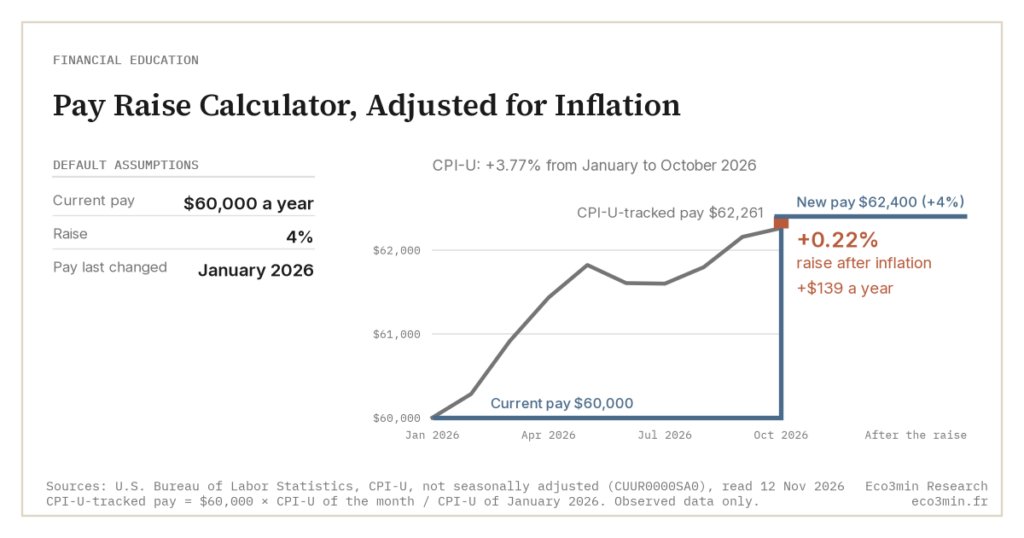
With the CPI-U up 3.77% between January and October 2026, a 4% raise on pay unchanged since January leaves 0.22% of extra purchasing power.
- On $60,000 a year, 4% adds $2,400: $200 a month, $46.15 a week, $1.15 an hour at 40 hours a week.
- Pay that had tracked the Bureau of Labor Statistics index over the same months would stand at $62,261, which is $139 below the new pay.
- The raise after inflation is (1 + raise) / (1 + inflation) − 1, measured from the month pay last changed to the latest published index.
A raise is announced against the old pay. It is spent at current prices. Between the month a salary was last set and the month it moves again, the Consumer Price Index for All Urban Consumers (CPI-U) of the U.S. Bureau of Labor Statistics (BLS) keeps moving. From January 2026 to October 2026, the latest month published, it went from 325.252 to 337.511, a rise of 3.77%. A raise is measured from the last pay change, not from zero. The calculator above runs that arithmetic on the official monthly series.
How the raise is measured
Three inputs drive the result: the current pay, the raise and the month the pay last changed. The raise can be entered as a percentage or as the new pay, and each field updates the other. The raise before inflation is the new pay divided by the old pay, minus one. Inflation over the period is the CPI-U of the latest published month divided by the CPI-U of the month of the last pay change, minus one.
The raise after inflation divides one by the other: (1 + raise) / (1 + inflation) − 1. Subtracting the two rates gives a close figure while both are small and drifts away as they grow. The same formula converts an investment return in the real return after inflation calculator. Applied to pay, it reads the inflation rate from the index, so no assumption is needed.
The table converts every figure into a yearly, monthly, weekly and hourly amount on fixed conventions: 12 months, 52 weeks and the weekly hours entered. At 40 hours a week, a year counts 2,080 paid hours.
A worked example on the October 2026 index
The default case is pay of $60,000 a year, unchanged since January 2026, and a 4% raise. The new pay is $62,400. That is $2,400 more a year, $200 more a month, $46.15 more a week and $1.15 more an hour, from $28.85 to $30.00 at 40 hours a week. Over the same months the CPI-U rose 3.77%, so pay that had tracked the index would stand at $62,261 in October 2026.
The new pay sits $139 a year above that benchmark, the calculator’s CPI-U-tracked pay. As a rate, the raise after inflation comes to 0.22%: nearly all of the 4% restores what prices took since January. With no raise at all, the same $60,000 would buy 3.63% less in October 2026 than in January. Each new monthly index moves these figures, which are the calculator’s default values on the index published in November 2026.
Why the period matters more than the headline rate
The usual reading sets a raise against the twelve-month inflation rate quoted in the news. That comparison answers another question. What a household feels is the price change since its own pay was last set, a span that can be nine months or thirty. The series shows how much the starting month matters. Pay set in April 2024 faced 7.64% of cumulative inflation by October 2026, thirty months later. Pay set in January 2026 faced 3.77%, nine months later.
One month is missing. The BLS series carries no index for October 2025 and flags it “Data unavailable due to the 2025 lapse in appropriations”. The calculator leaves the gap open: October 2025 cannot be selected, the CPI-U-tracked pay line breaks there, and a period that spans it is measured between two published months. A twelve-month comparison ending in October 2026 has no starting index in this series.
Read against zero, a 4% raise looks like 4% more to spend. Prices moved while the pay stood still, so part of the raise only catches up. Set against the CPI-U since the last pay change, the 4% raise in the default example leaves a real gain of 0.22%.
What the calculator leaves out
The CPI-U is a national average. It describes urban consumers as a whole, and a household whose rent, commute or region departs from that average has its own inflation rate, which the index cannot show. The series is not seasonally adjusted: over a period that is not a whole number of years, the result also carries the seasonal pattern of prices. Pay is taken before taxes, benefits and deductions, so the change in take-home pay will differ.
The monthly series behind the tool starts in January 2023, and no month after the latest published index can be selected: the calculator compares observed data and projects nothing. For older comparisons, the US inflation calculator since 1913 works on annual averages. A salary level can be placed against the median and average salary in the US or against US household income percentiles since 1967. More calculators: financial tools and simulators.
Frequently asked questions
How do you calculate a pay raise percentage?
Divide the new pay by the old pay, subtract one and multiply by 100. From $60,000 to $62,400 the raise is 4%. In the other direction, the old pay multiplied by 1.04 gives the new pay.
How is a pay raise adjusted for inflation?
Divide (1 + the raise) by (1 + inflation over the period), then subtract one. With a 4% raise and a 3.77% rise in the CPI-U from January to October 2026, the raise after inflation is 0.22%.
What raise keeps pace with inflation?
The raise that leaves purchasing power unchanged equals the cumulative change in the CPI-U since the pay was last set. From January to October 2026 that is 3.77%, or $62,261 on $60,000 a year. It is a descriptive benchmark: individual price baskets differ from the index.
How much is a 4% raise per hour?
At 40 hours a week, or 2,080 hours a year, $60,000 a year is $28.85 an hour and a 4% raise adds $1.15, to $30.00. The same raise is $46.15 a week, $200 a month and $2,400 a year.
Why is October 2025 missing from the list of months?
The Bureau of Labor Statistics published no CPI-U for October 2025 because of the 2025 lapse in federal appropriations. The calculator does not estimate the missing index: the month cannot be selected, and periods that span it are measured between published months.
Last updated — 17 November 2026
Disclaimer – Financial and Legal Information: The analyses, commentary, and content published on eco3min.fr are provided for informational and educational purposes only. They do not constitute investment advice or a solicitation to buy or sell financial instruments. Past performance is not indicative of future results. All investment decisions involve risk and are the sole responsibility of the reader.
Data, charts and calculated series are provided as is and may contain errors or lag behind their source: check any figure against the primary source cited before relying on it.
Content describing laws, regulations or contracts reflects the law as of its publication date and does not constitute legal or tax advice; applying it to a specific situation requires a qualified legal or tax professional.