Physical Silver, ETFs or Mining Equities: Three Different Exposures

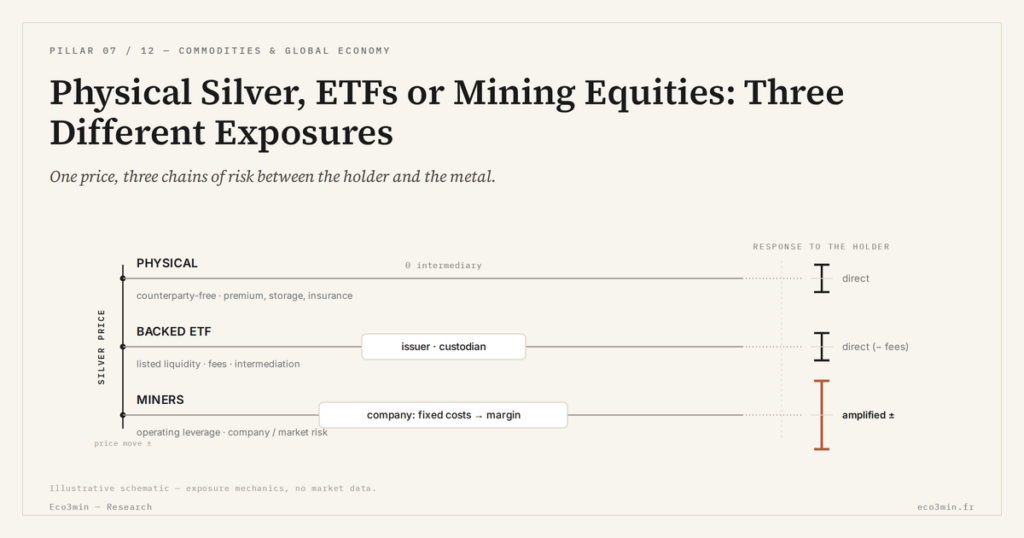
Holding physical silver, a metal-backed ETF, or shares in mining companies is not the same exposure. Each vehicle links the holder to the silver price through a different mechanism, with its own risks.
TL;DR
Physical silver, a backed ETF and mining shares track the same spot price through different chains of risk; the real choice is which chain you are willing to hold.
- Mining shares add operating leverage, since extraction costs are largely fixed: a 10% move in silver can translate into a 20-to-30% move in the share, up and down alike, plus company, jurisdiction and stock-market risk foreign to the metal.
- Physical coins and bars give the most direct, counterparty-free link to spot, but carry dealer premiums, storage and insurance, and a value-to-volume ratio far below gold's that makes silver bulkier to hold by value.
- Backed ETFs deliver the spot price with listed-security liquidity for an annual fee, while the segregated-versus-pooled distinction and, for derivatives products, contango determine what is actually owned.
- A recurring debate notes that the metal claimed by listed products and futures can exceed the readily deliverable physical stock, so in a severe squeeze a claim-holder and a bar-holder may not stand in the same position.
Comparing these three routes is not a matter of preference but of understanding: behind the same commodity, you are not buying the same thing.
1. Physical silver: direct ownership and its constraints
The most immediate form of exposure is holding the metal physically, as coins or bars. The holder then owns the silver outright, with no intermediary and shielded from counterparty risk: it is the purest exposure to the spot price. That purity, however, comes with specific costs and constraints. The purchase price is never the bare “spot” rate: it includes a dealer premium, higher for small coins than for large bars, plus a gap between buying and selling prices. Holding itself requires secure storage, insurance, and carries the risk of theft or loss. Depending on the jurisdiction, taxation — value-added tax, capital-gains treatment — materially changes the real cost. This route directly reflects silver’s investment demand, of which coins and bars are the most tangible channel.
The liquidity of physical silver is also less immediate than that of a listed asset. Reselling bars means going through a dealer, accepting a spread, and sometimes waiting; in periods of strong demand, premiums can spike and delays lengthen, as certain coin-market stress episodes have shown. To these frictions is added a feature specific to silver: its value-to-volume ratio is far lower than gold’s. Storing a given sum’s worth of silver takes up much more space and weighs much more, which raises storage costs and complicates handling. This is one of the concrete reasons behind the poor man’s gold idea: affordable by the unit, physical silver is paradoxically more cumbersome to hold by value.
The form of the metal matters too. Internationally recognised coins resell more easily and at a smaller discount than exotic or non-standard products; large bars carry the lowest premiums but are less divisible on resale. Some holders use segregated vault-storage services, sparing them personal custody while keeping ownership of identified bars — a middle ground between home storage and a listed product, which nonetheless reintroduces fees and a custodian. Each trade-off between premium, divisibility, security and liquidity draws a different holding profile, with no single configuration dominating the others in all circumstances. The same sum can be held as a stack of recognised one-ounce coins, easy to sell piece by piece, or as a single large bar, cheaper to buy but harder to liquidate in part — two profiles suited to different needs, neither inherently superior to the other. A closer look: our guide to gold access routes.
2. ETFs and listed products: exposure to the price without the metal
A second route runs through exchange-listed products, mainly index funds backed by the metal. The largest are physically backed: the fund holds bars in vaults, and the listed share represents a fraction of that stock. The investor then obtains exposure to the spot price without handling the metal, with the liquidity of a continuously tradable security. That convenience has a price: annual management fees that erode performance over time, and the introduction of a layer of intermediation — issuer, depositary, custodian — that creates a counterparty risk absent from direct ownership. The distinction between segregated and pooled metal, that is, between identified bars and a mere claim, is decisive here for understanding what one actually owns. More on this: the questions that actually decide an ETF.
Not all listed products are structurally equal. Some are backed by stored physical metal, others replicate the price through derivatives, which adds counterparty risk and, for products exposed to futures contracts, market-structure effects such as contango. Understanding these mechanics points to physical versus derivatives markets, a distinction central to any commodity index product. In every case, the object tracked remains the silver price, and therefore the gold/silver ratio signal and the forces described earlier; what the vehicle changes is the chain of intermediaries and risks between the holder and the metal.
The exchange mechanics of these funds are worth knowing. Their price tracks the value of the underlying metal through a creation-and-redemption mechanism operated by authorised intermediaries; in normal times, the gap between the listed price and the real value stays minimal. But in periods of stress, that gap can widen, and the product’s apparent liquidity can diverge from that of the underlying physical metal. Added to this is the question of the wrapper’s legal and tax framework — country of domicile, product status, capital-gains treatment — which varies from one product to another and changes the net return actually received. Understanding the wrapper matters as much as understanding the metal it tracks.
One recurring debate sharpens the distinction. Critics of paper silver argue that the volume of metal claimed by listed products and futures can exceed the readily deliverable physical stock, so that in a severe squeeze, holders of a claim and holders of a bar may not be in the same position. Defenders counter that physically-backed funds do hold the bars they represent, and that the difference lies in the fine print of each product rather than in the wrapper as a class. The practical point is the same either way: reading what a given product actually holds, and on what terms, is part of understanding the exposure, not an optional detail.
3. Miners and streaming: a leveraged exposure
The third route is the furthest from the metal itself: buying shares in companies tied to silver. This is no longer exposure to the metal’s price, but to a business whose results depend partly on that price. The central mechanism is operating leverage: a mine’s extraction costs being largely fixed, a rise in the silver price translates into a more-than-proportional increase in margins, and vice versa. A 10% move in the metal can thus produce a 20-to-30% move in the share. But this amplification works both ways, and it comes with company-specific risks: quality of management, jurisdiction and political risk, cost drift, dilution through share issuance, debt. A producer’s share also reflects the wider stock market, independently of silver.
Not all miners offer the same exposure. A company for which silver is only a by-product of copper or zinc dilutes the link to the metal, whereas a primary producer is far more directly exposed. This is where silver’s mine supply and producers and its structure illuminate the real nature of the exposure. Finally, an intermediate profile exists: streaming and royalty companies, which finance mines in exchange for a right to buy future metal at a reduced price. They offer exposure to the price without directly bearing operating costs, which changes their risk profile relative to conventional producers. Whatever the vehicle, the shareholder is exposed to silver’s monetary and industrial duality, but filtered through the fortunes of a business.
The streaming model illustrates this diversity of profiles well. A royalty company advances capital to a miner in exchange for the right to buy part of its future silver output at a pre-agreed, often very low, price. It thus captures the upside without bearing cost overruns or the mine’s operating risks, but it depends on the good execution of the projects it finances. At the other extreme, a primary producer concentrates the leverage but also all the operating risks. Between these poles, the range of exposures is wide, and two “silver” stocks can react very differently to the same move in the metal, depending on each company’s cost structure, jurisdiction and balance sheet. This heterogeneity rules out speaking of a single “mining” exposure: there are almost as many as there are companies.
At bottom, these three routes trace a spectrum from pure ownership to the most indirect exposure. Physical metal offers the most direct link to the price, at the cost of holding constraints; listed products add convenience and liquidity, at the cost of fees and intermediation; shares add leverage and a potential yield, at the cost of business risk and stock-market exposure. Understanding these differences means placing each vehicle within the physical economy of commodities: not seeking the “best”, a notion meaningless in the abstract, but identifying precisely what one is exposed to. The starting question is therefore not which vehicle performs best, but which chain of risks one is willing to hold between oneself and the metal — a question with no universal answer, since each holder’s constraints and time horizon differ.
- Physical silver offers the most direct exposure to the spot price, shielded from counterparty risk, but with premiums, storage, insurance and an unfavourable value-to-volume ratio.
- Backed ETFs replicate the price with the liquidity of a listed security, at the cost of management fees and a layer of intermediation; derivatives-based products add structural effects such as contango.
- Mining shares introduce operating leverage — amplification on the way up and down — together with company, jurisdiction and stock-market risks foreign to the metal.
- The three vehicles are not interchangeable: they link the holder to the same price through distinct chains of risk.
Last updated — 12 July 2026
Disclaimer – Financial Information: The analyses, commentary, and content published on eco3min.fr are provided for informational and educational purposes only. They do not constitute investment advice or a solicitation to buy or sell financial instruments. Past performance is not indicative of future results. All investment decisions involve risk and are the sole responsibility of the reader.
Read next
Full pillar →Reading the refinery utilisation rate: the threshold, the season, the turnarounds
A refinery runs full near ninety percent, not a hundred: the last slice of nameplate capacity is a…
IMO 2020: the regulatory shock that rewrote product spreads
An environmental rule on marine sulfur can move a refining spread more than a swing in crude. IMO…
The 2022–2023 refining golden age: anatomy of an episode
In 2022, refined fuel prices climbed faster than crude. That gap, measured by the 3-2-1 crack spread, reached…