
Red Sea Tensions: Why Global Trade Remains Vulnerable
Red Sea tensions are reviving concerns over global maritime routes. Without an immediate brutal shock, this strategic corridor concentrates fragilities capable of weighing durably on logistics chains, costs and inflation.

TL;DR
Red Sea tensions raise Asia-Europe trade costs through accumulating friction (insurance premiums, route diversions, delivery delays) that a still-elevated rate backdrop transmits faster into final prices and margins: Suez is running at 41 transits a day against 74 in 2023 (−45%, IMF PortWatch, Aug 2025-Aug 2026).
- The corridor links the Indian Ocean to the Mediterranean through the Suez Canal, concentrating a large share of Asia-Europe manufactured and intermediate-goods flows in a single passage.
- The same disruption bites harder than in past cycles: elevated rates raise the cost of capital tied up in inventories, while compressed industrial margins leave firms less room to absorb intermediate shocks.
Red Sea tensions have returned to the front of the geopolitical agenda, reviving concerns over the security of global maritime routes. Without producing an immediate brutal shock, this strategic zone today concentrates several fragilities capable of weighing durably on international trade. On the same theme: how systemic stress builds beneath the surface.
In a world marked by higher interest rates, strained logistics chains and a fragmented geopolitical landscape, these tensions act as a revealer. They serve as a reminder that globalization remains dependent on a handful of critical chokepoints.
These Red Sea tensions are not an isolated episode; they fit within a broader sequence of geopolitical reconfigurations, logistical vulnerabilities and macroeconomic constraints, examined within the framework of macroeconomics and geopolitics, which now condition the fluidity of global trade and the transmission of economic shocks.
Why the Red Sea is a strategic maritime route
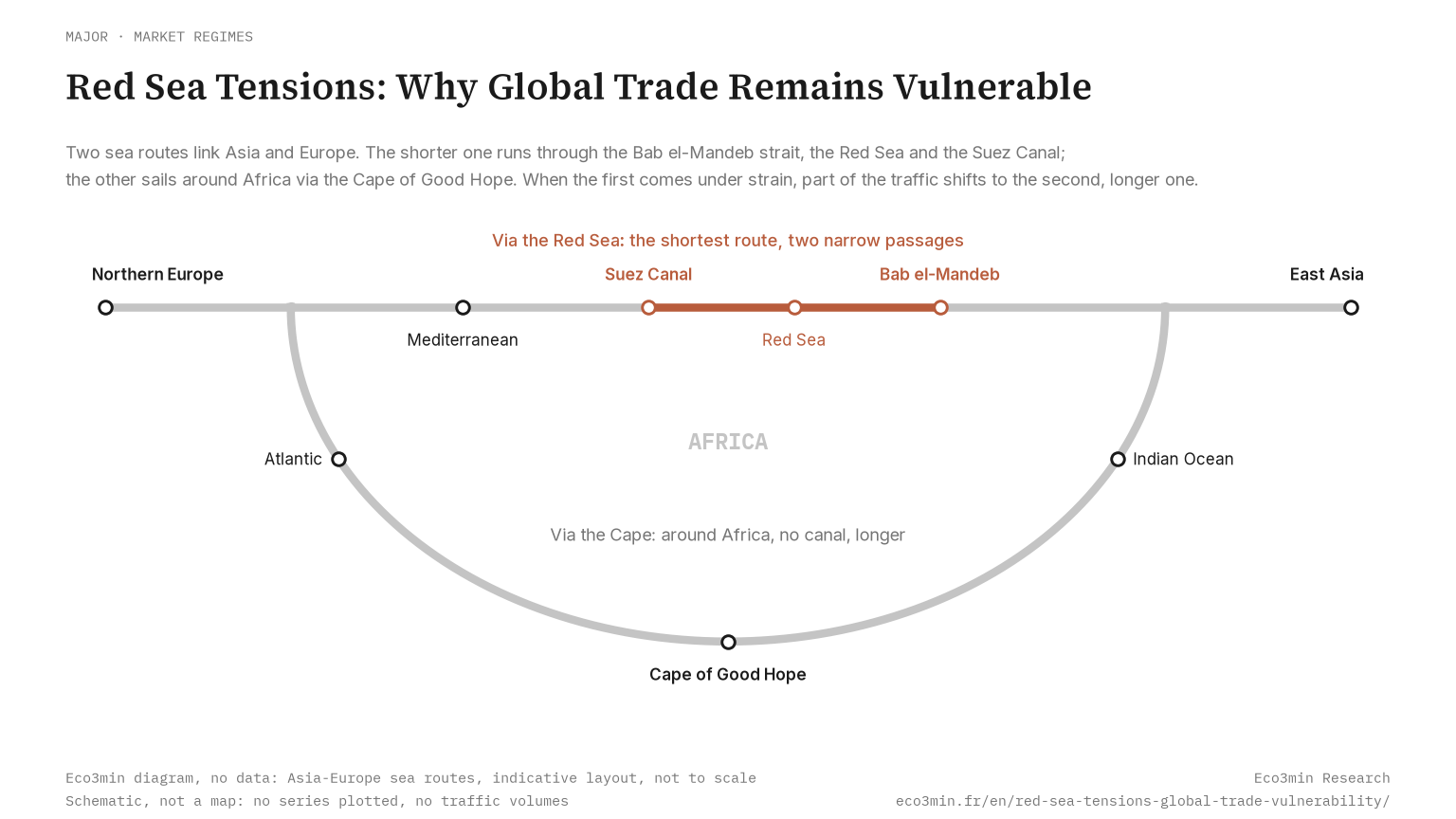
The Red Sea connects the Indian Ocean to the Mediterranean via the Suez Canal. It is one of the major axes of global trade, particularly for Asia–Europe flows. A significant share of manufactured goods, industrial components and intermediate products transits through it each year.
This concentration makes the zone structurally vulnerable: any disruption, even a limited one, can produce delays and additional costs — a mechanism that connects with our framework on the hidden tensions in markets and a reorganization of supply chains.
Geopolitical tensions without a complete blockage… for now
Unlike past logistical crises, the current Red Sea tensions do not translate into a complete shutdown of maritime routes. Flows continue, but under increased constraints: rising insurance premiums, partial route diversions and longer delivery times. Transit data measure it: between January-November 2023 and August 2025-August 2026, the Suez Canal went from 74 to 41 transits a day (−45%, container ships −54%), while the Cape of Good Hope rose from 49 to 91 (+87%). Trade is not blocked; it sails around Africa (IMF PortWatch, daily AIS transit calls, retrieved 20 Sept 2026).
This kind of disruption is often underestimated, because it produces no spectacular rupture. Yet within an already strained economic environment, such friction can produce significant cumulative effects.
For a deeper analysis of the logistical, inflationary and financial mechanisms tied to this key zone, see the reference article:
Red Sea corridor: a discreet geopolitical risk for global trade
Why these tensions weigh more today than in the past
The same logistical disruptions do not produce the same impact across different macroeconomic backdrops. In 2026, several factors are still amplifying the effects of Red Sea tensions:
- higher interest rates, which raise the cost of capital tied up in inventories;
- industrial margins that are already under pressure;
- a reduced corporate capacity to absorb intermediate shocks.
Within this framework, even a moderate increase in delivery times or logistical costs is transmitted more rapidly into final prices or corporate earnings.
Global trade: a diffuse but structural risk
Red Sea tensions illustrate a broader shift: global trade is becoming less fluid and more exposed to geopolitical uncertainty. The issue is not necessarily a brutal shock, but a progressive degradation of the conditions under which goods circulate.
For companies and investors alike, the question is not whether to anticipate an immediate crisis but how to integrate this kind of risk — a framing consistent with our reading of market regimes in medium-term decisions, whether on asset allocation, industrial strategy or inventory management.
The takeaway
Red Sea tensions are a reminder that global trade remains dependent on narrow and fragile corridors. Without producing a spectacular rupture, they can durably weigh on costs, delivery times and economic visibility.
Understanding these mechanisms helps in better grasping the macroeconomic risks ahead and avoiding an overly optimistic reading of a globalization that has become more constrained.
Last updated — 1 October 2026
Disclaimer – Financial and Legal Information: The analyses, commentary, and content published on eco3min.fr are provided for informational and educational purposes only. They do not constitute investment advice or a solicitation to buy or sell financial instruments. Past performance is not indicative of future results. All investment decisions involve risk and are the sole responsibility of the reader. Data, charts and calculated series are provided as is and may contain errors or lag behind their source: check any figure against the primary source cited before relying on it. Content describing laws, regulations or contracts reflects the law as of its publication date and does not constitute legal or tax advice; applying it to a specific situation requires a qualified legal or tax professional.
Read next
Full pillar →Weak or Strong Euro: Imported Inflation and Competitiveness
The euro's level acts on the area's economy through two opposing channels: it changes the price of imports,…
How to Read EUR/USD: What Moves a Currency Pair
EUR/USD is the price of one euro expressed in dollars: when it reads 1.14, one euro trades for…
Euro Below Parity in 2022: What Parity Means
In September 2022, the euro fell below parity with the dollar, to around 0.95, a low not seen…