DTWEXBGS: Long-Term Strong and Weak Dollar Cycles 1973-2026

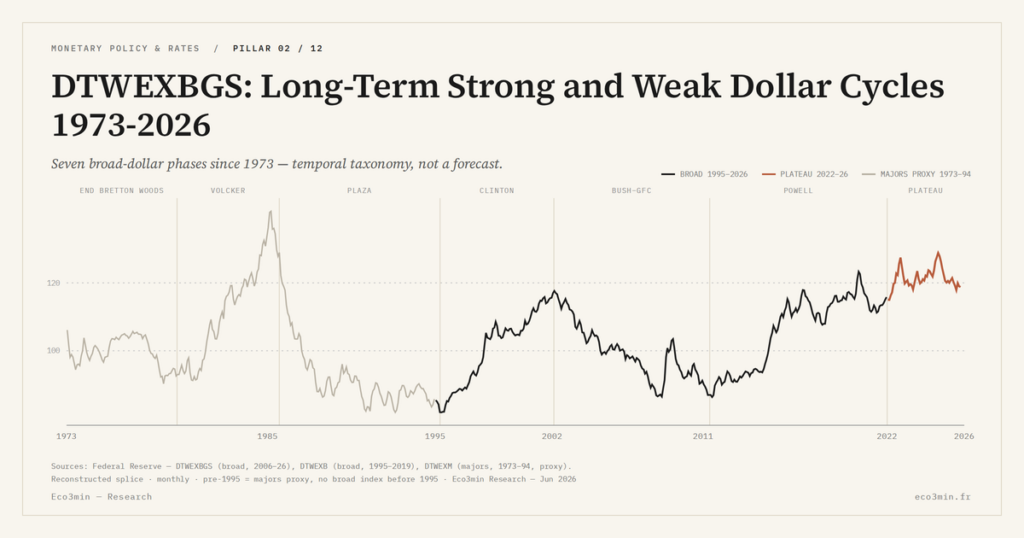
DTWEXBGS, reconstructed through pre-2019 Fed series, has cycled through seven distinct phases since 1973. Volcker, Plaza Accord, Clinton, GFC, Powell 2022: the temporal taxonomy structures any comparative reading.
TL;DR
The reconstructed broad dollar's upswings ran seven to eleven years and its declines three to six, an asymmetry now strained by a plateau holding above 118 for twenty-eight months.
- The Plaza Accord of September 22, 1985 pulled the broad dollar from ~127 to ~95 within eighteen months, a coordinated G5 depreciation of about -25%.
- From the May 2011 trough at ~85, the long Powell cycle ran eleven years to a +425-basis-point surge between March and December 2022, peaking near ~129.
This piece maps the seven cycles. It says nothing about their consequences — for the empirical audit of associated crises, Eco3min publishes a separate dataset study.
Since the collapse of Bretton Woods in March 1973, the broad dollar has traced a wide historical band. Trough around ~80 (post-Plaza 1995, post-GFC 2011), absolute peak at ~129 (September 2022). DTWEXBGS in its official form dates to January 2019, but earlier Fed series (DTWEXB notably) allow reconstruction of the 1973-2018 trajectory with acceptable methodological homogeneity. To situate this chronology in its analytical frame, see DTWEXBGS as an analytical instrument and more broadly the perspective of the dollar and global monetary architecture.
1973-1985 — end of Bretton Woods and Volcker peak
The first phase spans the decade following the end of fixed-exchange-rate regimes. Between 1973 and 1979, the reconstructed broad dollar oscillates around ~95-100, in a still-disorganized floating regime. The dual oil crisis (1973-1974, then 1979) and double-digit U.S. inflation weigh on the currency. Companion study: the anatomy of the dollar shortage regime.
The pivot comes in August 1979 with Paul Volcker’s appointment as Fed Chair. According to FRED data (Federal Funds Rate, DFF series), the Fed Funds rate is raised from 11% in August 1979 to a peak of 20% in June 1981. The real-rate differential becomes massive. The broad dollar gains more than 35% between 1980 and March 1985, peaking at a reconstructed equivalent of approximately ~127. The Volcker peak remains the fastest documented rise on the broad index — comparable in intensity only to the Powell 2021-2022 cycle. The historical parallel is detailed in the 1979-1982 Volcker shock. The taxonomy of crises associated with these phases is documented in the historical audit of crises tied to broad-dollar strength. Adjacent reading: the drivers of the EUR/USD exchange rate.
1985-1995 — Plaza Accord and managed weakness
On September 22, 1985, the G5 finance ministers and central bank governors — United States, Japan, Germany, France, United Kingdom — signed at the Plaza Hotel in New York a coordinated agreement to weaken the dollar. The intervention is massive: between September 1985 and end-1986, G5 central banks collectively sold tens of billions of dollars on FX markets. The broad dollar falls from ~127 to ~95 in eighteen months — cumulative depreciation of approximately -25%. The corresponding analytical frame is set out in our reading of the dollar as a systemic pivot.
The weakness phase then extends to the mid-1990s. Intermediate peaks remain contained. The trough is reached in April 1995 at a reconstructed level around ~80 — the lowest value ever touched by the broad index. This decade of weakness coincides with European convergence preparing for the euro, the industrial rise of Japan, and China’s gradual emergence in global trade. The transmission of these cycles to emerging economies is documented in the transmission of dollar cycles to emerging markets.
1995-2011 — Clinton cycle followed by Bush-GFC weakening
From 1995 to 2002, the broad dollar rises continuously. The Clinton-Greenspan cycle combines several factors: federal budget surplus 1998-2001, accelerated productivity carried by the first Internet wave, U.S. growth differential against a deflationary Japan. The broad dollar moves from ~80 in April 1995 to a peak of ~111 in February 2002 — cumulative appreciation of approximately +39% over seven years. The 1997 Asian crisis and the 1998 Russian crisis accelerate safe-haven flows toward the dollar. Eco3min’s map of historical market crises gathers these episodes.
The reversal occurs in 2002 with the dot-com bust and the dual Bush presidency, which accumulates fiscal deficit and the cost of military commitments in Iraq. The broad dollar drops from ~111 in 2002 to ~88 by July 2008. The 2008-2009 Great Recession produces a counter-cyclical safe-haven rebound typical of refuge assets: reconstructed DTWEXBGS briefly rises to ~104 in March 2009 before falling back to ~85 in May 2011 — its second historical trough. The Fed’s quantitative easing programs (QE1, QE2) weigh on the currency.
2011-2022 — long Powell cycle to the absolute peak
The fourth phase is the longest documented on the broad index: eleven years of continuous rise, punctuated by plateaus but without major reversal. The starting point is the May 2011 trough at ~85. The first rising sub-phase (2011-2014) accompanies the May 2013 taper tantrum, which marks the return of U.S. monetary normalization expectations. Reconstructed DTWEXBGS rises to ~100 by end-2014.
Between 2014 and 2019, the index plateaus between ~108 and ~115 in a Fed/ECB divergence configuration. The Trump presidency and the 2018-2019 tariff policies maintain pressure. COVID triggers a temporary plunge in March 2020 (~115 → ~110) before a sharp rebound tied to dollar safe-haven flows. But it is the Fed 2022 hiking cycle that pushes the index to its absolute peak: +425 basis points between March and December 2022, and a DTWEXBGS reaching ~129 in September 2022 — a level never touched in the reconstructed series since 1973.
2022-2026 — the persistent plateau
The current cycle constitutes an observable anomaly. DTWEXBGS has retreated from ~129 (September 2022 peak) to ~119-122 in May 2026 — compression of approximately -6% over forty-four months. According to FRED data (Federal Funds Rate, DFF series), the Federal Reserve has cumulated -100 basis points of cuts since September 2024. Classical interest-rate parity predicted faster depreciation. Related reading: DTWEXBGS and de-dollarization: narrative versus reserve flows.
The plateau sets in at a historically very elevated level. Twenty-eight consecutive months above 118 — a persistence not seen since the Volcker phase. Three competing hypotheses feed the analytical reading of the paradox, without any having received exclusive empirical validation. The distinctive features of the 2024-2026 cycle deserve separate treatment detailing each of the three hypotheses.
Transversal reading of the seven cycles
Four transversal observations emerge from the reconstructed chronology. First, DTWEXBGS peaks and troughs are not synchronous with those of the DXY: the emerging-market window built into the broad index introduces phase lags. Second, strong-dollar phases tend to last longer than weak-dollar phases — seven to eleven years for upswings, three to six years for the post-Plaza and post-GFC declines. Third, broad-dollar pivots coincide more often with U.S. monetary-policy ruptures than with external shocks. Fourth, the current peak at ~129 and the plateau above 118 for twenty-eight months constitute a configuration without modern equivalent. This point is put in perspective in the gold price set against the euro, yen and pound.
For a complementary reading of asset-class behavior across the broad-dollar phases, see the analysis of the worst broad-dollar first-halves since 1973. None of the seven phases has produced identical financial-asset behavior — temporal taxonomy remains a starting point, not a universal grid.
- Seven DTWEXBGS phases reconstructed since 1973: Volcker (1979-1985), Plaza (1985-1995), Clinton (1995-2002), Bush-GFC (2002-2011), long Powell (2011-2022), absolute peak September 2022, persistent plateau 2022-2026.
- Absolute peak at ~129 in September 2022, historical trough at ~80 in April 1995. Fifty-three-year historical band: ~80 to ~129.
- Rising phases typically last seven to eleven years, declining phases three to six years — asymmetry observed across the full record.
- The current plateau above 118 for twenty-eight consecutive months, despite a cumulative -100 bp of Fed cuts since September 2024, constitutes a configuration without modern equivalent in the reconstructed series.
Last updated — 12 July 2026
Disclaimer – Financial Information: The analyses, commentary, and content published on eco3min.fr are provided for informational and educational purposes only. They do not constitute investment advice or a solicitation to buy or sell financial instruments. Past performance is not indicative of future results. All investment decisions involve risk and are the sole responsibility of the reader.
Read next
Full pillar →Real Rates: The True Cost of Capital Is Repricing
Why real rates are reasserting themselves as markets' anchor and how to recalibrate investment and financing decisions facing…
Real Interest Rates: The Quiet Signal Reshaping Markets
Real interest rates: why their persistence in positive territory in 2026 is reshaping the rules for bonds, equities,…
OAT-Bund Spread: A Quiet Gauge of French Sovereign Risk
OAT-Bund spread: how this yield gap has become a key signal on French sovereign risk, fiscal policy and…