Why Regulation Reshapes Crypto Markets Without Erasing Them
Regulation does not eliminate crypto-assets but reshapes their structure, actors and market dynamics. An economic analysis of the durable transformation underway.

Analysis of the economic functions of money and the structural limits crypto-assets face in fulfilling them durably.
TL;DR
Crypto-assets satisfy money's three classic functions (unit of account, medium of exchange, store of value) only marginally, because monetary status depends on stabilized collective use and institutional backing.
- As a unit of account, crypto use stays marginal: prices, wages and contracts remain denominated in state currencies, and crypto payments usually rest on implicit conversion from a reference currency.
- As a medium of exchange, crypto liquidity is fragmented and cycle-sensitive: in 2025 several major crypto-assets ran daily volumes ≈30% to 50% below their 2021–2022 peaks despite unchanged infrastructure.
- As a store of value, 2022–2025 annualized crypto volatility ran ≈3 to 5 times that of major currencies, and without stable transactional demand programmed scarcity amplifies cycles rather than anchoring value.
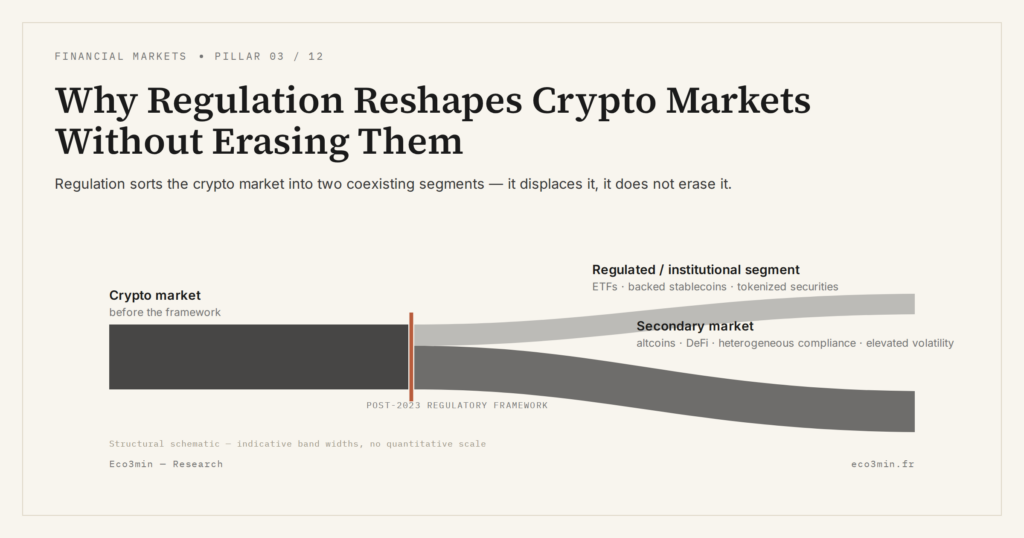
- Regulation since 2024 has acted mainly on intermediaries, compliance and market access, sharpening the line between regulated payment assets and crypto held for financial purposes without creating monetary uses.
The rapid rise of crypto-assets has sustained a persistent confusion between technological innovation and economic status. Being digital, decentralized or tradable is not enough to confer a monetary function. A currency rests on stabilized uses and collective conventions that go well beyond the simple transfer of value. Equating any tradable asset with a currency leads to flawed readings of its uses and value. Clarifying this distinction makes it easier to grasp the actual place of crypto-assets in the economy and in finance. Related reading: Our study on what crypto regulation changes and what it does not.
What prices imperfectly incorporate today is less the technology than the economic role actually played. The monetary normalization underway since late 2024 has made more visible the gap between assets carrying monetary functions and assets dependent on financial liquidity. These gaps fit within a broader movement documented in our analysis of rising rates and their impact on financial markets.
In classical economic analysis, a currency fulfills three inseparable functions: unit of account, medium of exchange and store of value. These functions do not stem from a protocol, but from durable collective adoption supported by legal, fiscal and institutional frameworks. The stability of these uses is central: a currency is used because every participant anticipates that others will use it tomorrow.
The majority of crypto-assets fail at this first criterion. Their use as a unit of account remains marginal: prices, wages and contracts continue to be denominated in state-issued currencies. Even when crypto payments are possible, they almost always rest on an implicit conversion from a reference currency.
Medium of exchange: occasional liquidity vs. generalized acceptance
Part of the consensus assumes that high liquidity is enough to confer monetary status. This reading conflates market depth with economic acceptance. In practice, the liquidity of crypto-assets is fragmented, concentrated on specific platforms and highly sensitive to financial cycles. Because those platforms sit in different jurisdictions, the applicable rulebook changes with the venue, which is the starting point of the divergence of securities regulation across jurisdictions.
In 2025, several major crypto-assets posted daily volumes ≈30% to 50% below their 2021–2022 peaks, despite unchanged technical infrastructure. This suggests that exchange capacity depends primarily on global liquidity conditions rather than on autonomous transactional usage.
By contrast, state-issued currencies retain their function as a medium of exchange even during stress periods, precisely because they are backed by payment systems, fiscal obligations and public balance sheets.
Store of value: relative stability vs. endogenous volatility
Store of value does not mean absence of fluctuations, but relative predictability over usual economic horizons. Yet most crypto-assets exhibit structurally elevated volatility, linked to the absence of stabilizing economic flows.
Between 2022 and 2025, annualized volatility of many crypto-assets remained ≈3 to 5 times higher than that of major currencies. This instability mechanically limits their use as a vehicle for savings or deferred contracts.
This structural instability sheds light on why crypto markets alternate between phases of rapid euphoria and abrupt corrections, with cycles more violent than those observed on traditional equity markets, as detailed in the analysis of crypto cycles compared with equities.
The central scenario advanced by some actors rests on the idea that programmed scarcity will eventually anchor value. This hypothesis overlooks a key point: without stable transactional demand, scarcity acts as a cycle amplifier, not as a monetary foundation.
The logic of programmed scarcity, often presented as a value-anchoring mechanism, in fact tends to amplify expansion and contraction phases when economic uses remain marginal — a point developed in the analysis of programmed scarcity in crypto-assets.
What regulation reveals without transforming monetary nature
A widespread reading sees in regulation a step toward monetary recognition. In reality, legal frameworks act mainly on intermediaries, compliance and market access. They clarify rules of holding and circulation, without thereby creating monetary uses. The same holding-and-circulation logic shows up, more sharply, in the US rules framing stablecoin issuers.
Regulatory developments observed since 2024 have rather reinforced the distinction between regulated payment assets and crypto-assets with financial purposes. This point sheds light on the transformation of crypto markets analyzed in the economic and financial framework of crypto-assets, where the issue centers on market structure rather than monetary function.
Why the confusion persists in public debate
The confusion between currency and tradable asset is partly explained by language. The very term “crypto-currency” sustains the idea of a functional equivalent. Yet historically, many assets have circulated without ever becoming currencies: debt instruments, private notes, indexed financial instruments.
What many readers are seeking here is to understand whether technology alone is enough to replace existing monetary frameworks. The reality observed suggests that monetary function depends less on innovation than on institutional and fiscal integration.
What the consensus assumes… and what it underestimates
The central scenario adopted by many actors assumes that with adoption and maturity, crypto-assets will converge toward monetary uses. This trajectory rests on the assumption of value stabilization and generalized payment use.
The analysis diverges on a precise mechanism: as long as crypto-assets remain held primarily for their financial potential rather than to settle recurring economic obligations, their monetary function will remain marginal. The issue is not transaction speed, but the nature of usage.
Variables that could shift the current reading
A change in fiscal frameworks, explicit integration into public payment systems, or the emergence of large-scale contractual uses could shift this reading. Conversely, prolonged tightening of monetary conditions or increased regulatory fragmentation would reinforce the distinction between currencies and crypto-assets. Fragmentation has a map, and the places it has favoured are set out in the concentration of crypto activity in Singapore, the UAE and Switzerland.
In a macro context marked by policy rates still close to ≈4%–5% in early 2026, the absence of intrinsic yield amplifies the unfavorable comparison with traditional monetary instruments.
Equating the ability to trade an asset with a monetary function leads to ignoring the central role of collective use, taxation and recurring economic obligations.
A currency is defined by stabilized uses and institutional constraints, not by the mere technical capacity to transfer value.
Observable economic implications
For firms, the non-monetary status of crypto-assets limits their use as a billing unit and complicates currency-risk management. For households, it reinforces the trade-off between stable monetary instruments and volatile financial assets. For markets, this distinction explains the strong sensitivity of crypto-assets to global liquidity cycles.
A relevant indicator remains the share of crypto transactions unrelated to financial trading, expressed relative to total market capitalization. As long as this ratio stays marginal, the monetary function remains theoretical.
- Money rests on collective and institutional uses, not on technology alone.
- Financial liquidity is not the same as generalized monetary acceptance.
- Without stable usage, scarcity and innovation amplify cycles rather than anchor value.
This is not the central scenario today, but a deep transformation of usage could shift this diagnosis. As things stand, most crypto-assets remain financial instruments, integrated into macro-financial cycles, far more than currencies in the strict economic sense.
- Confusing payment innovation with monetary function blurs the reading of crypto cycles.
- Stability of usage matters more than technological sophistication.
- The currency-versus-asset distinction remains central to interpreting observed volatility.
Last updated — 29 August 2026
Disclaimer – Financial Information: The analyses, commentary, and content published on eco3min.fr are provided for informational and educational purposes only. They do not constitute investment advice or a solicitation to buy or sell financial instruments. Past performance is not indicative of future results. All investment decisions involve risk and are the sole responsibility of the reader.
Read next
Full pillar →Crypto Seasonality: Why the Signal Is Weaker Than It Looks
Crypto’s cyclical regularities, monthly seasonality or the four-year cycle, rest on a very small number of observations. That…
Bitcoin Halving: How the Programmed Supply Cut Works
The halving writes bitcoin’s scarcity into an immutable rule, applied without exception since 2012. It shapes the pace…
Crypto Cycles: Why Their Amplitude Dwarfs Equity Swings
Crypto cycles post drawdowns two to four times deeper than equity markets. The asymmetry stems from market microstructure,…