Gold Demand Composition: Jewellery, Investment, Central Banks

Gold demand is no homogeneous aggregate: it brings together jewellery, investment in bars, coins and exchange-traded funds, central-bank purchases and technological use, components with opposite drivers that a single figure conceals.
TL;DR
Four components with opposite price sensitivities structure gold demand: jewellery that retreats as the metal grows dearer, official purchases and technology that barely react, and pro-cyclical investment.
- Jewellery captures the volume-value gap: after several quarters of double-digit volume declines, global jewellery spending rose about 18% in 2025 to a record near $172 billion.
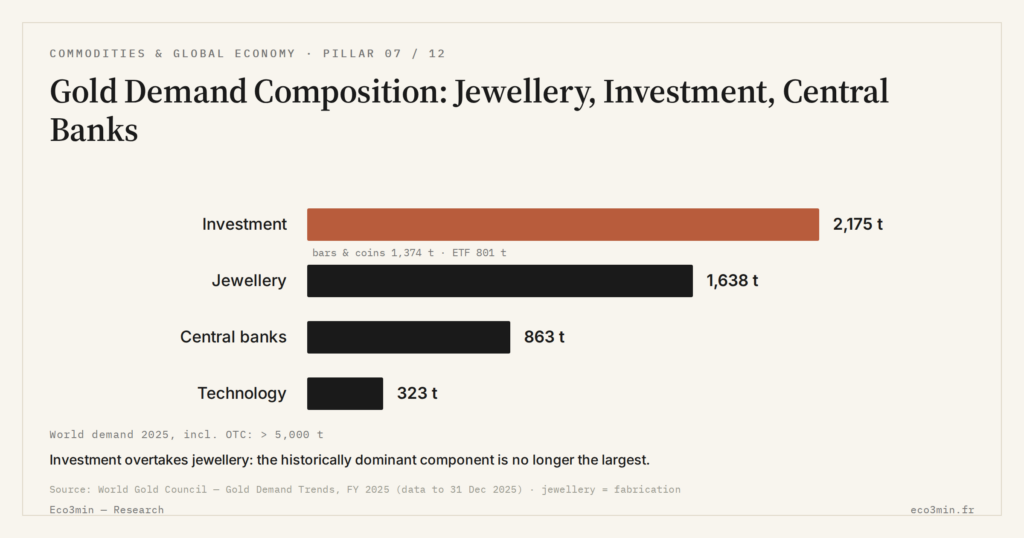
- Investment carried the year: bars and coins at a twelve-year high around 1,370 tonnes, US listed-fund holdings at a record near 2,020 tonnes, and investment value more than doubling beyond $240 billion.
- Central banks bought 863 tonnes net in 2025, below the more than 1,000 tonnes of 2022-2024 but close to double the 2010-2021 average of around 470 tonnes.
- The recomposition since 2024 lowered the whole market's price sensitivity: as inelastic investment and official purchases gain weight against jewellery, total demand collapses less readily when the price climbs.
Decomposing this demand illuminates why the same high price can push one segment down while another rises, and why its structure has shifted profoundly since 2024.
One demand, several components
Speaking of «gold demand» as a single block leads to misreadings. In 2025, world demand topped 5,000 tonnes, over a year marked by 53 price records and an average price of some $3,430 an ounce. But this total covers divergent moves: it was pulled by investment, while jewellery, its historically dominant component by volume, retreated.
Four broad components of flow demand are conventionally distinguished: jewellery, physical and financial investment, official central-bank purchases and technology. Each follows its own logic, and their sensitivity to price differs radically. It is this heterogeneity that makes gold at the core of reserves a market hard to sum up in one aggregate.
One clarification is needed at the outset: this breakdown concerns annual demand, that is, flows, not the distribution of the above-ground stock accumulated over centuries. The two readings complement each other but do not coincide, the first describing what is bought each year, the second what is held.
To these four components is added a less visible channel: over-the-counter transactions and off-exchange flows, often grouped under the term OTC purchases. It is by including them that total demand exceeded 5,000 tonnes in 2025. These flows, the work of wealthy or institutional investors, partly escape the classic sector statistics, but weigh in the market’s balance.
Jewellery, sensitive to price
Jewellery long formed the leading source of demand by volume. It is also the most price-sensitive: when the metal grows dearer, households opt for lighter pieces or defer their purchases. In 2025, jewellery volumes strung together several quarters of double-digit decline, a direct consequence of the succession of records.
One paradox is worth noting, however: while volume fell, the value of jewellery demand rose. Over the year, global jewellery spending increased by about 18% to a record on the order of $172 billion. Consumers purchase fewer grams but spend more, a sign of an intact attachment to value, distinct from consumption by weight.
This price elasticity is read sharply in Asian physical demand, where China and India saw their jewellery retreat in 2025 in favour of investment. Jewellery thus acts as the adjustment segment of demand: it absorbs part of the price shock where the other components hold firm.
The very boundary of jewellery is shifting. In China, very-high-purity jewellery, close to investment gold in its content, supported demand where traditional adornment retreated. This shift blurs the line between ornament and investment: the same purchase can belong to decorative use and to store of value, which complicates reading jewellery volumes alone.
Investment: bars, coins and exchange-traded funds
Investment was the engine of 2025. It covers two forms: the physical holding of bars and coins, and gold-backed exchange-traded funds, which hold metal on behalf of investors. Bar and coin demand reached a twelve-year high, on the order of 1,370 tonnes, while exchange-traded funds added some 800 tonnes to their holdings, their strongest growth in years. Related analysis: the gap between bullion and miners.
In the United States, this move was spectacular: listed funds absorbed the bulk of demand, lifting their holdings to a record near 2,020 tonnes. In all, the value of gold investment more than doubled over the year, exceeding $240 billion. Unlike jewellery, this component is pro-cyclical: it tends to grow with the price, in a loop where the rise attracts fresh flows.
The distinction between physical bar and exchange-traded fund is not neutral. The first ties up metal held outright; the second offers liquid exposure, more responsive to market moves. Together, they form an investment demand more volatile than the others, capable of amplifying cycles on the way up as on the way down.
The mechanism of exchange-traded funds deserves a clarification. These funds hold physical metal in vaults on behalf of their holders: an inflow of capital therefore translates into a real purchase of gold. In 2025, after several years of outflows, it was mainly North American funds that led the rebound, in a dynamic where the price rise fed the inflows, which in turn fed the rise. On the same theme: energy and critical minerals seen as physical markets.
Regulatory developments have, moreover, widened the pool of investment. In 2025, the authorisation given to Chinese insurers to participate in the gold market opened a potentially durable source of demand, anchored in long-term institutional investors. Such structural measures act less on the immediate cycle than on the demand base of the years ahead.
Central banks, strategic demand
The fourth component has transformed the market in recent years: central-bank purchases. In 2025, their net acquisitions reached 863 tonnes. This level, down from the more than 1,000 tonnes of the 2022 to 2024 years, remains close to double the average seen between 2010 and 2021, on the order of 470 tonnes.
This demand stands out for its relative insensitivity to price. Where the jeweller or investor reacts to the price, the central bank buys for strategic motives: reserve diversification, reduced dependence on the dollar, geopolitical protection. Official reserve accumulation thus installs a demand floor largely independent of market fluctuations, driven above all by emerging economies. In the same vein: our study on gold, real yields and the dollar.
It is this component that contributed most to changing gold’s regime, by adding to private demand a structural and inelastic buyer. Its relative slowdown in 2025 did not reverse the trend: official demand remains a pillar of the market, distinct in nature from the other segments.
The change in central banks’ status deserves emphasis. Net sellers of gold until the early 2010s, they have since become structural buyers. In 2025, around twenty institutions raised their reserves by at least a tonne, and sector surveys indicate that emerging-market banks intend to continue. This demand is part of an underlying trend, not an isolated episode.
Technology and what the composition reveals
Technology forms the most discreet component. Gold is used there for its conductivity and resistance, in electronics and certain medical uses. This demand, modest in volume and relatively stable, held up in 2025 despite the high price, supported by the growth of artificial-intelligence applications: the metal is hard to substitute there, which makes it little sensitive to cost.
Put end to end, this composition tells of a clear shift. Gold demand moved from a structure dominated by jewellery to one carried by investment and official purchases, two segments less sensitive, even pro-cyclical, to price. This slide explains why gold could rise even as its traditional component, adornment, retreated in volume. Its silver counterpart is developed in how global silver demand splits between its main uses.
This recomposed demand meets the rigidity of mine supply: it is from the confrontation between a near-fixed output and a demand whose nature has changed that the price is born. Placed within the geoeconomic frame of resources, the composition of gold demand appears as the indispensable grid for reading a market that no single figure sums up.
A useful way to recapitulate is to rank the components by their sensitivity to price. At one end, jewellery, which retreats when the metal grows dearer; at the other, technology and official purchases, little reactive to the price; in the middle, investment, pro-cyclical, intensifying with the rise. It is each segment’s position on this spectrum that determines its reaction to the same price.
This grid has a concrete reach. As the inelastic components, official demand and investment, gain weight against price-sensitive jewellery, total demand becomes less likely to collapse under the effect of a high price. The recomposition observed since 2024 thus alters not only the level of demand, but also its responsiveness to price.
One cross-cutting thread, finally, runs through these components: the gap between volume and value. In jewellery as in investment, tonnage has often understated the real economic weight, value rising on the back of the price. Reading gold demand through tonnes alone, without value, thus amounts to ignoring part of what the market expresses.
- Gold demand brings together four components with opposite drivers: price-sensitive jewellery, pro-cyclical investment, strategic official purchases, price-insensitive technology.
- In 2025, investment pulled demand, exchange-traded funds in the lead (about 800 tonnes added), while jewellery fell in volume but rose in value.
- Central banks bought 863 tonnes, below earlier records but close to double the 2010-2021 average: a demand floor with little price sensitivity.
Reading the mix, not only the total
The composition of gold demand is a reminder that the same total can cover opposite realities. A year of stable demand can mask the collapse of one segment offset by the surge of another, as 2025 showed, where investment erased the retreat of jewellery.
The balances remain open. A retreat in prices could revive jewellery while moderating investment flows; a new wave of tensions could instead amplify official and financial demand. Following the respective share of each component, more than the aggregate figure alone, remains the most faithful way to read gold demand. It is in this mix, not in its total, that the market’s meaning lies. A closer look: our decoding of the gold investing question.
Last updated — 12 July 2026
Disclaimer – Financial Information: The analyses, commentary, and content published on eco3min.fr are provided for informational and educational purposes only. They do not constitute investment advice or a solicitation to buy or sell financial instruments. Past performance is not indicative of future results. All investment decisions involve risk and are the sole responsibility of the reader.
Read next
Full pillar →Reading the refinery utilisation rate: the threshold, the season, the turnarounds
A refinery runs full near ninety percent, not a hundred: the last slice of nameplate capacity is a…
IMO 2020: the regulatory shock that rewrote product spreads
An environmental rule on marine sulfur can move a refining spread more than a swing in crude. IMO…
The 2022–2023 refining golden age: anatomy of an episode
In 2022, refined fuel prices climbed faster than crude. That gap, measured by the 3-2-1 crack spread, reached…