Silver in Electronics and Electric Vehicles: The Largest Industrial Outlet

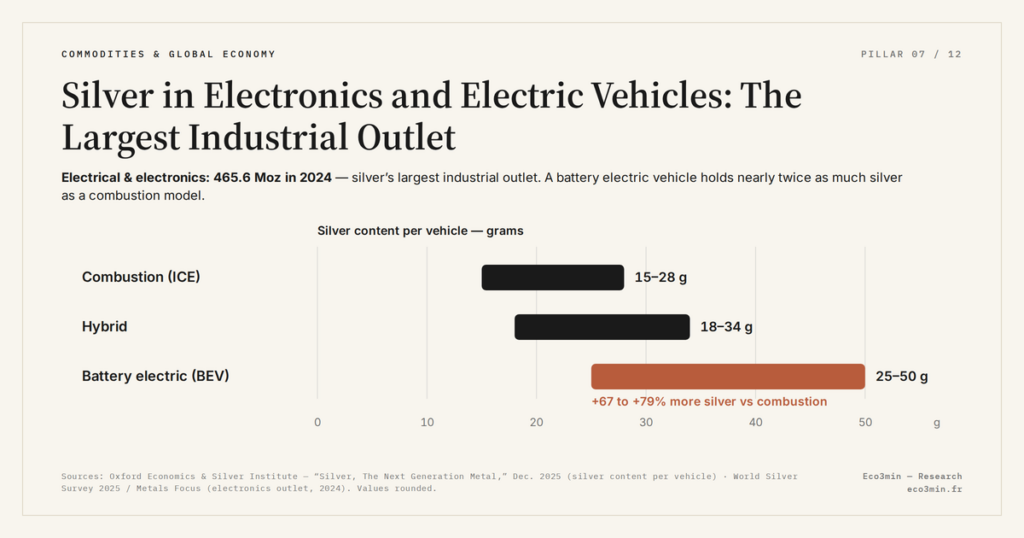
Electrical and electronics is silver’s largest industrial outlet, ahead of solar: 465.6 million ounces in 2024. The electric car, which holds about twice as much silver as a combustion model, is becoming its most dynamic driver.
TL;DR
Electronics is silver's largest industrial outlet at 465.6 million ounces in 2024, ahead of solar; electric cars drive its fastest-growing demand despite making up barely 1% of the total.
- Electrical and electronics demand hit a record 465.6 million ounces in 2024, up 4%, well above the roughly 198 million absorbed by photovoltaics and present in nearly every device from switches to data-centre hardware.
- A battery electric vehicle holds about 25 to 50 grams of silver versus 15 to 28 grams in a combustion model, roughly 67 to 79% more, on Oxford Economics and Silver Institute estimates.
- Motor vehicles already absorb more than 60 million ounces a year; the Silver Institute expects electric models to overtake combustion ones by 2027 and reach 59% of automotive demand by around 2031.
- The pure electric-vehicle segment uses only about 12 to 15 million ounces a year, barely above 1% of total demand: its weight lies in the trajectory, not the current mass.
Behind photovoltaics lies a vast, diffuse electronics demand that anchors silver in the real economy — with its own drivers and its own limits.
1. Silver, the ubiquitous metal of electronics
For all the attention solar attracts, it is not silver’s leading industrial use. According to the Silver Institute, electrical and electronics demand hit a record 465.6 million ounces in 2024, up 4% — markedly more than the roughly 198 million absorbed by photovoltaics. It is the metal’s largest industrial category, and the most diffuse: silver is present in virtually every electronic device, from the household switch to the supercomputer. The reason lies in its physical properties — it is the best electrical and thermal conductor known, and an excellent reflector — alongside antimicrobial qualities useful in healthcare. This dominance puts the split of silver demand in perspective: solar is the most publicised segment, but electronics remains the bedrock.
The uses are countless and often invisible. Silver forms the electrical contacts, relays, fuses and membrane switches found in keyboards, televisions and microwave ovens, prized for enduring millions of on-off cycles. Silver-based inks trace the pathways of printed circuit boards; the metal goes into multilayer ceramic capacitors and a multitude of connectors. The rollout of 5G amplifies this demand, since high-throughput, low-latency networks rely on silver’s conductivity to handle growing data loads. More recently, the rise of data centres and artificial-intelligence hardware adds a source of demand — still hard to quantify but structurally biased upward.
Beyond consumer electronics, silver runs through more specialised industrial uses: brazing alloys and solders, sensors of every kind, and a whole range of medical applications where its antimicrobial properties are put to work — dressings, catheters, surgical instruments. This diversity makes electrical and electronics demand a mosaic that cannot be substituted wholesale: replacing silver in a switch is one thing; replacing it simultaneously across thousands of applications with different requirements is another. It is this very dispersion that gives industrial demand its resilience — no single substitute can dislodge it at a stroke.
This demand shares a decisive trait with solar: silver is dissipated in tiny amounts per device, but across colossal production volumes. A few milligrams in a phone, a few grams in a control board: taken alone, negligible; multiplied by billions of units, it weighs heavily. And as with solar, the metal is rarely recovered before the device reaches end of life, even if recycling of electronic silver improves as the price climbs. This is also why electronics revives the tension of silver and copper as rival conductors: copper, far cheaper, is the natural candidate for replacement wherever performance allows.
2. The electric vehicle, a new automotive engine
The car illustrates the rise of electronic silver in striking fashion. A combustion vehicle already contains a meaningful amount — on the order of 15 to 28 grams, by Oxford Economics and Silver Institute estimates — chiefly in contacts, relays and switches. But a battery electric vehicle demands far more: about 25 to 50 grams, or 67 to 79% more, owing to high-voltage systems, power electronics, inverters and charge management. A hybrid sits between the two, around 18 to 34 grams. This higher intensity, combined with the electrification of the fleet, turns automotive demand into a growth relay for the metal, and feeds the chain linking industrial demand, price and silver’s valuation through the ratio.
The scale of the shift is telling. The Silver Institute estimates that more than 60 million ounces of silver are now consumed each year in motor vehicles, across all powertrains. In 2024, combustion vehicles still represented 55% of this automotive demand and electric ones 30%; but, hungrier and fast-growing, the latter are expected to overtake combustion vehicles as soon as 2027 and reach 59% of the total by around 2031, lifting automotive demand toward 94 million ounces by then. This dynamic is not confined to the vehicles themselves: the expansion of charging infrastructure, whose stations use silver contacts and silver-plated cables, adds a parallel demand — the global stock of public charging points rose by a third in 2024. Electrifying transport thus mobilises silver at several levels, placing it among the critical minerals of the energy transition.
The underlying trajectory explains the enthusiasm. The share of electric vehicles in global car production rose from about 3% in 2019 to close to 21% in 2024, and annual deliveries, on the order of 17 to 18 million units, could reach several tens of millions by 2030 on sector forecasts. Each additional point of penetration mechanically raises the average silver content of the new fleet, since vehicles at 25-50 grams replace vehicles at 15-28 grams. To this is added the rollout of charging points, whose future needs some estimates put in the tens of millions of units for the United States alone by 2030.
The real weight of this engine must nonetheless be measured. The electric-vehicle segment proper consumes only about 12 to 15 million ounces a year today, barely more than 1% of total silver demand. Its strength lies in the trajectory, not the current level: it is its growth, not its mass, that makes it a topic. Taken alone, it cannot move a market of more than a billion ounces; it is the sum of electronics, solar and automotive that creates the pressure, as photovoltaics, the other major outlet for the metal reminds us.
3. A structural engine, but one to keep in proportion
Electronic silver demand carries the same ambivalence as solar. On one side, it is structurally biased upward, driven by electrification, digitalisation and connectivity. On the other, it faces constant optimisation pressure: manufacturers continually seek to cut the silver per component, on cost grounds, and to substitute copper or other materials where performance allows. The net result depends on the race between rising volumes and falling content per device — exactly as in photovoltaics. Nothing ensures that electronic silver demand grows as fast as the number of devices produced.
This demand also runs into the same supply wall as the other uses. When electronics and automotive accelerate, metal cannot flow in quickly, because most silver leaves the ground as a by-product of other mines. It is the rigidity of mine supply that turns dynamic industrial demand into market tension: the physical deficit seen for several years is its direct trace. Electronic demand is therefore not merely an additional outlet; it is one of the forces that, added to the others, durably places silver on the side of scarcity rather than abundance.
One factor nonetheless tempers this tension. Higher prices make recycling of electronic silver more profitable, and recovery of the metal contained in equipment waste is improving, providing a secondary supply top-up. Moreover, silver represents only a tiny fraction of the cost of a device or vehicle, which lets manufacturers absorb a price rise without immediately eroding margins or abandoning the metal. This low short-term sensitivity of demand to price is also what sustains industrial consumption even as silver grows dearer.
The newest frontier is computing itself. The build-out of data centres and the hardware behind artificial intelligence — servers, high-speed interconnects, power-delivery systems — leans on silver’s conductivity at a moment when these facilities are multiplying worldwide. Estimates here remain tentative, because the silver embedded in a server or a network switch is rarely broken out separately, but the direction is not in doubt: every wave of digital expansion carries a thread of silver with it. Combined with electrification, this digital layer broadens the base of industrial demand well beyond the sectors usually cited, and makes the metal’s fortunes increasingly a function of the pace of technology rather than of jewellery or coinage. It is a quiet but cumulative shift: no single application dominates, yet together they keep redrawing the demand map year after year, eroding the old assumption that silver moves mainly with investment sentiment.
At bottom, electronics and the electric vehicle confirm a deep shift in silver: from a metal long seen through its monetary and ornamental uses, it is becoming above all a technological input. This pivot, still poorly integrated by part of the market, moves the centre of gravity of the price toward the real economy and industry — a movement that sits within the broader balances of the geoeconomics of commodities, where metal demand now follows the energy and digital transition.
It is often said that the electric car alone will send silver prices soaring. That confuses growth with level: the electric-vehicle segment accounts for only about 1% of total demand. The real industrial mass is electronics in the broad sense; it is the sum of all these uses, not any single one, that tightens the market.
Last updated — 27 June 2026
Disclaimer – Financial Information: The analyses, commentary, and content published on eco3min.fr are provided for informational and educational purposes only. They do not constitute investment advice or a solicitation to buy or sell financial instruments. Past performance is not indicative of future results. All investment decisions involve risk and are the sole responsibility of the reader.
Read next
Full pillar →Reading the refinery utilisation rate: the threshold, the season, the turnarounds
A refinery runs full near ninety percent, not a hundred: the last slice of nameplate capacity is a…
IMO 2020: the regulatory shock that rewrote product spreads
An environmental rule on marine sulfur can move a refining spread more than a swing in crude. IMO…
The 2022–2023 refining golden age: anatomy of an episode
In 2022, refined fuel prices climbed faster than crude. That gap, measured by the 3-2-1 crack spread, reached…