The 2021 Silver Squeeze: Financialization, COMEX and the Limits of the GameStop Playbook

In February 2021, in the wake of the GameStop affair, a wave of coordinated buying drove silver to nearly $30 an ounce within days. It was immediately dubbed a “silver squeeze”. But silver is not a small-float stock, and financialization had changed the rules of the game.
TL;DR
Silver's depth and SLV's share-creation mechanism meant the February 2021 retail rush could spike the price toward $30 but never engineer the share scarcity a GameStop-style squeeze requires.
- On 1 February 2021, COMEX silver jumped as much as 8.7% to about $29.25 an ounce, after SLV took a record net inflow near $944 million in a single day and had to source roughly 110 million ounces of metal in three days.
- On 3 February the fund issued an emergency prospectus amendment, warning its authorised participants might not gather enough deliverable metal to keep creating shares.
- With billions of ounces of bullion above ground and a futures complex turning over far more each day, the record inflow was a ripple, not the deliverable scarcity a corner needs.
- Where the 1980 Hunt corner concentrated a few wealthy actors taking physical delivery to drain a narrow float, the 2021 move was diffuse and ran through SLV shares and futures, with no actor removing metal durably.
Breaking down this episode and setting it against the 1980 corner reveals what ETFs and futures markets have transformed in the way a speculative rush spreads — or dies out.
1. The context: GameStop, Reddit and the silver target
The episode is inseparable from the market fever of January 2021. After driving GameStop’s share price sky-high to throttle the funds that were short the stock, Reddit’s WallStreetBets community was looking for its next target. On 28 January 2021 — the very day several brokers, including Robinhood, restricted GameStop purchases — posts began urging members to turn to silver. The argument, appealing on the surface, fit in a sentence: the major banks, JPMorgan foremost, supposedly held enormous short positions in silver; massive coordinated buying could trigger a “short squeeze” like GameStop’s. The reference to JPMorgan was not accidental: the bank had settled charges of manipulation (spoofing) in precious metals in 2020, for close to $920 million.
The narrative rested on an old suspicion: that the price was structurally suppressed by institutions, a claim that prolongs the debate over silver’s two faces. Mobilising a crowd of small investors to buy metal — directly or through the largest silver-backed exchange-traded fund, the iShares Silver Trust (SLV) — was, on this logic, supposed to lift a price allegedly held down. The idea spread rapidly, far beyond Reddit, carried by social media and a few media figures. Within days, silver had become the symbol of a retail “war” against Wall Street.
To understand the transposition, one must recall the mechanics of GameStop. A hedge fund, Melvin Capital, had built a large short position in a small-float stock; by buying shares and call options en masse, retail investors had forced the shorts to cover in a panic, propelling the price to absurd highs. The episode had convinced millions of individual investors that collective action could bend Wall Street. All that remained was to find the next target — and silver, wrapped in a persistent manipulation narrative, looked tailor-made. On 18 February 2021, the GameStop affair would even prompt a congressional hearing, a sign of the phenomenon’s scale.
The GameStop saga had done more than enrich a few traders: it had reframed retail investing as a collective, almost political act. Forums buzzed with the language of insurgency, of small investors versus a rigged system. Silver, with its decades-old folklore of suppression by bullion banks, slotted neatly into that frame — it offered not just a trade but a cause. This emotional charge, more than any cold assessment of market structure, explains how quickly the idea travelled, and how reluctant its believers were to hear that silver could not be squeezed the way a small stock could.
The suspicion of manipulation was not without factual basis. Several banks had been sanctioned for “spoofing” — orders placed then cancelled to distort prices — in precious-metals markets, with JPMorgan accepting the heaviest settlement in 2020. From that established fact, the retail narrative drew a far more ambitious conclusion: that silver’s price was structurally and durably crushed, and that coordinated buying would suffice to free it. Yet sanctioning isolated short-term manipulations does not prove the existence of a permanent price suppression — a logical leap the episode was about to test.
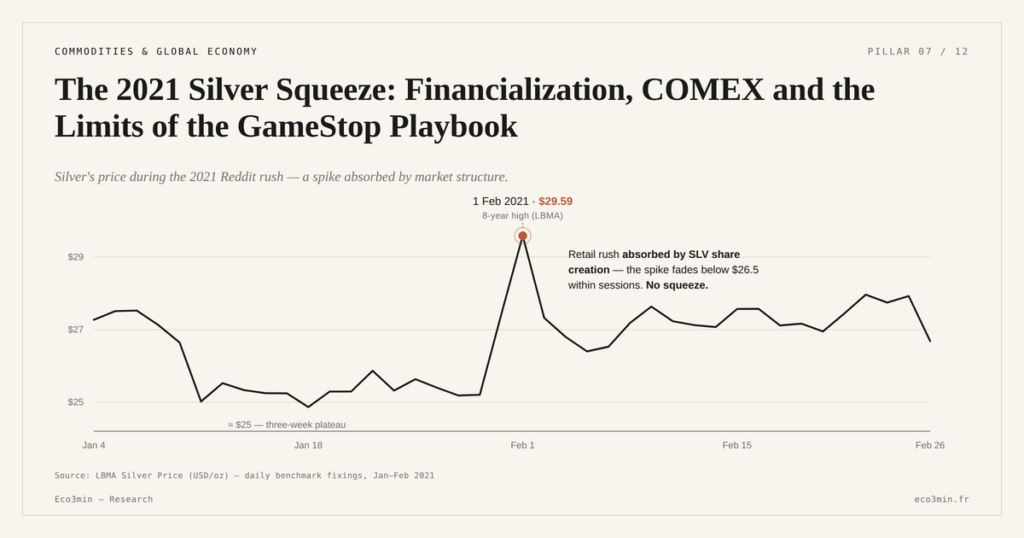
The price reaction was spectacular but brief. On 1 February 2021, the most-active futures on COMEX jumped by as much as 8.7%, reaching about $29.25 an ounce and brushing $30 intraday — an eight-year high. The previous Friday, SLV had recorded a record net inflow of about $944 million in a single day, and to meet that demand the fund had to acquire the equivalent of roughly 110 million ounces of metal in three days. This pressure on the investment side of silver demand was so intense that SLV issued, on 3 February, an emergency amendment to its prospectus, warning that authorised participants might not manage to source enough deliverable metal to create new shares.
The price path itself is instructive. In the first week of January, silver traded around $27, before retreating toward $24 or $25 and stalling there for three weeks. It was the call to buy launched in late January that broke this torpor: on the 28th, the price cleared $26, then accelerated over the weekend, when online dealers were overwhelmed, peaking on Monday 1 February. The move therefore combined a paper inflow, through SLV and futures, and a physical rush on coins and bars — two distinct dynamics that the media narrative merged into a single “squeeze”.
The physical market saw a parallel strain. Dealers in coins and bars, from the United States to Australia, were swamped with orders and watched their stocks of small formats run dry; premiums on physical metal climbed. US Mint sales jumped 173% in March 2021, and bullion distributors’ volumes soared. This mechanism directly linked physical silver, ETFs and miners, each channel reacting in its own way to the influx of buyers. The distinction between buying paper — SLV shares — and buying metal would in fact become the heart of the debate that followed.
The prospectus episode is worth pausing on. That a fund the size of SLV felt the need to warn publicly, mid-rush, that its intermediaries might struggle to gather deliverable metal to create new shares says much about the intensity of demand in those few days. But that very warning underscores the exercise’s limit: if metal became scarce to back the shares, the creation mechanism would seize, and SLV would stop amplifying the rise rather than propagating it indefinitely. The financial structure, here again, set its own boundary.
Silver miners joined the fever: companies such as First Majestic or Fortuna leapt in the metal’s wake. But the effervescence did not last. Once the retail momentum dissipated and the target proved elusive, the price retreated, leaving behind elevated physical premiums on small formats — the residue of a precautionary demand that was nothing like a speculative play. This persistence of physical demand, distinct from the paper peak, would feed the idea that something more lasting had played out beneath the media surface.
3. Why silver is not GameStop: depth and ETF creation
A short squeeze presupposes scarcity of the underlying: a narrow float, a limited number of shares, and short sellers forced to buy back from a draining pool. GameStop, a small cap with high short interest, met those conditions. Silver did not. This is where the depth of the silver market comes in: billions of ounces exist above ground as bars, coins and industrial stocks, and the futures market turns over considerable volumes. Asphyxiating such a market through retail buying, however massive, is of a different order of magnitude than cornering a small-float stock.
The arithmetic of the float confirms it. Cornering GameStop was possible because short interest at times exceeded the number of shares actually available, creating mechanical scarcity. Nothing of the sort applied to silver: even mobilising hundreds of millions of dollars, retail investors represented only a fraction of a market measured in tens of billions of dollars of metal and contracts. The target itself stayed vague — which “short” exactly was to be broken, and where? — whereas GameStop offered a named enemy and a quantifiable float.
Scale makes the point vivid. The roughly $944 million that flowed into SLV in a single record day was, by the standards of retail mobilisation, enormous; measured against the global silver market — billions of ounces of bullion plus a futures complex turning over far more each day — it was a ripple, not a wave. The metal the fund had to source was real, and the strain on small-coin inventories was real, but neither came close to the deliverable scarcity that defines a corner. The mismatch between the ambition of the slogan — some posts floated $1,000 an ounce — and the structural reality of the market was, in hindsight, the episode’s defining feature.
Above all, the chosen vehicle worked against the objective. A fund like SLV does not have a fixed number of shares: when demand floods in, its authorised participants create new shares by depositing the corresponding metal. Far from drying up supply, buying SLV therefore triggers the purchase of physical metal to back the new shares — but it also feeds the financial system the buyers claimed to be fighting, without creating the share scarcity a squeeze requires. Financialization plays the role of a shock absorber here: the ETF channel turns a rush into an orderly flow of share creation, whereas an old-style physical corner would aim to remove metal from circulation. The creation mechanism is worth detailing, for it lies at the heart of the misunderstanding: when an ETF’s price rises above the value of its underlying, specialised intermediaries buy the metal, deposit it with the fund and receive shares they resell, bringing the price back toward net asset value. Designed for liquidity and fidelity to the underlying, this process means a wave of SLV buying does not create a share shortage: it triggers their multiplication, backed by additional metal. The instrument buyers believed to be a squeeze weapon was, by construction, the opposite. The contrast with what the gold/silver ratio signals is clear: no lasting distortion of relative valuation appeared, a sign that the market had absorbed the shock, much as how ETF prices form would predict.
4. The authenticity debate: squeeze or narrative?
Another element separates 2021 from GameStop: the absence of unified buy-in. Very quickly, many WallStreetBets members publicly denied being behind the move, some stating unambiguously that no silver short squeeze was under way. Their reasoning was lucid: buying SLV amounted to enriching market makers and funds — Citadel, notably, held positions in the fund — that is, precisely the actors retail investors thought they were fighting. The target, unlike GameStop, was not clearly identified, and the real beneficiary of an SLV purchase remained ambiguous.
The conspiratorial fringe of the narrative added a further twist. When Robinhood and other brokers had restricted GameStop trading days earlier, some retail voices read it as proof that the system protected its own; the same suspicion was projected onto silver, with claims that any restriction or warning around SLV showed the banks feared the squeeze. In reality, the SLV prospectus amendment reflected a logistical concern about share creation, not a defensive manoeuvre against retail. But in a climate of distrust, every institutional reflex was reinterpreted as confirmation that the squeeze was working — a self-reinforcing story largely detached from the metal’s actual mechanics.
From this arose a controversy never settled: was the “silver squeeze” a genuine retail initiative, or a narrative amplified, even orchestrated, by better-informed interests? The truth probably blends the two: real retail enthusiasm, grafted onto pre-existing institutional positioning and a viral narrative. Lacking a rally comparable to GameStop’s, the movement missed the fuel needed to last. It did, however, leave a trace: a dedicated community, r/WallStreetSilver, formed in its wake and redirected its strategy toward accumulating physical metal, having understood that paper would not bend the market.
That reorientation is itself a lesson. By distinguishing the purchase of paper — which feeds the financial structure — from the accumulation of metal — which alone removes supply — the community rediscovered, in its own way, the logic of an old-style physical corner. But it ran into the same limit: without a concentration of capital and a coordinated will to take delivery, scattered purchases cannot throttle so vast a market. The “silver squeeze” thus survived more as a cultural and community movement than as a real threat to the price, gathering tens of thousands of holders convinced of the metal’s undervaluation.
5. 1980 versus 2021: what financialization changed
The comparison with the great corner of 1980 is unavoidable, but it is through their differences that the two episodes illuminate the market. On one side, the 1980 Hunt corner rested on a handful of very wealthy actors, demanding physical delivery of the metal to drain a narrow float: a concentrated, capital-intensive operation aimed at the physical heart of the market. On the other, in 2021, the move was diffuse, social, media-driven, and ran essentially through financial instruments — SLV shares and futures — with no large delivery demand and no actor able to remove metal durably.
This contrast sums up what forty years of financialization have transformed. Between the two dates, ETFs, derivatives markets and public access to trading have multiplied the channels through which investment demand transmits to price — but these channels mediate and dampen far more than they concentrate. A corner requires concentration and physical metal; financialization disperses and dematerialises. That is why a single word, “squeeze”, covers in 1980 and 2021 two phenomena of very different natures, only one of which truly threatened the market.
The lesson goes beyond silver. The same financialization that democratised access to markets has also interposed, between investor and asset, a layer of instruments — ETFs, derivatives, market makers — that absorbs and redistributes demand shocks. This layer protects the market from a physical throttling, but it shifts the risk elsewhere: toward the soundness of these intermediaries and the fidelity of the link between the paper and the metal it is meant to represent. Understanding where that link can be strained matters far more than watching for a spectacular “squeeze” that, in so deep a market, has little chance of succeeding.
This does not mean a frenzy is without consequence. A spike in demand, even fleeting, can strain the physical market for small formats, inflate premiums and expose logistical fragilities in the investment-metal chain. But these effects, real as they are, stay local and transitory: they do not durably move the valuation, which the market’s depth and arbitrage pull back toward its fundamentals. It is precisely this dissociation between short-term noise and underlying signal that makes the 2021 episode so instructive for anyone wishing to read silver’s price without being carried away by the story of the moment. Resituating these episodes within the geoeconomics of physical resources yields the lasting takeaway: silver’s price can leap under a frenzy, but the market’s structure determines whether that frenzy becomes a durable distortion or a flash in the pan. In 2021, the depth and financialization of the market delivered their answer within days — while the narrative took far longer to fade than the price spike that had fed it.
The 2021 “silver squeeze” is often presented as a successful short squeeze, GameStop-style. That is a confusion. Silver is a deep market, and SLV creates new shares backed by metal when demand floods in, instead of making shares scarce. With no narrow float and no identified target, there was no real throttling — only a fleeting price spike.
Last updated — 27 June 2026
Disclaimer – Financial Information: The analyses, commentary, and content published on eco3min.fr are provided for informational and educational purposes only. They do not constitute investment advice or a solicitation to buy or sell financial instruments. Past performance is not indicative of future results. All investment decisions involve risk and are the sole responsibility of the reader.
Read next
Full pillar →Reading the refinery utilisation rate: the threshold, the season, the turnarounds
A refinery runs full near ninety percent, not a hundred: the last slice of nameplate capacity is a…
IMO 2020: the regulatory shock that rewrote product spreads
An environmental rule on marine sulfur can move a refining spread more than a swing in crude. IMO…
The 2022–2023 refining golden age: anatomy of an episode
In 2022, refined fuel prices climbed faster than crude. That gap, measured by the 3-2-1 crack spread, reached…