
The 1980 Hunt Brothers Corner: Anatomy of the Largest Silver Squeeze

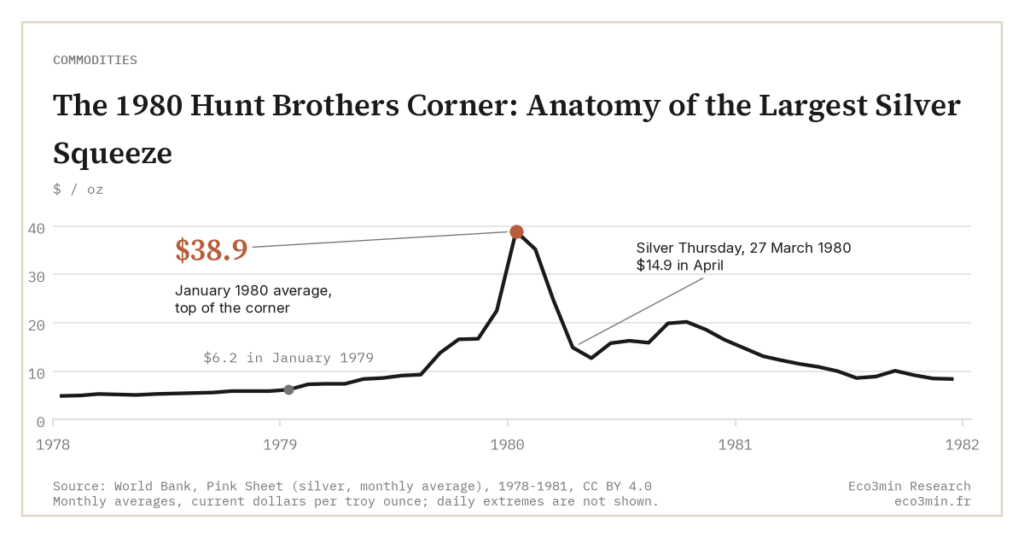
In fifteen months, two Texas heirs drove silver up to nearly $50 an ounce, before a brutal collapse on 27 March 1980. The Hunt corner remains the most famous example of what a price can become when speculation, not real demand, holds the reins.
TL;DR
On 27 March 1980 silver halved in one session and a missed margin call forced a near-$1.7 billion bank rescue: an engineered price cannot outlast the buyer sustaining it.
- At the peak the Hunts controlled a considerable share of the available silver and close to two-thirds of open COMEX futures; estimates of their share of readily deliverable silver run as high as a third.
- COMEX's 'Silver Rule 7' (7 January 1980) forced near-full cash settlement on new futures purchases, cutting the leverage behind the rise.
- Volcker's sharply positive real rates raised the cost of holding a yieldless metal; a 1988 Minpeco verdict found the Hunts liable for manipulation, confirming the $50 peak was an artefact.
Reconstructing this attempt to corner the market, its mechanics and its failure, lastingly illuminates how frenzies on commodity markets form — and unravel.
The Hunt brothers and the genesis of the corner
Nelson Bunker Hunt and William Herbert Hunt were the sons of Haroldson Lafayette Hunt, a Texas oil magnate and one of the richest men in the United States, who died in 1974, leaving his children a colossal fortune and a visceral distrust of the federal government and of paper money. In the 1970s, marked by runaway inflation and the end of the dollar’s gold convertibility, that distrust found a natural outlet: converting part of that fortune into tangible metal. Silver, more accessible than gold and industrially useful, became their target. This logic flows entirely from silver’s monetary nature, seen as a refuge against the depreciation of banknotes.
From the mid-1970s, the Hunts accumulated methodically. Rather than speculating on the futures markets and reselling, they often demanded physical delivery of the metal, thereby removing silver from circulation and draining the available float. Over the last nine months of 1979, they are estimated to have held more than 100 million ounces of physical silver, on top of large futures positions. By teaming up with wealthy partners, notably in the Middle East, they are thought to have controlled, at the peak, a considerable fraction of the silver available outside industrial uses, and close to two-thirds of the open futures contracts on COMEX. Such concentration was anything but trivial for so narrow a market.
This strategy was no whim. Burned by earlier losses on other commodities, the Hunts saw in silver a bet that was both ideological and patrimonial: to guard against what they regarded as Washington’s monetary irresponsibility. To multiply their firepower, they joined forces with wealthy investors, notably from the Gulf, within joint vehicles designed to buy and store metal on a large scale. Far from a simple speculative round-trip, the operation aimed to immobilise silver durably, betting that its growing scarcity would push the price up indefinitely. It is this intent to withdraw metal from the market, more than the volume itself, that distinguishes a corner from an ordinary investment.
The mechanics of the corner: physical against paper
A corner rests on a simple asymmetry. By buying massively both the physical metal and futures contracts callable for delivery, an actor can place short sellers in an untenable position: at expiry, they must deliver a metal that has become rare and dear, or buy back their positions at any price. The more the physical float shrinks, the tighter the vice. This is precisely what the narrowness of the physical silver market allows: a limited available stock, unresponsive in the short term, on which concentrated demand exerts disproportionate leverage.
The result was a vertiginous ascent. Silver’s price, starting from a modest level in early 1979, reached a high of $49.45 at the London Fix on 18 January 1980, after a dramatic rise in a year. Gold peaked three days later, on 21 January, and the gold/silver ratio fell to its modern floor. But this move combined two things it is important not to confuse: the Hunts’ corner on one hand, and the general inflationary fever of the late 1970s on the other, which was lifting commodities across the board. The operation’s leverage rested on the combination of physical silver and futures contracts, each dollar committed as margin commanding a far larger exposure.
One must, however, guard against a caricatured reading. The late 1970s were a period of double-digit inflation and widespread distrust of the dollar, during which commodities as a whole — from gold to oil — reached peaks. Silver did not therefore flare up in a vacuum: it surfed a real macroeconomic wave, which the Hunts’ action amplified and accelerated to excess. Distinguishing the part played by context from the part played by manipulation is precisely what makes the episode instructive: a single price can result from fundamental forces and a speculative distortion superimposed, and it is their separation, after the fact, that reveals what was sustainable and what was not.
Quantifying their exact share is itself contested. Estimates of how much of the world’s above-ground silver the Hunts effectively controlled vary widely, from a modest fraction to something near a third of the metal readily available for delivery, depending on whether one counts only physical holdings or adds the silver implied by their futures. This ambiguity matters: it is the difference between an actor large enough to tip a tight market and one merely riding a broad commodity boom. The court’s later finding of manipulation points to the former, but the precise arithmetic has fed decades of argument among historians of the episode.
That same mechanism carried its own fragility. Technically, the trap closed on the weakest short sellers. Many had sold futures without holding the metal, betting on a fall; as the price rose and expiry approached, they had to either buy back their positions at a loss or deliver a metal that could not be found. Each forced buyback in turn fed the rise, in a loop that played into the Hunts’ hands. To hold and grow their futures positions, the Hunts had to borrow heavily and post rising margins with their brokers. As long as the price climbed, the edifice held and even strengthened; but it took only a reversal for the spiral to invert, turning a virtuous circle into a deadly trap. A price supported not by consumption but by the continuous buying of an indebted actor has no foundation: it holds as long as the buyer can buy, and collapses the moment he cannot.
The exchanges strike back: “Silver Rule 7”
The surge alarmed regulators and market operators. A handful of actors threatened to empty the market of its metal and ruin the short sellers, among them leading financial institutions. On 7 January 1980, COMEX struck back by adopting the measure that became famous as “Silver Rule 7”: it drastically limited futures purchases on margin, imposing collateral requirements such that any large new purchase had to be settled almost entirely in cash. In parallel, margin requirements were raised and position limits introduced, while the Federal Reserve pressed banks to curb speculative lending.
The effect was immediate and decisive. Deprived of the leverage that had fed their rise, the Hunts could no longer supply the demand that held up the price. The machine seized: without massive new buying, silver began to retreat from its January high. Many commentators still present this intervention as an arbitrary “change of rules” that broke the Hunts; in reality, it illustrates the capacity, and the will, of exchanges to defend the integrity of their market when an actor threatens to unbalance it. This retreat gradually brought the gold/silver ratio floor back toward less extreme levels, a sign that the distortion was easing.
The intervention was not free of controversy. Several members of the boards of the exchanges concerned themselves held short positions, which fuelled the accusation, levelled by the Hunts, of a rule change tailored to bring them down. The line between a legitimate defence of market integrity and the defence of private interests was, at the time, hotly debated. Still, on the substance, the measure answered a real risk: a market in which a handful of actors can exhaust the deliverable metal ceases to perform its price-discovery function. The tools deployed — raised margins, position caps, a shift to liquidation-only — have since become the standard repertoire of exchanges facing excessive concentration.
Silver Thursday and the bank rescue
The fall, at first slow, accelerated as operators understood the game was ending. On 27 March 1980 — “Silver Thursday” — the price collapsed by half in a single session, dropping from about $21.62 to $10.80 an ounce. That day, the Hunts could not meet a margin call of around $100 million from their broker, Bache. The mechanism had inverted: to raise funds, they had to sell metal, which pushed the price down, triggering fresh margin calls in a self-feeding spiral. Within weeks, assets estimated at some $7 billion had turned into a debt of about $1.7 billion.
The danger by then extended far beyond the Hunts. Their default threatened to drag down their brokers and the banks that had financed them, raising the spectre of a chain reaction through the financial system. As the well-known adage of finance has it, owing the bank a hundred dollars is the borrower’s problem; owing it billions becomes the bank’s. To avoid collapse, a banking consortium negotiated, under the watchful eye of the Federal Reserve, a rescue loan on the order of $1.1 to $1.7 billion, in exchange for the orderly liquidation of the positions and the pledging of the Hunts’ assets. This episode illustrates financial leverage and systemic fragility: an individual position large enough to threaten the whole, forced to be bailed out not out of kindness, but to protect the system.
The panic was not confined to silver. The brutal fall shook other commodity markets and rattled brokerage houses, foremost among them Bache, directly exposed to the Hunts. It was this potential contagion — the fear that a private bankruptcy might jam an entire section of the financial system — that justified the banks’ coordinated intervention, quietly orchestrated to avoid a disorderly forced sale. The rescue, moreover, hardly benefited the Hunts themselves: it required them to liquidate their positions over time and to pledge their holdings, turning the former cornerers into supervised debtors.
The legacy: verdict, bankruptcy and lessons
The aftermath was heavy. The Hunts had to dismantle their positions over nearly a decade. In 1988, they were found civilly liable for having conspired to manipulate the silver market, following an action brought by Minpeco, a Peruvian state mining company, and ordered to pay more than $130 million in damages. That same year, Nelson Bunker Hunt filed for bankruptcy, and the two brothers were barred from the futures markets. The fleeting “silver king” ended ruined, his billions evaporated.
The judicial sanction completed this verdict. The Minpeco action led, in 1988, to recognising the existence of a conspiracy to manipulate prices, dismissing the brothers’ defence that they had merely invested freely. This judgment matters beyond the particular case: it establishes that accumulating an asset with the intent to drain its market and force its price amounts to manipulation, not a mere investment strategy. The distinction, sometimes thin in practice, is central for anyone seeking to understand the legal limits of commodity speculation.
The unwinding itself was a slow ordeal. Forced to sell into a falling market and to service the rescue debt, the brothers spent years disposing of the very metal whose scarcity they had bet on, each sale a reminder that the price they had engineered could not be cashed in at scale. The fortune built on oil and multiplied by leverage drained away, and with it the aura of invincibility that had surrounded the family name. By the time the last positions were closed, the silver king of January 1980 had become a cautionary tale taught in trading rooms and law schools alike. It is a rare case where the punishment, the loss and the legend all converged on the same lesson.
The macroeconomic context finished what “Silver Rule 7” had begun. At the turn of 1979-1980, Paul Volcker’s Federal Reserve launched a dramatic rise in interest rates to break inflation. Sharply positive real rates raised the cost of holding a metal that yields nothing, and undercut the very argument that had fed the rush into precious metals. Silver, like gold, then began a long decline: from its 1980 peak, it fell back toward a handful of dollars in the early 1980s, and would not regain such nominal levels for decades. The fever had broken, and with it the illusion of limitless scarcity.
One nuance is often glossed over. While the Hunts’ role in the surge is established, some analysts stress that they have at times become a convenient scapegoat, asked to explain on their own a peak that the inflationary backdrop partly accounts for. The truth lies between the two: the Hunts did not create the rise from nothing, but they pushed it well beyond what the fundamentals justified, to the breaking point. Acknowledging this share of context does not exonerate the manipulation; it merely warns against rewriting history by ascribing to a single cause a phenomenon that had several. It is this rigour in attributing causes that separates analysis from legend, and that keeps the Hunt corner a live case study rather than a mere morality tale.
Beyond the anecdote, the episode delivers lasting lessons. The first is that a corner is structurally unstable: it creates an artificial price, sustained by buying rather than by use, which does not survive the moment the cornerer stops buying. The second is that the 1980 peak did not reflect a “fundamental” value of silver at $50: it was a market artefact, which invalidates the silver catch-up myth built on that high. The third is that organised markets possess tools — margins, limits, emergency rules — to neutralise a manipulation, even at the cost of massive losses for its author.
This legacy finally sheds light on later episodes. When, in 2021, a wave of coordinated buying briefly sent silver soaring, the comparison with 1980 imposed itself — but the drivers were different, as the 2021 silver squeeze shows. Resituating the Hunt corner within the physical commodity markets and their long history allows it to be read for what it was: not the revelation of a hidden value in the metal, but the striking demonstration of what separates a speculative price from an economic one — a lesson each generation of markets seems condemned to relearn at its own expense.
- The Hunt brothers accumulated more than 100 million ounces of physical silver and large futures positions, controlling at the peak a considerable share of the available silver and close to two-thirds of COMEX contracts.
- The price reached a record $49.45 on 18 January 1980 after a dramatic rise, driven both by the corner and by 1970s inflation.
- COMEX’s “Silver Rule 7” (7 January 1980), by limiting margin purchases, cut the Hunts’ leverage and triggered the retreat.
- On 27 March 1980 (“Silver Thursday”), the price collapsed from $21.62 to $10.80; a missed margin call forced a $1.1-to-1.7 billion bank rescue loan to avert a cascade.
- In 1988, the Hunts were found liable for manipulation (the Minpeco case) and went bankrupt: the 1980 peak was an artefact, not a fundamental value.
Last updated — 6 October 2026
Disclaimer – Financial and Legal Information: The analyses, commentary, and content published on eco3min.fr are provided for informational and educational purposes only. They do not constitute investment advice or a solicitation to buy or sell financial instruments. Past performance is not indicative of future results. All investment decisions involve risk and are the sole responsibility of the reader. Data, charts and calculated series are provided as is and may contain errors or lag behind their source: check any figure against the primary source cited before relying on it. Content describing laws, regulations or contracts reflects the law as of its publication date and does not constitute legal or tax advice; applying it to a specific situation requires a qualified legal or tax professional.
Read next
Full pillar →The Gold/Silver Ratio: Is the Oldest Precious-Metals Signal Still Reliable?
The gold/silver ratio pits two metals long treated as cousins, yet silver now draws 58% of its demand…
Pure-play refiners versus integrated majors: downstream margin exposure
A pure-play refiner owns only the downstream, so its earnings track the refining margin. An integrated major also…
Jet fuel, the forgotten margin: the jet crack and the aviation link
The 3-2-1 crack spread reduces the refining margin to two products, gasoline and diesel. Jet fuel sits outside…