
Texas Refineries: All 34 on the EIA List and Every Change Since 1994
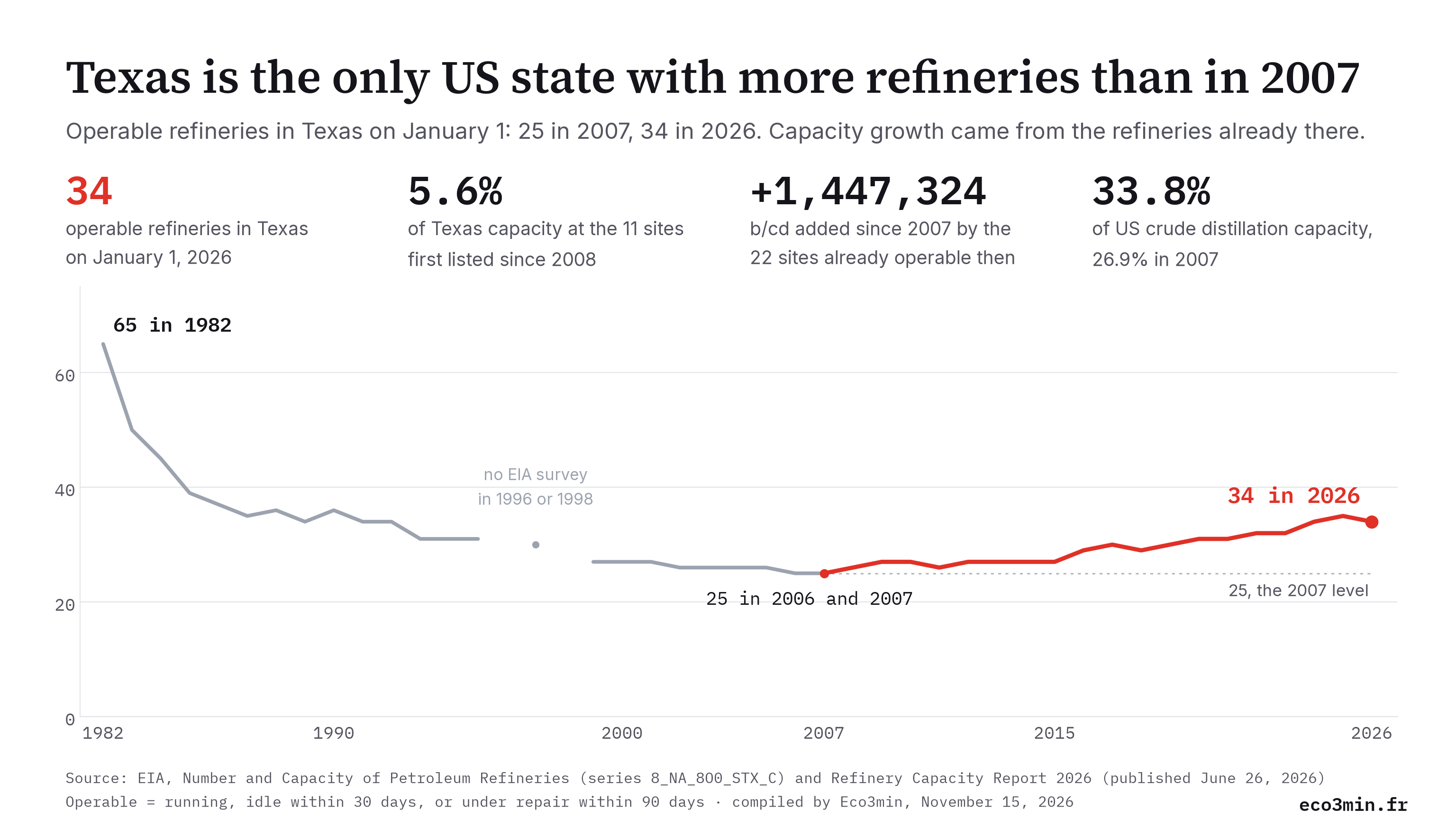
Texas refineries numbered 34 on January 1, 2026, by the EIA’s count, nine more than in 2007, while no other state added one. The added capacity came mostly from refineries already on the list in 2007.
The EIA has counted Texas refineries each January 1 since 1982, and its site files online go back to 1994. Matching those lists year by year shows which sites came in, which left, and where the capacity went.
Texas had 34 operable refineries on January 1, 2026, nine more than in 2007, the only state to gain, yet newcomers hold 5.6% of capacity.
- Since 2008, twelve sites have joined the EIA’s Texas list. The eleven still there hold 344,000 barrels per calendar day (b/cd) of 6,134,650. The largest, Kinder Morgan at Galena Park, has 105,000.
- The 22 refineries operable in both 2007 and 2026 added 1,447,324 b/cd, against a state net gain of 1,449,124.
- Houston Refining, 263,776 b/cd, dropped out of the 2026 count: the largest Texas entry in the EIA’s table of refineries shut down since 1990.
The 2026 edition of the EIA’s Refinery Capacity Report, published on June 26, 2026, puts Texas at 34 refineries and 6,134,650 b/cd of atmospheric crude distillation capacity, 33.8% of the US total of 18,160,493.
How many refineries are in Texas
On January 1, 2026, Texas had 34 of the 130 operable refineries in the US. The EIA’s glossary counts a refinery as operable if it was running, idle but able to restart within 30 days, or under repair that could finish within 90 days. Of the 34, 29 report atmospheric crude distillation capacity. The other five, at the bottom of the table with 0 b/cd, report none and still count.
The four largest, Motiva in Port Arthur (656,400 b/cd), Marathon’s Galveston Bay refinery in Texas City (631,000), ExxonMobil Beaumont (612,000) and ExxonMobil Baytown (564,500), hold 40.2% of the state’s capacity. Corpus Christi has six of the 34 lines, two of them the East and West lines of the Flint Hills refinery.
| # | Refinery | City | Operator (EIA) | b/cd | Listed since | |
|---|---|---|---|---|---|---|
| Texas | 34 refineries | 6,134,650 | ||||
| 1 | Port Arthur (Motiva) | Port Arthur | Motiva Enterprises LLC | 656,400 | 1994 | |
| 2 | Texas City / Galveston Bay | Texas City | Marathon Petroleum Co LP | 631,000 | 1994 | |
| 3 | ExxonMobil Beaumont | Beaumont | ExxonMobil Refining & Supply Co | 612,000 | 1994 | |
| 4 | ExxonMobil Baytown | Baytown | ExxonMobil Refining & Supply Co | 564,500 | 1994 | |
| 5 | Port Arthur (Premcor) | Port Arthur | Premcor Refining Group Inc | 385,000 | 1994 | |
| 6 | Deer Park Refining | Deer Park | Deer Park Refining LP | 312,500 | 1994 | |
| 7 | Flint Hills Corpus Christi West | Corpus Christi | Flint Hills Resources LP | 290,000 | 1994 | |
| 8 | Valero Corpus Christi | Corpus Christi | Valero Refining Co Texas LP | 290,000 | 1994 | |
| 9 | Sweeny | Sweeny | Phillips 66 Company | 277,000 | 1994 | |
| 10 | Port Arthur (TotalEnergies) | Port Arthur | TotalEnergies Petrochem & Refining USA | 238,000 | 1994 | |
| 11 | Valero Texas City | Texas City | Valero Refining Co Texas LP | 225,000 | 1994 | |
| 12 | Valero Houston | Houston | Valero Refining Co Texas LP | 205,000 | 1994 | |
| 13 | McKee | Sunray | Diamond Shamrock Refining Co LP | 195,000 | 1994 | |
| 14 | Citgo Corpus Christi | Corpus Christi | CITGO Refining & Chemical Inc | 165,000 | 1994 | |
| 15 | Borger | Borger | WRB Refining LP | 149,000 | 1994 | |
| 16 | El Paso | El Paso | Western Refining Company LP | 133,000 | 1994 | |
| 17 | Pasadena Refining | Pasadena | Pasadena Refining Systems Inc | 118,750 | 1994 | |
| 18 | Kinder Morgan Galena Park | Galena Park | Kinder Morgan Crude & Condensate | 105,000 | 2015 | |
| 19 | Three Rivers | Three Rivers | Diamond Shamrock Refining Co LP | 89,000 | 1994 | |
| 20 | Flint Hills Corpus Christi East | Corpus Christi | Flint Hills Resources LP | 87,500 | 1994 | |
| 21 | Tyler | Tyler | Delek Refining Ltd | 74,000 | 1994 | |
| 22 | Big Spring | Big Spring | Alon USA Energy Inc | 73,000 | 1994 | |
| 23 | Buckeye Texas Processing | Corpus Christi | Buckeye Texas Processing LLC | 60,000 | 2016 | |
| 24 | Magellan Corpus Christi | Corpus Christi | Magellan Processing LP | 50,000 | 2017 | |
| 25 | Targa / Hartree Channelview | Channelview | Hartree Refining LLC | 45,000 | 2019 | |
| 26 | Texas International Terminals | Galveston | Texas International Terminals | 45,000 | 2022 | |
| 27 | Petromax Refining | Houston | Petromax Refining Co LLC | 25,000 | 2016 | |
| 28 | San Antonio | San Antonio | The San Antonio Refinery LLC | 20,000 | 1994 | |
| 29 | Lazarus Energy | Nixon | Lazarus Energy LLC | 14,000 | 2012 | |
| 30 | Enterprise Products | Mont Belvieu | Enterprise Products Texas Operating LLC | 0 | 2024 | |
| 31 | Equistar Chemicals | Channelview | Equistar Chemicals LP | 0 | 2008 | |
| 32 | Pasadena Performance Products | Pasadena | Pasadena Performance Products LLC | 0 | 2025 | |
| 33 | Silsbee | Silsbee | Trecora Hydrocarbons LLC | 0 | 1994 | |
| 34 | Targa Downstream | Mont Belvieu | Targa Downstream LLC | 0 | 2024 |
The only state with more refineries than in 2007
Texas gained nine refineries after 2007; no other state gained one. On January 1, 2007, 33 states had at least one operable refinery. By 2026, 19 had the same count, 13 had fewer, and Texas alone had more: 25 then, 34 now. California went from 21 to 12 and Louisiana from 19 to 15. The national picture is in the count of refineries in every US state.
2007 is the low point of the Texas count, 25 in 2006 and 2007, so the size of the gain depends on that base. The ranking does not: against any year from 1993 to 2017 except 2010, when Delaware had none on the list, Texas is the only state with more refineries in 2026.
The state’s share of US distillation capacity was 26.9% in 2007 and 33.8% in 2026, against 28.3% in 1982. Its own capacity peaked at 6,343,466 b/cd on January 1, 2025, the last list before the Houston Refining exit.
Where the nine extra refineries came from
Eleven of the twelve sites first listed since 2008 are still on the list; the twelfth, Belvieu Environmental Fuels, appeared in 2009 and 2010 only. The Flint Hills refinery in Corpus Christi has been reported as two lines, East and West, since 2020, which adds one to the count without adding a site. Three sites on the 2007 list have left it: Trigeant in Corpus Christi (last listed in 2014), Marathon’s Texas City refinery (2017) and Houston Refining (2025).
The newcomers are small. The largest, Kinder Morgan’s Galena Park unit, has 105,000 b/cd, below the 149,000 b/cd of the median Texas refinery with crude distillation capacity. Four of the eleven, Equistar in Channelview, Enterprise and Targa Downstream in Mont Belvieu, and Pasadena Performance Products, report no crude distillation capacity.
Where the capacity came from
Texas capacity rose from 4,685,526 b/cd in 2007 to 6,134,650 in 2026, a net gain of 1,449,124. The 22 refineries on both lists added 1,447,324. The newcomers brought 344,000, and the three departures had held 342,200 in 2007, so entries and exits nearly cancel out.
Three sites account for 848,900 b/cd of the incumbents’ gain. Motiva in Port Arthur went from 285,000 to 656,400, ExxonMobil Beaumont from 348,500 to 612,000 and Galveston Bay in Texas City from 417,000 to 631,000. Galveston Bay’s line rose by 112,000 b/cd on the 2018 list, the year Marathon’s neighboring Texas City refinery left it. The EIA file records no cause. Only two incumbents lost capacity: Deer Park (21,200 b/cd less) and Three Rivers (4,000 less).
In Texas, the count follows small plants and listing changes; the capacity follows three Gulf Coast refineries, which added 848,900 b/cd since 2007.
Texas refinery count and site lifelines, 1982 to 2026
The top panel is the Texas count, with the 2007 level carried forward as a dotted line. The buttons zoom on one period. The lower panel gives every site on the EIA’s Texas list since 1994 one line, as thick as its crude capacity, in red if it first appeared from 2008 on. Hover or tap for the year, the capacity and the operator. The years 1996 and 1998 stay blank because the EIA ran no survey.
Every refinery that entered or left the Texas list since 1994
Between 1994 and 2026, 16 lines entered the list and 13 left it, taking the count from 31 to 34. The year is the first January 1 list on which the change shows. Capacity is the figure on the site’s first list for an entry and on its last list for an exit. Where the EIA’s table of permanently shut refineries has a line for the site, the note gives its last month of operation.
| Year | Change | Refinery | City | b/cd | Note |
|---|---|---|---|---|---|
| 1997 | Left | Southwestern Refining | Corpus Christi | 104,000 | Last listed 1995; no line in the EIA shutdown table |
| 1999 | Left | Petrolite | Kilgore | 600 | Last operated December 1997, per the EIA shutdown table |
| 1999 | Left | Pride Refining | Abilene | 42,750 | Last operated May 1998, per the EIA shutdown table |
| 1999 | Left | Shell Odessa | Odessa | 28,300 | Last operated October 1998, per the EIA shutdown table |
| 2001 | Left | Howell Hydrocarbons / Specified Fuels | Channelview | 1,400 | No line in the EIA shutdown table |
| 2001 | Entered | Haltermann Products | Channelview | 880 | Last listed 2005 |
| 2002 | Left | Coastal Corpus Christi | Corpus Christi | 98,000 | Valero Corpus Christi, same city, gained 98,000 b/cd on the same list |
| 2002 | Left | Trifinery | Corpus Christi | 27,000 | Valero Corpus Christi, same city, gained 98,000 b/cd on the same list |
| 2002 | Entered | Trigeant | Corpus Christi | 0 | No crude distillation capacity; last listed 2014 |
| 2006 | Left | Haltermann Products | Channelview | 880 | Last operated September 2004, per the EIA shutdown table |
| 2008 | Entered | Equistar Chemicals | Channelview | 0 | No crude distillation capacity |
| 2009 | Entered | Belvieu Environmental Fuels | Mont Belvieu | 0 | No crude distillation capacity; last listed 2010 |
| 2011 | Left | Belvieu Environmental Fuels | Mont Belvieu | 0 | No line in the EIA shutdown table |
| 2012 | Entered | Lazarus Energy | Nixon | 9,589 | 14,000 b/cd in 2026 |
| 2015 | Left | Trigeant | Corpus Christi | 0 | Last operated December 2013, per the EIA shutdown table |
| 2015 | Entered | Kinder Morgan Galena Park | Galena Park | 42,000 | 105,000 b/cd in 2026 |
| 2016 | Entered | Buckeye Texas Processing | Corpus Christi | 46,250 | 60,000 b/cd in 2026 |
| 2016 | Entered | Petromax Refining | Houston | 25,000 | |
| 2017 | Entered | Magellan Corpus Christi | Corpus Christi | 42,500 | 50,000 b/cd in 2026 |
| 2018 | Left | Marathon Texas City | Texas City | 86,000 | Texas City / Galveston Bay, same city, gained 112,000 b/cd on the same list |
| 2019 | Entered | Targa / Hartree Channelview | Channelview | 35,000 | 45,000 b/cd in 2026 |
| 2020 | Left | Koch / Flint Hills Corpus Christi | Corpus Christi | 320,000 | Reported from 2020 as two lines, East and West |
| 2020 | Entered | Flint Hills Corpus Christi East | Corpus Christi | 73,500 | Part of the Koch / Flint Hills Corpus Christi refinery, listed since 1994 |
| 2020 | Entered | Flint Hills Corpus Christi West | Corpus Christi | 265,000 | Part of the Koch / Flint Hills Corpus Christi refinery, listed since 1994 |
| 2022 | Entered | Texas International Terminals | Galveston | 45,000 | |
| 2024 | Entered | Enterprise Products | Mont Belvieu | 0 | No crude distillation capacity |
| 2024 | Entered | Targa Downstream | Mont Belvieu | 0 | No crude distillation capacity |
| 2025 | Entered | Pasadena Performance Products | Pasadena | 0 | No crude distillation capacity |
| 2026 | Left | Lyondell-Citgo / Houston Refining | Houston | 263,776 | Last operated February 2025, per the EIA shutdown table; now operating as other than a refinery |
Six of the thirteen exits have a line in the EIA’s shutdown table. Of the other seven, Koch, later Flint Hills, in Corpus Christi, did not close: from 2020 it is reported as two lines. Three left on a list where a refinery in the same city gained at least the capacity of each: Coastal’s Corpus Christi plant (98,000 b/cd) and Trifinery (27,000), 125,000 together, as Valero Corpus Christi gained 98,000 in 2002, and Marathon Texas City (86,000) as Galveston Bay gained 112,000 in 2018. The last three, Southwestern Refining (104,000 b/cd, last listed 1995), Howell Hydrocarbons, later Specified Fuels, and Belvieu Environmental Fuels, have neither a shutdown line nor such a gain.
The 2026 exit: Houston Refining
The only site to enter or leave the 2026 list is Houston Refining, 263,776 b/cd, 4.2% of Texas capacity a year earlier. The EIA’s shutdown table gives February 2025 as its last month of operation and notes a facility “in operation as other than a refinery since it no longer processes crude oil or unfinished oils”. It is the largest Texas entry in that table, which starts in 1990; the next is El Paso Refining, 50,000 b/cd, shut down in December 1992.
The site had been on every list since 1994, as Lyondell-Citgo until 2006 and as Houston Refining from 2007. With it gone, the count went from 35 to 34 and capacity fell by 208,816 b/cd, a gap narrowed by expansions at five other sites. Eco3min follows the other national exits in its account of US refinery closures since the 2020 peak and in a register of every permanent US refinery shutdown since 1990.
What this register does not prove
Before 1994 the count is all there is. Texas went from 65 refineries in 1982 to 39 by 1985 and 31 by 1993, but the EIA’s site files online start in 1994, so this page cannot name the sites behind that fall.
An operable refinery is not necessarily a busy one. The count says a site could run; how hard the fleet actually runs is tracked in the weekly US refinery utilization dataset, with the thresholds explained in how to read the utilization rate.
A line on the list is not always a refinery in the everyday sense. Five of the 34 report no crude distillation capacity, and the EIA counts the Flint Hills East and West lines separately. Where an exit coincides with a same-city capacity gain, the table records the numbers, not a merger: no EIA file used here states the cause. Why a site opens or closes is outside the list too: the files carry no margin data, and how crack spreads move with plant use is covered in the comparison of crack spreads and refinery utilization.
Questions
How many refineries are in Texas?
The EIA counted 34 operable refineries in Texas on January 1, 2026, out of 130 in the US. Of the 34, 29 report crude distillation capacity. Together they hold 6,134,650 b/cd, 33.8% of US capacity. Texas had 25 in 2007 and 65 in 1982.
What is the largest refinery in Texas?
Motiva’s Port Arthur refinery, with 656,400 b/cd on January 1, 2026, the largest in the US as well. Marathon’s Galveston Bay refinery in Texas City follows at 631,000 b/cd, then ExxonMobil’s Beaumont (612,000) and Baytown (564,500) refineries.
What is the newest refinery in Texas?
The most recent site with crude distillation capacity to join the EIA’s Texas list is Texas International Terminals in Galveston, 45,000 b/cd, first counted on January 1, 2022. Pasadena Performance Products joined in 2025, but it reports no crude distillation capacity.
Which Texas refineries have closed since 1994?
Thirteen lines have left the EIA’s Texas list since 1994. Six have a line in the EIA’s table of permanent shutdowns, the largest being Houston Refining (263,776 b/cd), last operated in February 2025. Koch, later Flint Hills, in Corpus Christi did not close: it has been reported as two lines since 2020.
Texas held 33.8% of US crude distillation capacity on January 1, 2026: 6,134,650 of 18,160,493 b/cd. The share was 26.9% in 2007 and 28.3% in 1982. By count, Texas has 34 of the 130 US refineries.
Method
The Texas count comes from EIA series 8_NA_8O0_STX_C, 1982 to 2026. Texas capacity and the national totals come from the EIA’s table by state. The sites come from the 31 annual site files of the Refinery Capacity Report available online: 1994, 1995, 1997 and 1999 to 2026. Eco3min matched each line to a physical site: same city, with operators following each other in consecutive years without overlap. The site CSV keeps one id per EIA line and adds a physical_site_id, shared by the Flint Hills East and West lines and the single line they replaced in 2020. For every survey year, the matched sites add up to the EIA’s Texas count and capacity. The 2014 file also has a Kinder Morgan line in Galena Park with no current capacity, outside the EIA’s count of 27, so it is left out of that year. The EIA ran no survey for 1996 or 1998, and both CSV files leave those years blank. Data retrieved November 15, 2026, under the EIA’s copyright and reuse terms.
Last updated — 15 November 2026
Disclaimer – Financial and Legal Information: The analyses, commentary, and content published on eco3min.fr are provided for informational and educational purposes only. They do not constitute investment advice or a solicitation to buy or sell financial instruments. Past performance is not indicative of future results. All investment decisions involve risk and are the sole responsibility of the reader.
Data, charts and calculated series are provided as is and may contain errors or lag behind their source: check any figure against the primary source cited before relying on it.
Content describing laws, regulations or contracts reflects the law as of its publication date and does not constitute legal or tax advice; applying it to a specific situation requires a qualified legal or tax professional.