
Every Currency Redenomination Since 1960
Since 1960, thirty countries have struck zeros off their currency, in forty-six separate operations. The largest removed twelve zeros at once. The smallest removed one. Every ratio below comes from the issuing central bank or the official legal text.
The operation is presented as housekeeping: shorter price tags, smaller spreadsheets, fewer digits in the accounting system. That reading holds for twenty-two of those thirty countries. It fails for the other eight.
Cutting zeros off a currency is treated as a technical fix. Whether it was one depends on what happened next, not on how many zeros came off.
- Forty-six redenominations across thirty countries since 1960, every ratio traced to the issuing central bank or an official gazette.
- Twenty-two countries did it once and never again. Eight came back, and five of those eight removed more zeros each time.
- No country whose first cut removed more than three orders of magnitude has ever repeated. Every repeat began at three or fewer.
- Zimbabwe removed twenty-five zeros in three years, across three operations, the last at 1,000,000,000,000 to one.
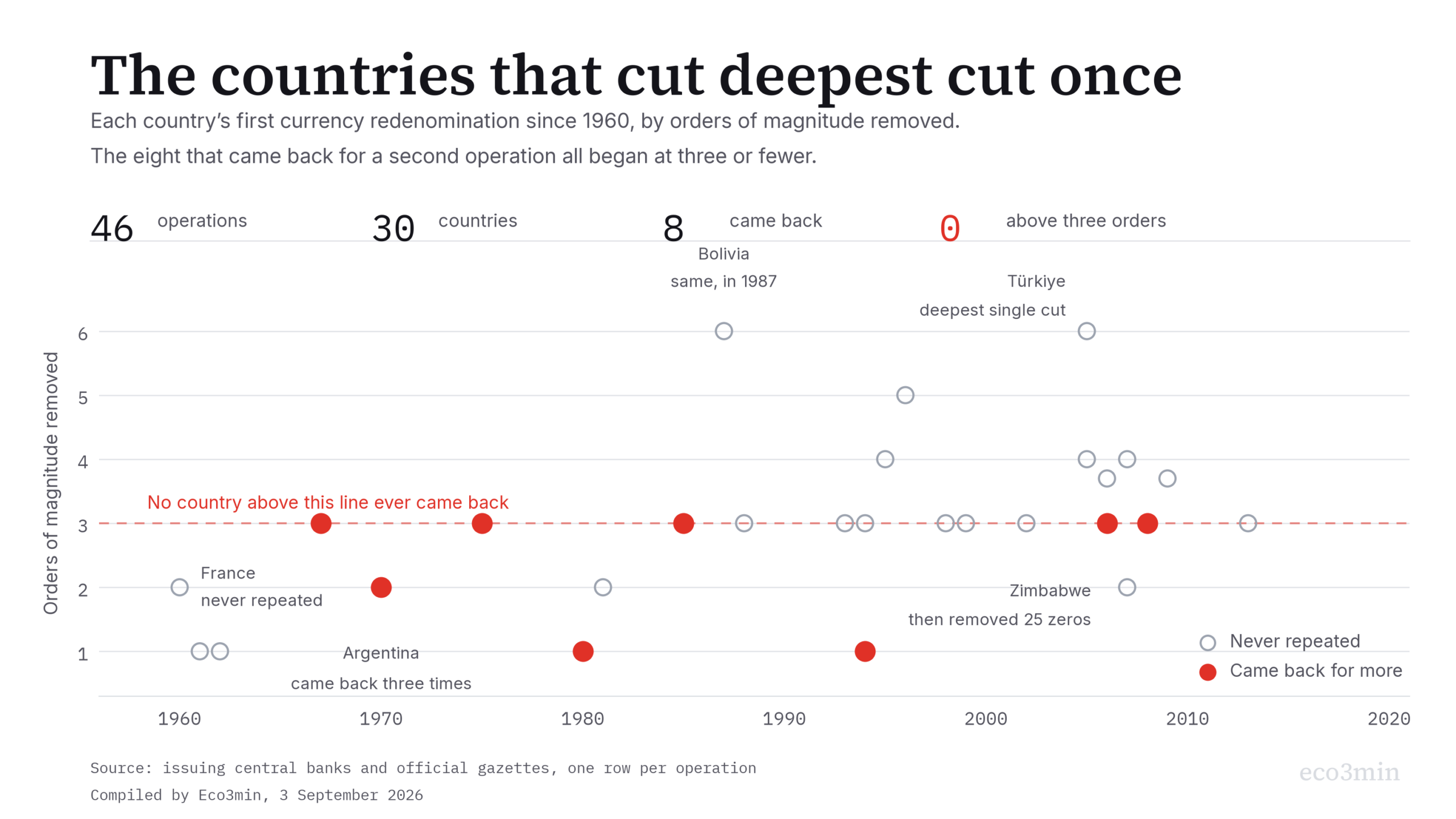
In January 2005, Türkiye deleted six zeros from the lira. Consumer price inflation had peaked at 105.2 per cent in 1994 and was still near 89.1 per cent the following year, on World Bank figures drawn from TurkStat; by 2005 it was 8.2 per cent. The zeros came off after the fire was out, and the operation was a filing exercise. Türkiye has not had to do it since.
That is one way this goes. The register below holds the other ways.
Every currency redenomination since 1960
One row per operation, ordered by date of entry into force. The ratio column reads as the number of old units exchanged for one new unit. The bar shows zeros removed, on a common scale.
| # | Country | In force | Unit | Ratio | Zeros | Source |
|---|---|---|---|---|---|---|
| 1 | France | 1 January 1960 | franc to new franc | 100:1 | 2 | Official Journal of the French Republic |
| 2 | Soviet Union | 1 January 1961 | old ruble to new ruble | 10:1 | 1 | Bank of Russia archives |
| 3 | South Korea | 10 June 1962 | hwan to won | 10:1 | 1 | Bank of Korea |
| 4 | Brazil | 13 February 1967 | cruzeiro to cruzeiro novo | 1,000:1 | 3 | Banco Central do Brasil |
| 5 | Argentina | 1 January 1970 | peso moneda nacional to peso ley 18.188 | 100:1 | 2 | Banco Central de la República Argentina |
| 6 | Chile | 1975 | escudo to peso | 1,000:1 | 3 | Banco Central de Chile partial |
| 7 | Uruguay | 1 July 1975 | peso to nuevo peso | 1,000:1 | 3 | Banco Central del Uruguay |
| 8 | Israel | 22 February 1980 | lira to sheqel | 10:1 | 1 | Bank of Israel |
| 9 | Iceland | 1 January 1981 | old krona to new krona | 100:1 | 2 | Seðlabanki Íslands |
| 10 | Argentina | 1 June 1983 | peso ley 18.188 to peso argentino | 10,000:1 | 4 | Banco Central de la República Argentina |
| 11 | Peru | February 1985 | sol de oro to inti | 1,000:1 | 3 | Banco Central de Reserva del Perú partial |
| 12 | Argentina | 15 June 1985 | peso argentino to austral | 1,000:1 | 3 | Banco Central de la República Argentina |
| 13 | Israel | 4 September 1985 | sheqel to new sheqel | 1,000:1 | 3 | Bank of Israel |
| 14 | Brazil | 28 February 1986 | cruzeiro to cruzado | 1,000:1 | 3 | Banco Central do Brasil |
| 15 | Bolivia | 1 January 1987 | peso boliviano to boliviano | 1,000,000:1 | 6 | Banco Central de Bolivia |
| 16 | Nicaragua | 14 February 1988 | cordoba to cordoba nuevo | 1,000:1 | 3 | Banco Central de Nicaragua |
| 17 | Brazil | 16 January 1989 | cruzado to cruzado novo | 1,000:1 | 3 | Banco Central do Brasil |
| 18 | Peru | 1 July 1991 | inti to nuevo sol | 1,000,000:1 | 6 | Banco Central de Reserva del Perú |
| 19 | Argentina | 1 January 1992 | austral to peso convertible | 10,000:1 | 4 | Banco Central de la República Argentina |
| 20 | Mexico | 1 January 1993 | peso to nuevo peso | 1,000:1 | 3 | Banco de México |
| 21 | Uruguay | 1993 | nuevo peso to peso uruguayo | 1,000:1 | 3 | Banco Central del Uruguay partial |
| 22 | Brazil | 1 August 1993 | cruzeiro to cruzeiro real | 1,000:1 | 3 | Banco Central do Brasil |
| 23 | Croatia | 30 May 1994 | Croatian dinar to kuna | 1,000:1 | 3 | Hrvatska narodna banka |
| 24 | Brazil | 1 July 1994 | cruzeiro real to real | 2,750:1 | – | Banco Central do Brasil |
| 25 | Belarus | 20 August 1994 | ruble to ruble | 10:1 | 1 | National Bank of the Republic of Belarus |
| 26 | Poland | 1 January 1995 | old zloty to zloty | 10,000:1 | 4 | Narodowy Bank Polski |
| 27 | Ukraine | 2 September 1996 | karbovanets to hryvnia | 100,000:1 | 5 | National Bank of Ukraine |
| 28 | Russia | 1 January 1998 | ruble to ruble | 1,000:1 | 3 | Bank of Russia, 1998 annual report |
| 29 | Bulgaria | 5 July 1999 | old lev to lev | 1,000:1 | 3 | Bulgarian National Bank |
| 30 | Belarus | 1 January 2000 | ruble to ruble | 1,000:1 | 3 | National Bank of the Republic of Belarus |
| 31 | Afghanistan | 2002 | old afghani to afghani | 1,000:1 | 3 | Da Afghanistan Bank partial |
| 32 | Türkiye | 1 January 2005 | Turkish lira to new Turkish lira | 1,000,000:1 | 6 | Türkiye Cumhuriyet Merkez Bankası |
| 33 | Romania | 1 July 2005 | old leu to leu | 10,000:1 | 4 | Banca Națională a României |
| 34 | Azerbaijan | 1 January 2006 | old manat to manat | 5,000:1 | – | Central Bank of the Republic of Azerbaijan |
| 35 | Mozambique | 1 July 2006 | metical to new metical | 1,000:1 | 3 | Banco de Moçambique |
| 36 | Zimbabwe | 1 August 2006 | dollar to dollar | 1,000:1 | 3 | Zimbabwe Government Gazette |
| 37 | Sudan | January 2007 | dinar to Sudanese pound | 100:1 | 2 | Central Bank of Sudan partial |
| 38 | Ghana | July 2007 | cedi to Ghana cedi | 10,000:1 | 4 | Bank of Ghana partial |
| 39 | Venezuela | 1 January 2008 | bolivar to bolivar fuerte | 1,000:1 | 3 | Banco Central de Venezuela |
| 40 | Zimbabwe | 1 August 2008 | dollar to dollar | 1010:1 | 10 | Zimbabwe Government Gazette Extraordinary |
| 41 | Turkmenistan | 1 January 2009 | old manat to manat | 5,000:1 | – | Central Bank of Turkmenistan |
| 42 | Zimbabwe | February 2009 | dollar to dollar | 1012:1 | 12 | Reserve Bank of Zimbabwe |
| 43 | Zambia | 1 January 2013 | old kwacha to kwacha | 1,000:1 | 3 | Bank of Zambia |
| 44 | Belarus | 1 July 2016 | ruble to ruble | 10,000:1 | 4 | National Bank of the Republic of Belarus |
| 45 | Venezuela | 20 August 2018 | bolivar fuerte to bolivar soberano | 100,000:1 | 5 | Banco Central de Venezuela |
| 46 | Venezuela | 1 October 2021 | bolivar soberano to bolivar digital | 1,000,000:1 | 6 | Banco Central de Venezuela |
What counts as a redenomination, and what does not
The count depends on a definition, so here is the one used: a change in the scale of the unit of account, at a ratio other than one, on a continuous monetary territory. Everything in the table meets it. Several famous currency events do not.
Brazil is the clearest illustration. The Banco Central do Brasil lists eight monetary standards since 1960, but only five of them changed the scale. In 1970, 1984 and 1990 the currency was renamed at one to one: one cruzado novo became one cruzeiro, and nothing else moved. Counting those would inflate Brazil from five operations to eight without a single extra zero being removed.
- Bresil 1970, 1984, 1990. Trois changements de padrao monetario a ratio 1:1 (NCr$1,00 = Cr$1,00). Le nom change, l’echelle non.
- Turquie 2009. Retrait du prefixe ‘nouvelle’ de la livre turque, prevu par la loi 5083 comme seconde etape. Ratio 1:1.
- Zone euro, 1999 et apres. Substitution externe : les monnaies nationales sont remplacees par une monnaie commune, pas rebasees.
- Equateur 2000, Salvador 2001. Dollarisation : substitution externe.
- Royaume-Uni et Irlande 1971. Decimalisation : changement de base divisionnaire (240 pence deviennent 100), l’unite de compte est inchangee. Une livre reste une livre.
The other confusion worth closing is with hyperinflation. A redenomination is an administrative act; hyperinflation is a price process. The two coincide often enough to be conflated and diverge often enough that the conflation misleads, which is why Eco3min keeps a separate record of which episodes actually crossed into hyperinflation, built on a different criterion and a different source.
The British case is the one most often miscounted. Decimalisation on 15 February 1971 replaced 240 pence to the pound with 100, which changed the subdivision and left the pound itself untouched. It belongs to a different family of operations, and it is why no major English-speaking currency appears anywhere in this register.
The size of the cut is not the story
The intuition is that a big ratio signals a big disaster. The register does not support it, and the clean test is France against Argentina.
France removed two zeros on 1 January 1960, under an ordinance signed on 27 December 1958. Argentina removed exactly the same two zeros on 1 January 1970, under Ley 18.188. Identical gesture, identical ratio, ten years apart. France never touched the scale of its currency again. Argentina came back in 1983, in 1985 and in 1992.
Across the whole register the pattern holds in an uncomfortable direction. The median first operation removed 3 zeros among the countries that never repeated, and 3 zeros among those that did: the same number. The depth of the first cut carries no signal at all about what follows. What does carry a signal is the ceiling. No country whose first operation removed more than three orders of magnitude has ever had to run a second one, and eight countries in the register did exactly that and stopped. Orders of magnitude rather than whole zeros, because three of the ratios here are not powers of ten.
Among the eight countries that came back, five escalated monotonically: Israel, Peru, Belarus, Zimbabwe and Venezuela. Belarus went from one zero to three to four. Venezuela went from three to five to six. Zimbabwe went from three to ten to twelve, the last two operations separated by six months, against the backdrop of the collapse behind those three operations.
A deep redenomination marks the end of an inflation. The shallow ones are the bets placed while it is still running.
What the register does not prove
The ceiling result rests on eight repeat countries. That is a small group, and one future case would break it. It is stated here as a property of this register, not as a law.
The causal arrow is also open, and probably points backwards. A government choosing to strike six zeros at once usually does so because the episode has already been stabilised and the final scale is known. A government striking three is often still inside the episode, sizing the cut against an inflation that has not finished. On that reading the depth of the cut is a consequence of stabilisation rather than a cause of it, and the register cannot separate the two. Separating the two takes a reading by regime, the kind that starts from inflation regimes and their structural drivers.
The record is also silent on cost. Nothing here measures what these operations did to contracts, to savings, or to the price level in the months that followed. The table counts zeros, and zeros are the one thing a redenomination is guaranteed to change.
The error is reading the number of zeros removed as a measure of how severe the inflation was. It misleads because the ratio is chosen after the fact, and the governments that cut deepest are usually those that have already stopped the bleeding. The ratio describes the past; the repetition describes the present.
The gaps, named
forty of the forty-six rows are verified in full against a primary source. Six carry a confirmed ratio and an unconfirmed day of entry into force, flagged in the table and in the CSV. Nothing here is sourced from an aggregator.
That standard has a price, and the price is eleven known cases left out:
- Yougoslavie. Cinq redenominations documentees entre 1990 et 1994, dont la plus grande jamais enregistree. La banque centrale emettrice a disparu avec l’Etat ; la Banque nationale de Serbie ne documente pas les reformes de son predecesseur. Aucun ratio verifiable en primaire.
- Angola. Deux reformes attendues sur la decennie 1990. Le Banco Nacional de Angola ne publie pas d’historique de ses unites monetaires.
- Georgie. Lari introduit le 25/09/1995 (date confirmee par la Banque nationale de Georgie), mais le ratio face au coupon n’est pas publie.
- Tadjikistan. Somoni introduit le 30/10/2000 (date confirmee par la Banque nationale du Tadjikistan), ratio non publie.
- Moldavie. Leu introduit le 29/11/1993 par decret presidentiel 200/1993 (date et texte confirmes par la BNM), ratio face au coupon non publie.
- Lettonie. Lats substitue au rouble letton a partir du 05/03/1993 (date confirmee par Latvijas Banka), ratio non publie.
- Macedoine du Nord. Denomination de 1993 non documentee avec son ratio par la banque centrale.
- Indonesie. Reforme du 13/12/1965 etablie par le decret presidentiel 27/1965 (confirme par Bank Indonesia), ratio non publie.
- Vietnam. Echange monetaire de septembre 1985 confirme par la State Bank of Vietnam, ratio non publie.
- Nicaragua (1990 et 1991). Deux operations successives decrites par le Banco Central de Nicaragua, mais exprimees en parite avec le dollar plutot qu’en ratio de conversion interne. Non reductibles a un ratio.
- Chili (1960). Passage du peso a l’escudo au ratio de 1 000 pour 1, atteste par le Banco Central de Chile, mais date d’effet non confirmee en primaire et possiblement anterieure au 01/01/1960.
Yugoslavia is the significant loss. It ran the densest sequence of redenominations on record in the early 1990s, and the central bank that carried them out disappeared with the state. Its successor does not document them. A register that filled that hole from a secondary compilation would be longer and worth less.
A vanishing operation
Twenty-one of the forty-six operations use the same ratio of 1,000 to one, 46 per cent of the register, which makes three zeros the default unit of this particular currency surgery. Only one row departs from a round figure entirely: Brazil in July 1994 converted at 2,750 cruzeiros reais to the real, because the rate came from the transition unit of account rather than from striking zeros.
The other visible movement is the disappearance. The register carries thirty-two operations between 1985 and 2009, and four since 2010: Zambia in 2013, Belarus in 2016, Venezuela in 2018, Venezuela in 2021. Whatever else the last sixteen years did to the world’s currencies, they left the zeros where they were.
Questions
How many currency redenominations have there been since 1960?
Forty-six, across thirty countries, on the criterion used here: a change in the scale of the unit of account at a ratio other than one, on a continuous monetary territory. Renamings at one to one, euro adoption, dollarisation and decimalisation are excluded. eleven further cases are known but omitted because no issuing central bank publishes their ratio.
Which redenomination removed the most zeros?
Zimbabwe in February 2009, at 1,000,000,000,000 old dollars for one new dollar, or twelve zeros in a single operation. It was the third Zimbabwean operation in three years, after three zeros in August 2006 and ten in August 2008, for twenty-five zeros in total.
Has the US dollar or the pound sterling ever been redenominated?
Neither appears in this register, and nor do the Canadian, Australian, New Zealand or Irish currencies. British and Irish decimalisation on 15 February 1971 changed the subdivision of the pound from 240 pence to 100, which is a different operation: the unit of account kept its value.
Does removing zeros change the rate of inflation?
A redenomination rescales existing prices and contracts by a constant, so by construction it leaves relative prices and the inflation rate unchanged on the day it takes effect. The register shows what happened afterwards rather than what the operation caused: twenty-two countries never ran a second one, and eight did. Between two cuts, the price dynamics themselves belong to inflation read through its mechanisms, measurement and history, not to the register.
Last updated — 18 September 2026
Disclaimer – Financial Information: The analyses, commentary, and content published on eco3min.fr are provided for informational and educational purposes only. They do not constitute investment advice or a solicitation to buy or sell financial instruments. Past performance is not indicative of future results. All investment decisions involve risk and are the sole responsibility of the reader.