
Inflation-linked bonds: what they protect (and what they don’t)

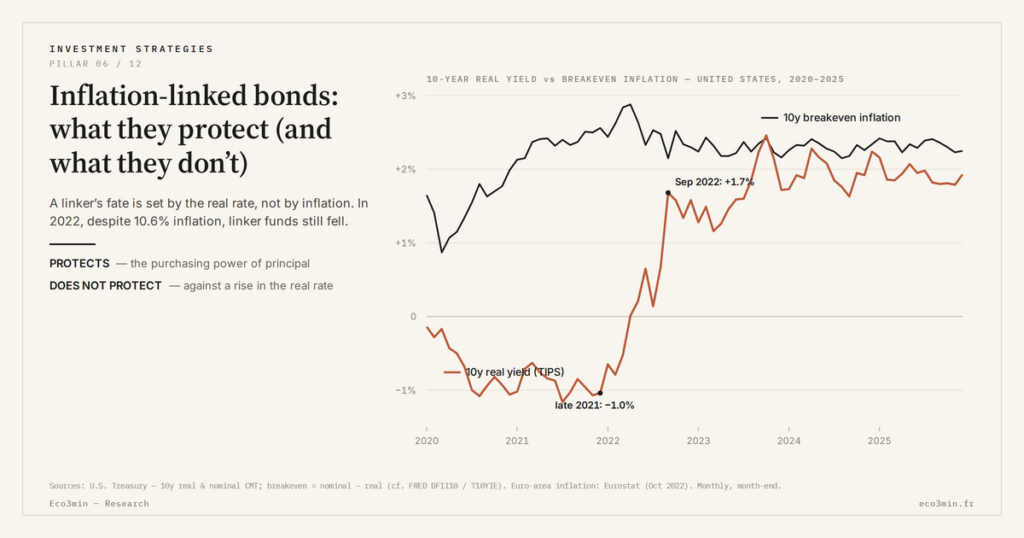
Inflation-linked bonds protect the purchasing power of the principal against rising prices, but not against rising real rates. In 2022, despite double-digit inflation, TIPS and OATi ETFs fell, because the real-rate component outweighed the indexation.
TL;DR
Buying an inflation-linked bond means taking a position on the breakeven, the inflation the market already prices in; it beats its nominal twin only if realised inflation exceeds that.
- An inflation-linked bond carries a real duration: when the real rate rises, the present value of its flows falls. In 2022, euro-area inflation peaked above 10% (Eurostat, October 2022), yet inflation-linked ETFs still fell.
- The inflation breakeven, the gap between nominal and real yields, is the price of that protection: a linker outperforms its nominal equivalent only when realised inflation exceeds the level the market had already priced in.
Protecting against inflation and protecting against losses are two distinct things. This page describes what indexation covers, what it leaves intact, and how the breakeven frames the relative case for these securities by regime.
Inflation-linked bonds carry a promise that is widely misread: they protect principal against rising prices, but not against rising real rates — and the two do not always move together. In 2022, with euro-area inflation peaking above 10% (Eurostat, October 2022), TIPS and OATi ETFs still fell, because the climb in real rates outweighed the inflation accrual. The protection is genuine, but conditional on the regime. This page describes what the indexation covers, what it does not, and how the inflation breakeven — the gap between nominal and real yields — frames the relative case for these securities. It covers the limits of the protection and its reading by regime, and refers for the detailed workings of the calculation to the indexation mechanics in detail. It describes an asset’s behaviour across regimes; it prescribes no allocation. This observation aligns with the analysis in the Eco3min lens on selecting investments by cycle.
What indexation protects: the purchasing power of the principal
An inflation-linked bond adjusts its reference value — the principal, and therefore the coupon computed on that principal — to the movement of a price index. Concretely, if prices rise, the principal on which the issuer computes repayment and interest is uplifted by the same amount. At maturity, the holder recovers a capital whose purchasing power has been preserved against the inflation recorded over the life of the security. That is the central promise of the OATi in France, of TIPS in the United States, and of their equivalents: to neutralise monetary erosion on the capital.
This protection is genuine and well-defined. Where a nominal bond pays a fixed coupon whose real value erodes as inflation accelerates, the linked bond maintains the real value of the flows. For a holder whose objective is to preserve the purchasing power of capital over the long term, this characteristic answers a precise need. The exact workings of the adjustment — frequency, reference index, treatment of coupon and principal at maturity — belong to the indexation mechanics, treated separately and referred to in the introduction; there is no need to detail those workings here to grasp the essential limit that follows. For more detail: our study on shielding savings from inflation.
For the protection covers a precise quantity — the purchasing power of the principal — and that alone. It says nothing about the security’s market value before maturity, nor about its behaviour if real rates move. Conflating “protection of purchasing power at maturity” with “protection against market losses during the life of the security” is the most frequent misreading of this asset class.
What it does not protect: real-duration risk
An inflation-linked bond remains a bond. As such, it carries a duration — a sensitivity of its market price to a change in rates. But the relevant rate for a linked security is not the nominal rate: it is the real rate, the nominal rate less inflation expectations. When the real rate rises, the present value of a linker’s real flows falls, exactly as a nominal bond’s value falls when the nominal rate rises. This sensitivity to the real rate is what is called real duration.
2022 made this distinction tangible. With euro-area inflation peaking at 10.6% (Eurostat, October 2022), inflation-linked ETFs fell. The US 10-year real yield went from −1.04% at end-2021 to +1.68% at end-September 2022 (US Treasury, DFII10 series), a 2.7-point rise in nine months, while the 10-year breakeven stayed between 2.15% and 2.88% at month-end. Along that path, a 10-year TIPS held at constant maturity loses about 23% in real price over 2022; indexation, 6.4% of US inflation December to December, offsets only part of it, for a total loss close to 18% (computed from Treasury yields and BLS CPI). The reason lies in the arithmetic: the climb in real rates weighed on the present value of the flows more than the indexation uplifted the principal. A holder who expected their linked fund to rise in the middle of an inflationary surge discovered that it could fall, because the real-rate component dominated the inflation component. Inflation protection was at work; it was simply outweighed by the move in the real rate.
A technical factor often deepens the surprise: indices of linked securities are frequently long in maturity, hence carry a high real duration. Many holders buy these funds for their “inflation protection” label without perceiving that they acquire, at the same time, a marked exposure to real duration. The same rate-sensitivity mechanics described for nominal securities applies here, transposed to the real rate: a long linked fund takes, on a rise in real rates, a capital fall comparable in magnitude to that of a long nominal fund on a rise in nominal rates.
Two opposite scenarios illuminate this dependence. If inflation surprises to the upside while real rates stay stable, the linker clearly outperforms its nominal equivalent: the indexation plays in full, unchecked by the real rate. If, by contrast, inflation comes with a climb in real rates — the 2022 configuration — the capital loss tied to real duration can erase the indexation gain, or exceed it. The same asset, in two different regimes, produces two opposite outcomes in the presence of inflation. It is this dependence on the real rate, not inflation alone, that decides the fate of a linked fund.
An inflation-linked bond is assumed to protect in every case of rising prices. But indexation protects the purchasing power of the principal, not the security’s market value against a rise in real rates. In 2022, despite high inflation, linked funds fell because the real-rate component prevailed. “Protected against inflation” does not mean “protected against losses”.
The inflation breakeven: what you actually take a position on
The variable that articulates protection and risk is the inflation breakeven: the gap between the nominal yield and the real yield of comparable maturity. That breakeven represents the average inflation the market anticipates over the period. It conditions the relative case for a linked security versus its nominal equivalent, on a simple logic: the linker is advantageous if realised inflation exceeds the breakeven, disadvantageous if it stays below.
This logic changes the nature of what is being bought. Acquiring a linked security is not “protecting against inflation” in the abstract, but taking a position on the gap between future inflation and the inflation already priced in. If the market already anticipates high inflation — a high breakeven — the indexation is expensive, and the linker will outperform its nominal equivalent only if realised inflation exceeds that already-high expectation. If the breakeven is low, the indexation is cheap, and an inflation surprise benefits the linker more.
The breakeven therefore reads as a price: the price of inflation protection at the moment of purchase. A linker bought when the breakeven is very high can disappoint even with persistent inflation, if that inflation does not exceed the level already anticipated. That is what separates effective protection from protection paid for too dearly, and it is why the mere presence of inflation does not suffice to make a linked fund a winning holding: it takes an inflation surprise to the upside relative to the consensus.
Reading by real-rate regime
Reading linked securities by regime requires reasoning on the real rate, not on inflation alone. In a regime of rising real rates — as in 2022 — the linker falls, its real duration dominating the indexation effect, even if inflation is high. In a plateau regime of real rates, the linker behaves essentially according to its real carry, the indexation adding recorded inflation to the real yield. In an easing regime of real rates, the linker benefits from the fall in the real rate, independently of inflation, its real duration then amplifying the appreciation. The starting point has changed since 2021: on 30 September 2026 the US 10-year real yield reached 2.93%, its highest since November 2008 and above the October 2023 peak (2.46% at month-end), with a breakeven of 2.36% in early October. Companion research: how each protection holds up regime by regime.
The symmetric case is worth noting. In a regime where inflation undershoots the breakeven priced at purchase, the linker underperforms its nominal equivalent: the holder paid for protection the realised inflation did not justify. A linker is therefore not a one-way bet on protection but a position whose payoff hinges jointly on the real-rate path and on whether inflation beats what was already expected. Neither leg alone settles the outcome, which is why reading a linked fund by the real-rate regime, rather than by the inflation headline, is the discipline this page argues for.
Real-rate risk is, however, only one of two risks “beyond duration” worth knowing. The other is credit risk, which constitutes the other risk beyond duration and obeys a distinct cycle logic. Inflation and credit are two independent axes: a government linker carries no notable credit risk, but a fund of inflation-linked corporate bonds would combine the two. Distinguishing these axes avoids attributing to indexation a behaviour that in fact stems from credit.
Finally, the inflation dimension reaches beyond the linker alone: it is the inflation regime that governs the correlation between equities and bonds, and therefore the diversifying role of fixed income as a whole. The link between inflation and the correlation shift is treated separately. Placed back in the comparison, linked securities emerge as a particularly clear case of the cluster’s thesis: their behaviour depends on the real-rate regime, not on a fixed protective quality. It is this grid that allows one to do the work of placing linkers in the comparison, and to grasp that a holding depends on the regime rather than on a label.
Last updated — 6 October 2026
Disclaimer – Financial and Legal Information: The analyses, commentary, and content published on eco3min.fr are provided for informational and educational purposes only. They do not constitute investment advice or a solicitation to buy or sell financial instruments. Past performance is not indicative of future results. All investment decisions involve risk and are the sole responsibility of the reader. Data, charts and calculated series are provided as is and may contain errors or lag behind their source: check any figure against the primary source cited before relying on it. Content describing laws, regulations or contracts reflects the law as of its publication date and does not constitute legal or tax advice; applying it to a specific situation requires a qualified legal or tax professional.
Read next
Full pillar →Which bond ETF for the rate regime
A bond ETF has no fixed behaviour: the same exposure can cushion a portfolio or erase several years…
Target-Date Funds vs Self-Directed Portfolios: The Mechanics of a Delegated Glide Path
A target-date fund is sold as a simple, set-and-forget win. It is first something narrower: a delegated glide…
What Guaranteed Savings Products Have Paid: Fixed Annuity and Stable Value Yields Through the Rate Cycle
US guaranteed savings products credit a rate that trails the bond market rather than tracking it. Through the…