
Is the US Stock Market Open Today?
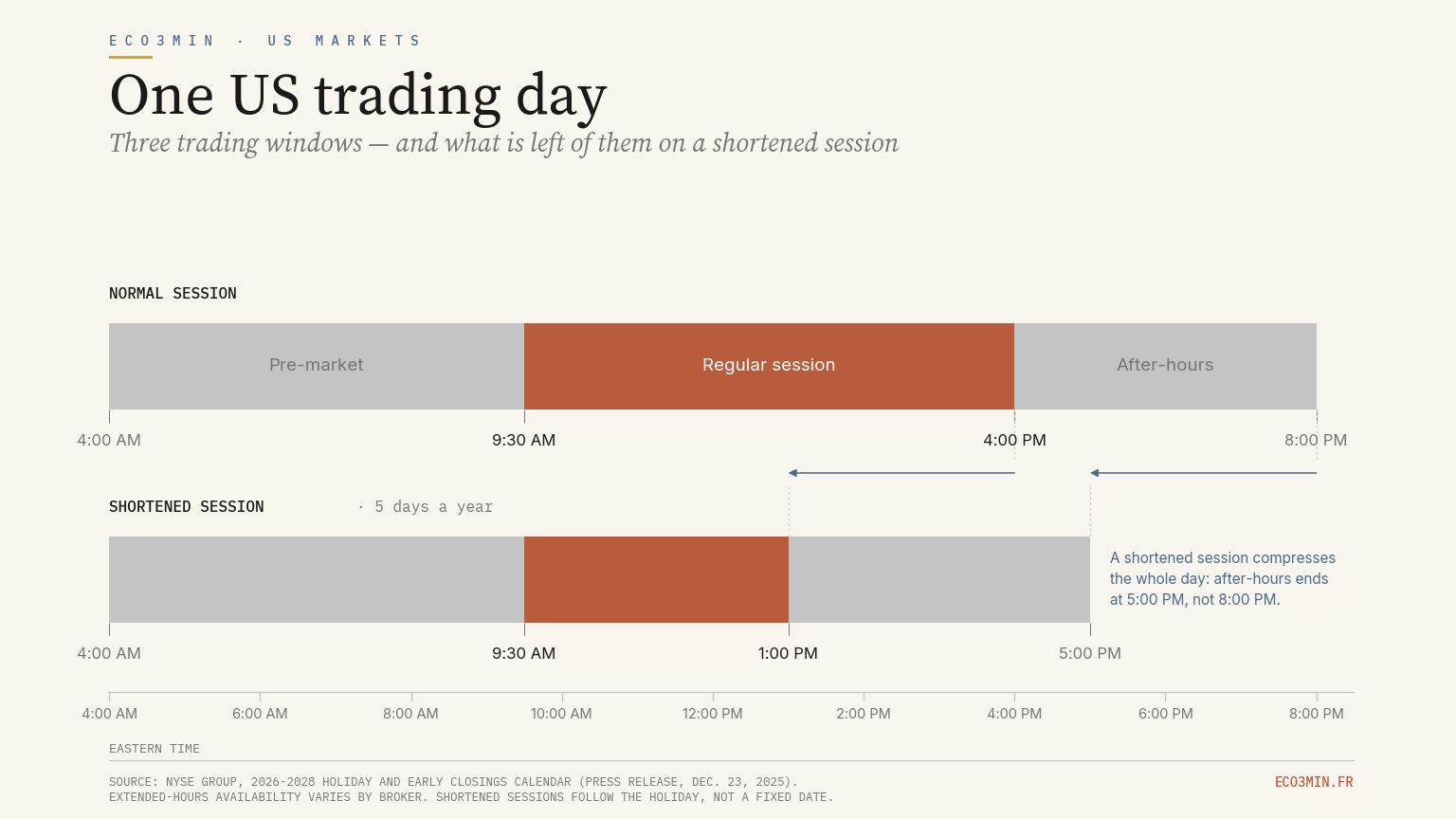
The New York Stock Exchange and Nasdaq trade from 9:30 AM to 4:00 PM Eastern Time, Monday through Friday, on a holiday calendar published years in advance. What catches people out is not the holidays themselves but the exceptions around them: sessions that end at 1:00 PM instead of 4:00 PM, and a bond market that runs on a different calendar entirely — closed on two federal holidays when equities trade a full session. This page shows the live status of the equity market, then lays out both calendars side by side through 2028.
US stock market
Closed
Sources: NYSE Group press release, December 23, 2025 (2026-2028 calendars); SIFMA Holiday Schedule (US fixed income recommendations). Accessed August 6, 2026. SIFMA times are recommendations only: each firm decides whether its desks stay open.
The three sessions of a US trading day
A normal weekday splits into three windows, all Eastern Time. Pre-market runs from 4:00 AM to 9:30 AM, regular trading from 9:30 AM to 4:00 PM, and after-hours from 4:00 PM to 8:00 PM. Only the middle window is the exchange session in the strict sense: it is the one that produces the official opening and closing prices, and the one where the closing auction concentrates the day’s largest single burst of volume.
The two outer windows run on electronic communication networks rather than the exchange floor mechanism. They are open to retail order flow at most brokers, but they carry structurally wider spreads and thinner books, which is why a headline printed at 6:00 AM can move a stock several percent on volume that would be unremarkable at midday. The gap between an after-hours print and the next morning’s official open is a routine feature of earnings season, not an anomaly.
Shortened sessions: the exception that trips people up
On a small number of days each year, both exchanges close at 1:00 PM instead of 4:00 PM. These are not holidays and they are not announced late — NYSE publishes them in the same release as the holiday calendar, years ahead. They cluster around Thanksgiving and Christmas, and they follow the holiday rather than a fixed date, so they migrate through the week from year to year.
One detail that the shortened-session tables usually omit: on those days the after-hours window closes at 5:00 PM rather than 8:00 PM. The whole day compresses, not just the regular session.
The 2027 calendar contains an instructive edge case. Christmas Day falls on a Saturday, so the holiday is observed on Friday, December 24 — which means there is no separate Christmas Eve early close that year, because Christmas Eve is the holiday. The same logic removes New Year’s Day from the 2028 calendar entirely: January 1, 2028 is a Saturday, and NYSE observes no substitute.
The US bond market has no exchange and no opening bell. Trading hours and holiday closures are set by recommendation from SIFMA, the industry trade association, and the recommendations are exactly that — each firm decides for itself whether its fixed income desks stay open. Normal hours run 8:00 AM to 5:00 PM Eastern.
The divergence that matters is structural rather than incidental. Bond settlement runs through Fedwire and the Federal Reserve‘s payment systems, which close on every federal banking holiday. Equity settlement does not have that dependency. So Columbus Day and Veterans Day are full bond market closures while the NYSE and Nasdaq trade an ordinary session — two days a year when the Treasury curve simply does not print while equities are moving.
SIFMA also recommends more shortened sessions than the exchanges do, typically ending at 2:00 PM: the Friday before Memorial Day, the day before Independence Day, the day after Thanksgiving, Christmas Eve and New Year’s Eve. Good Friday is the one date where the recommendation genuinely varies from year to year, sometimes a full close and sometimes a noon cutoff, depending in part on whether the Employment Situation report is released that morning.
Full calendar through 2028
Dates below combine the NYSE Group holiday and early-closing release with SIFMA’s US recommendations. Rows marked to be confirmed on the bond side are dates where SIFMA has published a full closure but not yet its early-close schedule.
| Date | Holiday | Equities (NYSE / Nasdaq) | Bonds (SIFMA rec.) |
|---|---|---|---|
| 2026 | |||
| Thursday, January 1, 2026 | New Year's Day | Closed | Closed |
| Monday, January 19, 2026 | Martin Luther King Jr. Day | Closed | Closed |
| Monday, February 16, 2026 | Presidents' Day | Closed | Closed |
| Friday, April 3, 2026 | Good Friday | Closed | Closes 12:00 PM |
| Friday, May 22, 2026 | Friday before Memorial Day | Normal session | Closes 2:00 PM |
| Monday, May 25, 2026 | Memorial Day | Closed | Closed |
| Friday, June 19, 2026 | Juneteenth | Closed | Closed |
| Thursday, July 2, 2026 | Day before Independence Day | Normal session | Closes 2:00 PM |
| Friday, July 3, 2026 | Independence Day (observed) | Closed | Closed |
| Monday, September 7, 2026 | Labor Day | Closed | Closed |
| Monday, October 12, 2026 | Columbus Day | Normal session | Closed |
| Wednesday, November 11, 2026 | Veterans Day | Normal session | Closed |
| Thursday, November 26, 2026 | Thanksgiving Day | Closed | Closed |
| Friday, November 27, 2026 | Day after Thanksgiving | Closes 1:00 PM | Closes 2:00 PM |
| Thursday, December 24, 2026 | Christmas Eve | Closes 1:00 PM | Closes 2:00 PM |
| Friday, December 25, 2026 | Christmas Day | Closed | Closed |
| Thursday, December 31, 2026 | New Year's Eve | Normal session | Closes 2:00 PM |
| 2027 | |||
| Friday, January 1, 2027 | New Year's Day | Closed | Closed |
| Monday, January 18, 2027 | Martin Luther King Jr. Day | Closed | Closed |
| Monday, February 15, 2027 | Presidents' Day | Closed | Closed |
| Friday, March 26, 2027 | Good Friday | Closed | To be confirmed |
| Monday, May 31, 2027 | Memorial Day | Closed | Closed |
| Friday, June 18, 2027 | Juneteenth (observed) | Closed | Closed |
| Monday, July 5, 2027 | Independence Day (observed) | Closed | Closed |
| Monday, September 6, 2027 | Labor Day | Closed | Closed |
| Monday, October 11, 2027 | Columbus Day | Normal session | Closed |
| Thursday, November 11, 2027 | Veterans Day | Normal session | Closed |
| Thursday, November 25, 2027 | Thanksgiving Day | Closed | Closed |
| Friday, November 26, 2027 | Day after Thanksgiving | Closes 1:00 PM | To be confirmed |
| Friday, December 24, 2027 | Christmas Day (observed) | Closed | Closed |
| 2028 | |||
| Monday, January 17, 2028 | Martin Luther King Jr. Day | Closed | — |
| Monday, February 21, 2028 | Presidents' Day | Closed | — |
| Friday, April 14, 2028 | Good Friday | Closed | — |
| Monday, May 29, 2028 | Memorial Day | Closed | — |
| Monday, June 19, 2028 | Juneteenth | Closed | — |
| Monday, July 3, 2028 | Day before Independence Day | Closes 1:00 PM | — |
| Tuesday, July 4, 2028 | Independence Day | Closed | — |
| Monday, September 4, 2028 | Labor Day | Closed | — |
| Thursday, November 23, 2028 | Thanksgiving Day | Closed | — |
| Friday, November 24, 2028 | Day after Thanksgiving | Closes 1:00 PM | — |
| Monday, December 25, 2028 | Christmas Day | Closed | — |
Sources: NYSE Group press release, December 23, 2025 (2026-2028 calendars); SIFMA Holiday Schedule (US fixed income recommendations). Accessed August 6, 2026. SIFMA times are recommendations only: each firm decides whether its desks stay open.
What a closed market does not stop
A holiday closure suspends price discovery on the cash market; it does not suspend the economy. Futures on the major indices trade on CME Globex on an almost-continuous schedule and often remain open, in shortened form, on days when the cash market is shut. Foreign exchange runs continuously from Sunday evening to Friday evening regardless of US holidays. And macroeconomic releases follow their own calendar: on Good Friday, April 3, 2026 — an equity market holiday — the Bureau of Labor Statistics released the Employment Situation report on schedule, a case SIFMA flagged explicitly in its own closure recommendation for that day.
The practical consequence is that a closure is a gap in the record rather than a pause in events. When the cash market reopens, it reprices everything that accumulated in the interval at once — which is why the opening print after a three-day weekend has three days of news to absorb rather than one. The mechanism sits within the market regimes and financial dynamics framework; the underlying series are available in the macro-financial data hub.
Frequently asked questions
What time does the US stock market open and close?
Regular trading runs from 9:30 AM to 4:00 PM Eastern Time, Monday through Friday. Pre-market trading is available from 4:00 AM and after-hours trading until 8:00 PM at most brokers, both with wider spreads and thinner liquidity than the regular session.
Is the stock market open on Columbus Day and Veterans Day?
Yes for equities — the NYSE and Nasdaq trade a normal session on both. The bond market is closed on both, because fixed income settlement depends on Federal Reserve payment systems that observe every federal banking holiday. These are the two clearest days each year where the two calendars diverge.
Which days does the market close early?
Both exchanges close at 1:00 PM Eastern on the day after Thanksgiving, and on Christmas Eve or the day before Independence Day when those fall on a weekday that is not itself a holiday. On shortened days the after-hours window also ends early, at 5:00 PM rather than 8:00 PM.
Why is there no Christmas Eve early close in 2027?
Because Christmas Day falls on a Saturday in 2027 and the holiday is observed on Friday, December 24. Christmas Eve is the closure itself, so there is no shortened session before it. The same rule removes New Year’s Day from the 2028 calendar: January 1 falls on a Saturday and no substitute day is observed.
Do futures trade when the stock market is closed?
Generally yes. Equity index futures trade on CME Globex on a near-continuous schedule and typically remain open in shortened form on US holidays, though not always. Foreign exchange trades continuously from Sunday evening to Friday evening irrespective of the US holiday calendar.
Are these dates final?
NYSE publishes its holiday and early-closing calendar roughly three years ahead and it changes very rarely. SIFMA’s bond market schedule is a set of recommendations, revised each December for the following two years and occasionally adjusted for market conditions.
Last updated — 8 October 2026
Disclaimer – Financial and Legal Information: The analyses, commentary, and content published on eco3min.fr are provided for informational and educational purposes only. They do not constitute investment advice or a solicitation to buy or sell financial instruments. Past performance is not indicative of future results. All investment decisions involve risk and are the sole responsibility of the reader. Data, charts and calculated series are provided as is and may contain errors or lag behind their source: check any figure against the primary source cited before relying on it. Content describing laws, regulations or contracts reflects the law as of its publication date and does not constitute legal or tax advice; applying it to a specific situation requires a qualified legal or tax professional.