
US-Europe Daylight Saving Gap: When the Clock Offset Changes
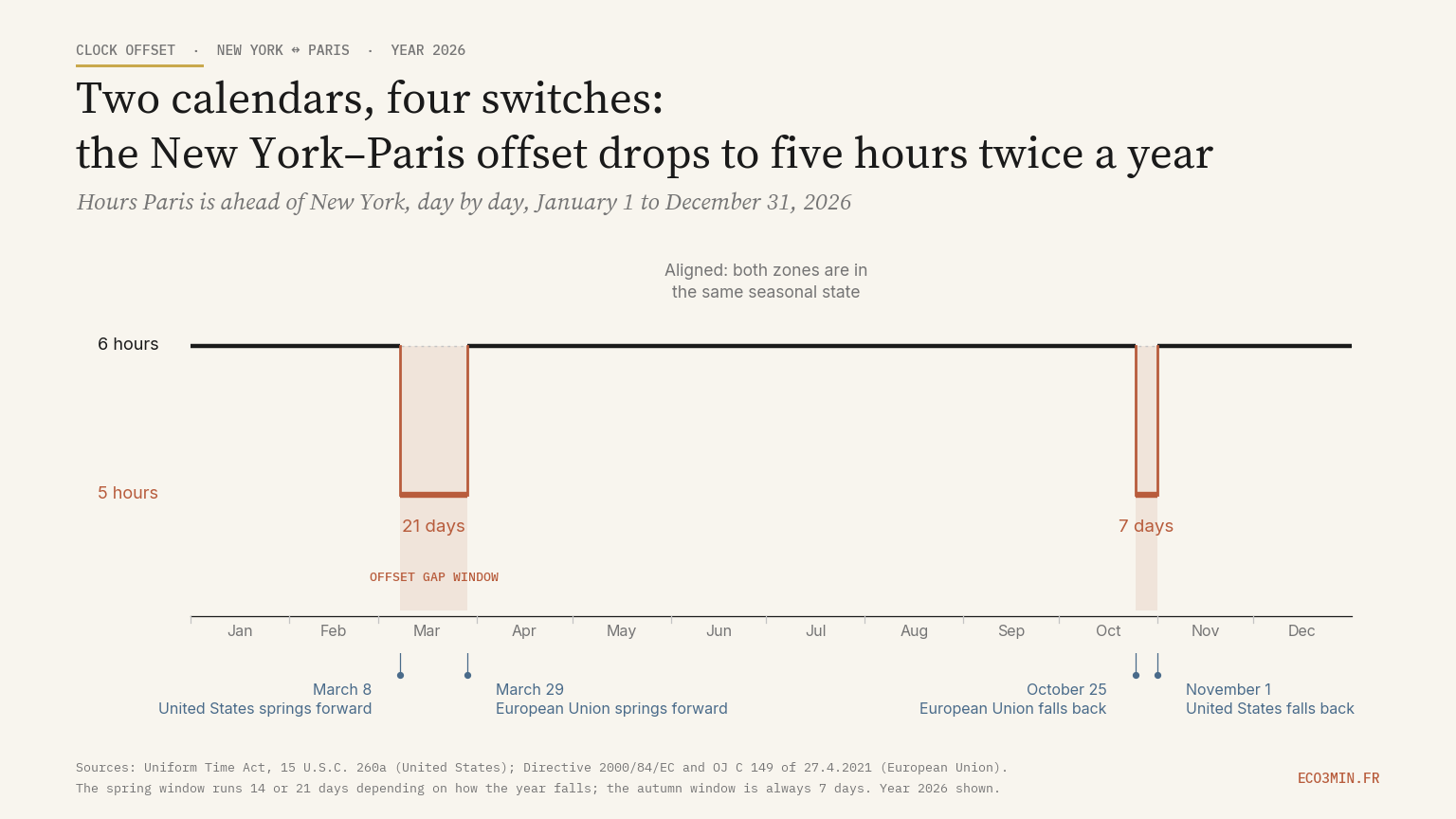
New York and Paris sit six hours apart for eleven months of the year. Twice a year the gap narrows to five hours, because the United States and the European Union do not change their clocks on the same dates: second Sunday in March and first Sunday in November on one side, last Sunday in March and last Sunday in October on the other. The result is two offset gap windows, two or three weeks long in spring and seven days long in autumn, during which any conversion built on “six hours” is wrong by one. This page gives today’s offset, the next switch date, the table of windows over the next six years, and where the two pending reforms stand.
New York ↔ Paris clock offset
6 hours
Aligned. New York and Paris are in the same seasonal state, so the offset sits at its reference value.
At this offset
- 9:00 a.m. in Paris is 3:00 a.m. in New York
- 5:30 p.m. in Paris is 11:30 a.m. in New York
- 9:30 a.m. in New York is 3:30 p.m. in Paris
Next change: Sunday, October 25, 2026. European Union, clocks back one hour.
Transitions derived from the server time-zone database (rules: Uniform Time Act, 15 U.S.C. 260a, for the United States; Directive 2000/84/EC for the European Union). Local times.
Two statutes, two calendars
On the US side the rule sits in section 3 of the Uniform Time Act of 1966, codified at title 15, section 260a of the United States Code. As it now reads, following section 110 of the Energy Policy Act of 2005, daylight saving time runs from 2 a.m. on the second Sunday in March to 2 a.m. on the first Sunday in November. The previous dates — first Sunday in April and last Sunday in October — applied through 2006; the current calendar took effect in March 2007.
On the European side the rule sits in articles 2 and 3 of Directive 2000/84/EC of 19 January 2001. The summer-time period begins at 1 a.m. Universal Time on the last Sunday in March and ends at 1 a.m. Universal Time on the last Sunday in October. The text sets no expiry: it provides that these dates apply “from 2002 onwards”, with no closing date.
Beyond the dates, the two texts differ on a point most conversion tools handle badly. The European directive fixes a single instant in Universal Time, so all twenty-seven member states switch simultaneously. The US statute fixes 2 a.m. in each zone’s own local time: Eastern switches first, Pacific three hours later in real time. For those three hours the gap between New York and Los Angeles is two hours rather than three.
The friction: two windows a year, only one of variable length
The spring window opens when US clocks go forward, on the second Sunday in March, and closes when EU clocks go forward, on the last Sunday of the same month. Through that interval North America is already on daylight saving time while Europe is still on winter time, and the New York-Paris offset falls from six hours to five. Its length is not constant from year to year, since it depends on where the Sundays fall in March.
The autumn window works the other way round. It opens when the European Union returns to winter time, on the last Sunday in October, and closes when the United States returns to standard time, on the first Sunday in November. Europe has gone back to standard time while North America is still on daylight saving, and the offset falls to five hours again. Its length, by contrast, never varies.
The table below lists those windows for the years ahead. Dates are computed from the server time-zone database — the same one operating systems and programming libraries read — rather than keyed in by hand.
| Year | Window | Opens | Closes | Length | Offset |
|---|---|---|---|---|---|
| 2026 | Spring | March 8 United States, clocks forward one hour | March 29 European Union, clocks forward one hour | 21 d | 5 hours |
| 2026 | Autumn | October 25 European Union, clocks back one hour | November 1 United States, clocks back one hour | 7 d | 5 hours |
| 2027 | Spring | March 14 United States, clocks forward one hour | March 28 European Union, clocks forward one hour | 14 d | 5 hours |
| 2027 | Autumn | October 31 European Union, clocks back one hour | November 7 United States, clocks back one hour | 7 d | 5 hours |
| 2028 | Spring | March 12 United States, clocks forward one hour | March 26 European Union, clocks forward one hour | 14 d | 5 hours |
| 2028 | Autumn | October 29 European Union, clocks back one hour | November 5 United States, clocks back one hour | 7 d | 5 hours |
| 2029 | Spring | March 11 United States, clocks forward one hour | March 25 European Union, clocks forward one hour | 14 d | 5 hours |
| 2029 | Autumn | October 28 European Union, clocks back one hour | November 4 United States, clocks back one hour | 7 d | 5 hours |
| 2030 | Spring | March 10 United States, clocks forward one hour | March 31 European Union, clocks forward one hour | 21 d | 5 hours |
| 2030 | Autumn | October 27 European Union, clocks back one hour | November 3 United States, clocks back one hour | 7 d | 5 hours |
| 2031 | Spring | March 9 United States, clocks forward one hour | March 30 European Union, clocks forward one hour | 21 d | 5 hours |
| 2031 | Autumn | October 26 European Union, clocks back one hour | November 2 United States, clocks back one hour | 7 d | 5 hours |
Transitions derived from the server time-zone database (rules: Uniform Time Act, 15 U.S.C. 260a, for the United States; Directive 2000/84/EC for the European Union). Local times.
What the window moves
Any appointment anchored to New York time appears one hour earlier from Paris during the window, then returns. The New York Stock Exchange core trading session, which runs from 9:30 a.m. to 4:00 p.m. Eastern Time, opens at 3:30 p.m. Paris time in the aligned regime and at 2:30 p.m. during a window. The Federal Open Market Committee statement, released at 2:00 p.m. Eastern Time on decision days, lands at 8:00 p.m. Paris time in the aligned regime and at 7:00 p.m. during a window.
The shift runs both ways. A meeting set for 5:30 p.m. Paris time, which is 11:30 a.m. in New York for most of the year, becomes 12:30 p.m. during the window. Nothing moves in either side’s local diary: what moves is the correspondence between them, which is why the error usually goes unnoticed until the meeting starts. How US policy transmits into European assets is covered under macro-financial regimes, the underlying series are catalogued in research and data, and the current reading sits on Macro Watch.
A mismatch that has not always looked like this
The current pattern dates from 2007. Before then US daylight saving ended on the last Sunday in October, exactly as in Europe, so there was no autumn window. In spring the mismatch existed but ran the other way, with the European Union switching first on the last Sunday in March and the United States a week later on the first Sunday in April. The Energy Policy Act of 2005 did not create the mismatch: it reversed its direction in spring and opened a window in autumn.
Two reforms could move these boundaries again, and neither has been completed. On the European side the Commission proposed in September 2018 to repeal Directive 2000/84/EC; the European Parliament adopted its first-reading position on 26 March 2019, by 410 votes to 192 with 51 abstentions. The Council has never adopted its own, and the procedure remains open with no deadline. On the US side the House of Representatives passed H.R. 139, the Sunshine Protection Act, on 14 July 2026 by 308 votes to 117; the bill was received in the Senate on 15 July and referred to the Committee on Commerce, Science, and Transportation. It repeals section 3 of the Uniform Time Act, which carries the seasonal period, and advances each zone’s reference offset by one hour, while leaving states already exempt free to keep their current standard time.
The two files do not bear on the transatlantic offset in the same way. A European repeal that let each member state choose between permanent summer and permanent winter time would redraw the zone map inside the Union. Permanent US daylight saving time, by contrast, would not remove the mismatch: it would extend it, as the last question below sets out.
Frequently asked questions
Why do US and European clocks change on different dates?
Because the two calendars come from independent statutes adopted thirty-five years apart, with no procedure for aligning them. The European calendar comes from Directive 2000/84/EC of 19 January 2001; the US calendar comes from the Uniform Time Act of 1966, whose dates were changed by section 110 of the Energy Policy Act of 2005. Each designates a Sunday relative to a month, but neither the Sundays nor the months line up. No joint body is charged with reconciling them.
How long does the offset gap last?
The spring window runs fourteen or twenty-one days depending on the year. It separates the second Sunday in March from the last Sunday in March: when March has five Sundays those dates are three weeks apart, when it has four they are two weeks apart. The autumn window is always exactly seven days, as a matter of arithmetic: the last Sunday in October necessarily falls between the 25th and the 31st, and adding seven days necessarily lands on the first Sunday in November.
How large is the gap with New York, depending on the European city?
Paris moves from six hours to five. The size depends on the European zone: Lisbon, which follows the same switch dates on a zone one hour behind Paris, moves from five hours to four against New York on exactly the same dates. London, no longer an EU member but still on the same switch dates, is in the same position as Lisbon. The windows are common to Western Europe; the size of the offset is not.
Will my calendar or spreadsheet handle the window automatically?
It depends on how the tool stores time. A system that works with named zones — America/New_York, Europe/Paris — and reads an up-to-date time-zone database applies the right rule without intervention. A system that stores a fixed offset, say “UTC-5”, or a spreadsheet formula along the lines of “New York time plus six”, is wrong by one hour for the whole length of the window. This is the most common source of error on recurring invitations set months in advance.
Does the European calendar stop after 2026?
No. Article 4 of Directive 2000/84/EC requires the Commission to publish an indicative timetable of future dates every five years; the one in Official Journal C 149 of 27 April 2021 covers 2022 to 2026 inclusive. That timetable is an information measure: the rule itself sits in articles 2 and 3, which apply “from 2002 onwards” with no end date. The absence of a published timetable beyond 2026 therefore does not change the switch dates.
Has the autumn window always existed?
No. Until 2006 the United States ended daylight saving on the last Sunday in October, the same Sunday as the European Union, so there was no autumn window at all — only a few hours of mismatch on the switching Sunday itself, since the European Union switches at 01:00 UTC and the US Eastern zone at 06:00 UTC. In spring the mismatch ran the other way: the European Union switched first, on the last Sunday in March, and the United States a week later, on the first Sunday in April, which put the offset at seven hours for that week rather than five.
Last updated — 12 August 2026
Disclaimer – Financial and Legal Information: The analyses, commentary, and content published on eco3min.fr are provided for informational and educational purposes only. They do not constitute investment advice or a solicitation to buy or sell financial instruments. Past performance is not indicative of future results. All investment decisions involve risk and are the sole responsibility of the reader. Data, charts and calculated series are provided as is and may contain errors or lag behind their source: check any figure against the primary source cited before relying on it. Content describing laws, regulations or contracts reflects the law as of its publication date and does not constitute legal or tax advice; applying it to a specific situation requires a qualified legal or tax professional.