
CPI Escalation Clauses in Commercial Leases
A commercial lease with a CPI escalation clause points at a published number, and the clause is only as precise as the pointer. The Bureau of Labor Statistics publishes thousands of consumer price indexes, on two population definitions, several geographies, more than one base period, and in both adjusted and unadjusted form — and a clause that names none of these leaves the arithmetic open. Two mechanics decide the answer more often than the wording does: the release calendar, which sets which reference month exists on any given adjustment date, and the seasonal adjustment status, which decides whether the number is final at all. This page sets out the latest published index, the release schedule, a worked adjustment, and the one month that has no index at all.
Latest published index
Consumer Price Index for All Urban Consumers
U.S. city average, all items, not seasonally adjusted
333.952
June 2026 — + 3.5 % over 12 months
- Index base period
- 1982-84=100
- BLS series
- CUUR0000SA0
- Released
- July 14, 2026
- Next scheduled release
- November 10, 2026 — October 2026
Source: U.S. Bureau of Labor Statistics, series CUUR0000SA0 and CPI release schedule.
A clause that says “the CPI” names nothing in particular
The BLS fact sheet on contract escalation lists four parameters that identify a series: the population coverage, meaning the index for All Urban Consumers or the index for Urban Wage Earners and Clerical Workers; the area coverage, from the U.S. city average down to a region or a single metropolitan area; the series title, since an all-items index and a rent-of-primary-residence index are different series; and the index base period. Change any one of them and the percent change between two dates changes with it.
The two population definitions are not interchangeable. The index for All Urban Consumers covers all families living in urban areas. The index for Urban Wage Earners and Clerical Workers is a subset of that population, restricted to families where more than half of income comes from clerical or hourly-wage occupations, and its weights differ accordingly. BLS notes that the two indexes move similarly over long horizons and can diverge over short ones — which is precisely the horizon a single annual rent adjustment measures.
Area coverage carries a second, less visible constraint. BLS recommends the U.S. city average for escalator clauses, on the ground that metropolitan-area indexes rest on relatively small samples, carry substantially larger sampling errors, and often move more than the national index. There is also a publication-frequency problem: the U.S. city average, the four regions, the city-size classes, the region-by-size classes and three major metropolitan areas are published every month, while the remaining published metropolitan areas appear only bimonthly or semiannually. A clause that names a local area and a monthly reference period can therefore name a month for which that area has no index.
Seasonal adjustment makes the number provisional
The U.S. city average is published both seasonally adjusted and unadjusted, and the difference is not cosmetic for a contract. Seasonal factors are recalculated every year, and seasonally adjusted index levels are revised for up to five years after their original release. A rent computed from a seasonally adjusted figure can therefore be contradicted later by the same series, without any error on anyone’s part and without any new price information. BLS states plainly that the use of seasonally adjusted data in escalation agreements is inappropriate; the unadjusted index, once published, is not revised.
The arithmetic itself is unambiguous once the series is fixed. The index point change between the two periods is divided by the index of the earlier period and multiplied by one hundred. The worked example published by BLS carries the result to one decimal place, which is where most of the residual disagreement between two parties ends up living: an unrounded change and the same change rounded to a tenth of a point produce different rent figures on a large base.
Worked escalation
Monthly base rent, adjusted by the percent change in the index between the reference month and the same month one year later.
| Base rent | 10,000.00 USD |
| Index, reference month (June 2025) | 322.561 |
| Index, adjustment month (June 2026) | 333.952 |
| Unrounded | + 3.5314 % |
| Rounded to one decimal | + 3.5 % |
| Adjusted rent | 10,350.00 USD |
Unrounded change and the same figure rounded to one decimal, the convention used in the BLS worked example.
Base amount chosen for illustration. BLS states it neither encourages nor discourages the use of price adjustment measures in contracts, and does not draft contract wording.
The release calendar decides which month exists
There is roughly a two-week lag between the end of a reference month and the date its index is released, and releases are scheduled at 8:30 a.m. Eastern Time. The consequence for a lease is mechanical rather than legal. An adjustment computed on 1 January cannot use the December index, which has not been published yet; the most recent available reference month is November, and often the clause is written around a month earlier still to leave margin. The table below is the published schedule, with the reference month each release covers.
Release schedule
Each index is released about two weeks after the reference month ends. The month available on any given adjustment date is set by this table, not by the calendar.
| Reference month | Release date | |
|---|---|---|
| April 2026 | May 12, 2026 | released |
| May 2026 | June 10, 2026 | released |
| June 2026 | July 14, 2026 | released |
| July 2026 | August 12, 2026 | released |
| August 2026 | September 11, 2026 | released |
| September 2026 | October 14, 2026 | released |
| October 2026 | November 10, 2026 | upcoming |
| November 2026 | December 10, 2026 | upcoming |
at 8:30 a.m. ET. Source: U.S. Bureau of Labor Statistics, series CUUR0000SA0 and CPI release schedule.
And sometimes the month does not exist at all
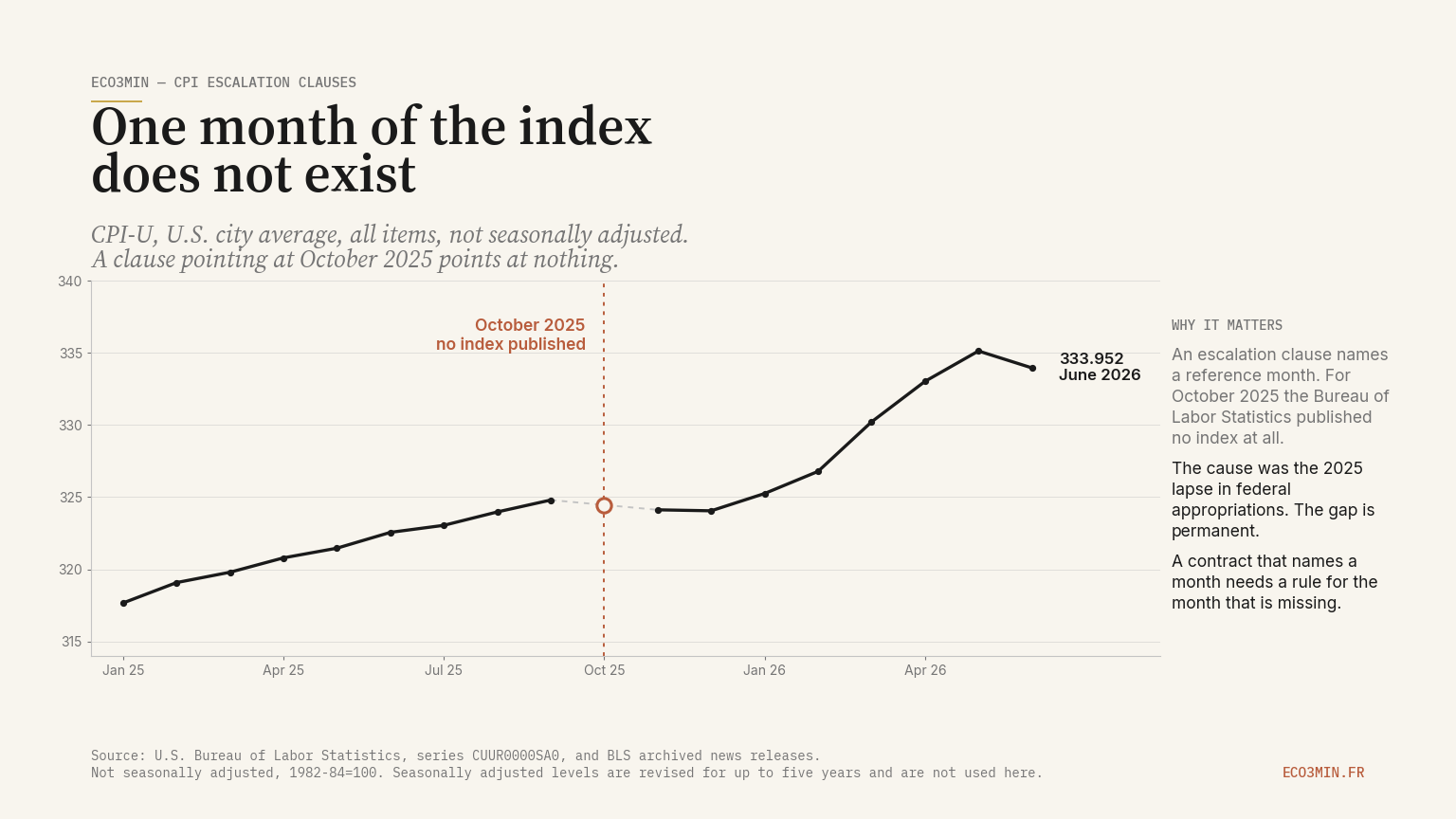
October 2025 has no Consumer Price Index. The BLS archive of news releases records the month with a single line: not published because of the 2025 lapse in federal government appropriations. The collection method explains why the gap is permanent rather than delayed — the index rests largely on in-person visits to outlets and telephone calls, and those observations cannot be reconstructed after the fact. The November 2025 index was released on 18 December 2025, later in the month than every other release on the current schedule, and the series resumes there.
For an escalation clause the effect is narrow and awkward. A lease that names October as its reference month has, for that one year, nothing to point at. A lease that measures a twelve-month change ending in October 2025, or beginning there, has the same problem from the other side. This is the situation the BLS fact sheet has in view when it lists a built-in method for handling major revisions or changes in the index base period as one of the parameters a clause covers: the general case is a base-period change, the concrete case here is a missing observation.
Published index levels
| Reference month | Index level | 12-month change |
|---|---|---|
| January 2025 | 317.671 | |
| February 2025 | 319.082 | |
| March 2025 | 319.799 | |
| April 2025 | 320.795 | |
| May 2025 | 321.465 | |
| June 2025 | 322.561 | |
| July 2025 | 323.048 | |
| August 2025 | 323.976 | |
| September 2025 | 324.800 | |
| October 2025 | not published | |
| November 2025 | 324.122 | |
| December 2025 | 324.054 | |
| January 2026 | 325.252 | + 2.4 % |
| February 2026 | 326.785 | + 2.4 % |
| March 2026 | 330.213 | + 3.3 % |
| April 2026 | 333.020 | + 3.8 % |
| May 2026 | 335.123 | + 4.2 % |
| June 2026 | 333.952 | + 3.5 % |
BLS did not publish a Consumer Price Index for October 2025 because of the 2025 lapse in federal government appropriations.
Source: U.S. Bureau of Labor Statistics, series CUUR0000SA0 and CPI release schedule.
Where this sits in the wider data picture
An escalation clause is one of the places where a statistical series stops being an indicator and becomes a payment instruction, which is why its publication mechanics matter more than its economic interpretation. The same distinction runs through most indexed obligations, from wage agreements to statutory benefit adjustments. The macro-financial regimes pillar covers how price data feed into the wider cycle, the research and data section holds the underlying series and their documentation, and Macro Watch tracks the releases as they come.
Frequently asked questions
Which CPI series does a lease actually name?
Only the one it identifies in full. BLS describes four parameters that pin a series down: population coverage, area coverage, series title, and index base period. A clause naming “the Consumer Price Index” without them leaves each of those open, and BLS has stated that it can neither draft contract wording nor mediate interpretive disputes between the parties.
Why is seasonally adjusted data unsuited to escalation?
Because it is not final. Seasonal factors are recalculated annually and seasonally adjusted index levels are subject to revision for up to five years after first release. A payment derived from such a figure can be inconsistent with the same published series a year later. The unadjusted index is not revised once published, which is why BLS describes the use of seasonally adjusted data in escalation agreements as inappropriate.
Which reference month is available on a given adjustment date?
The one whose release has already happened. Each index appears about two weeks after its reference month ends, at 8:30 a.m. Eastern Time on a scheduled date. On an adjustment date early in a month, the most recent published index is normally the one for the month before last, and the schedule above gives the exact correspondence for the current calendar.
What happened to the October 2025 index?
It was not published. The BLS news release archive records October 2025 as not published because of the 2025 lapse in federal government appropriations, and the underlying observations could not be collected retroactively. The November 2025 index was released on 18 December 2025, later in the month than the usual mid-month slot. The gap sits in the unadjusted U.S. city average series shown above.
Can a lease use a metropolitan-area index instead of the national one?
It can, and BLS publishes separate series for a set of metropolitan areas as by-products of the national index. BLS also recommends the U.S. city average for escalator clauses, because area indexes rest on smaller samples, carry larger sampling errors, and move more sharply. Publication frequency is the other constraint: only three major metropolitan areas appear monthly, the rest bimonthly or semiannually.
How is the percent change computed?
By taking the index point change between the two periods, dividing it by the index level of the earlier period, and multiplying by one hundred. The BLS worked example rounds the result to one decimal place. On a large base rent the rounding convention is not neutral, which is why the calculation block above shows the unrounded figure alongside the rounded one.
Last updated — 6 October 2026
Disclaimer – Financial and Legal Information: The analyses, commentary, and content published on eco3min.fr are provided for informational and educational purposes only. They do not constitute investment advice or a solicitation to buy or sell financial instruments. Past performance is not indicative of future results. All investment decisions involve risk and are the sole responsibility of the reader. Data, charts and calculated series are provided as is and may contain errors or lag behind their source: check any figure against the primary source cited before relying on it. Content describing laws, regulations or contracts reflects the law as of its publication date and does not constitute legal or tax advice; applying it to a specific situation requires a qualified legal or tax professional.