
Fed Blackout Period Calendar: Dates and the Exact Rule
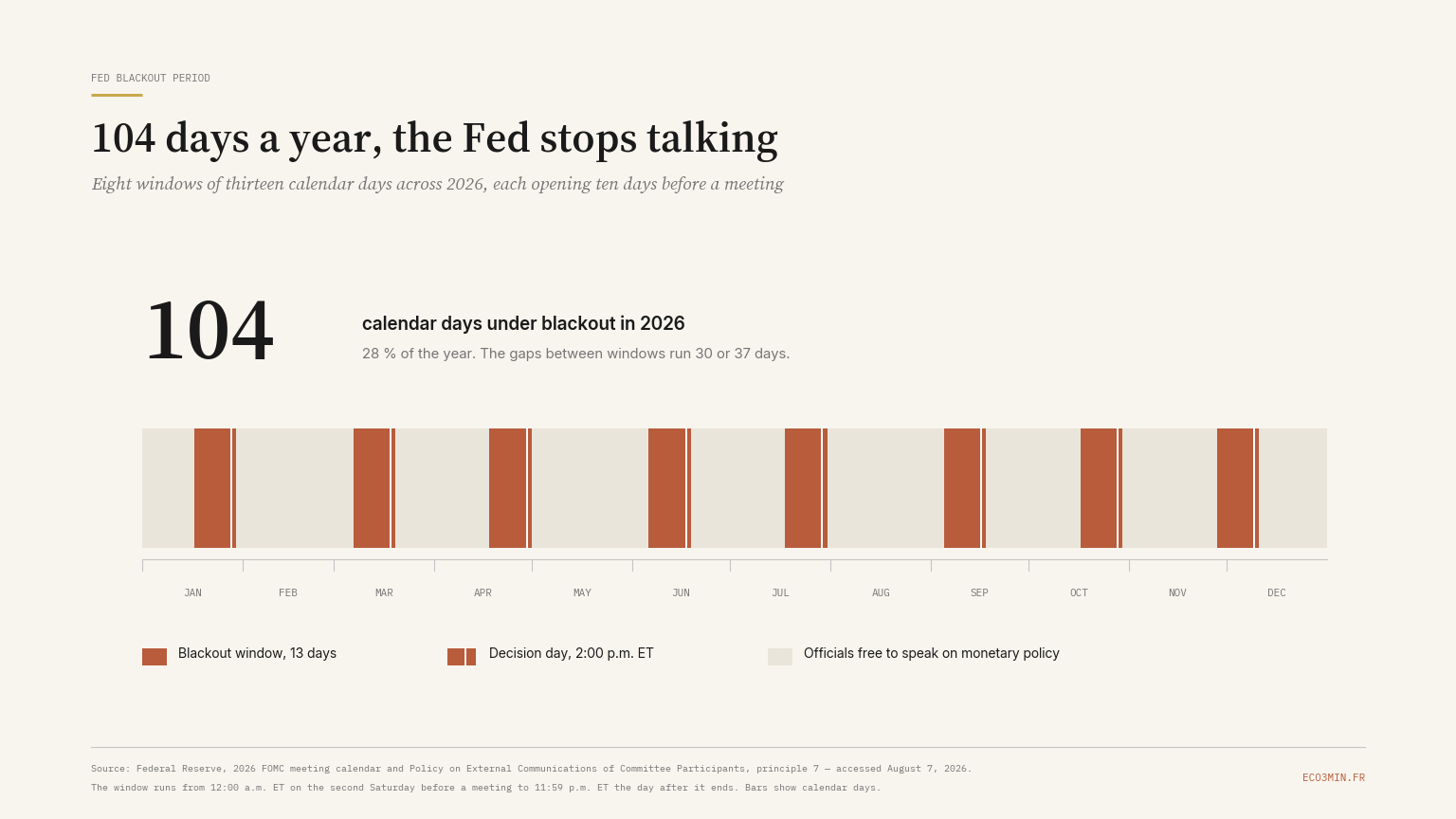
Eight times a year, Federal Reserve officials stop speaking publicly about monetary policy. The window is not the week before the meeting: it opens at 12:00 a.m. Eastern Time on the second Saturday before the first day of the meeting and closes at 11:59 p.m. the day after the last, thirteen calendar days in all. The rule is anchored on the meeting rather than on Thursday, and a footnote moves the opening when a federal holiday falls just before it. This page gives the current state, the calculation, and the full calendar through December 2027.
Fed blackout period
Blackout not in effectThe next blackout opens Saturday, October 17, 12:00 a.m. ET.
in 1 day 20 h
Rule defined in Eastern Time; all times shown in Eastern Time.
How the window is calculated
The rule fits in one sentence of principle 7 of the FOMC Policy on External Communications of Committee Participants, adopted June 22, 2011 and reaffirmed effective January 27, 2026: the blackout period begins at 12:00 a.m. Eastern Time the second Saturday before a meeting and ends at 11:59 p.m. Eastern Time the day after a meeting. The policy supplies its own worked example. If the meeting starts on a Tuesday, the window opens at the start of the Saturday that falls ten days earlier; if it ends on a Wednesday, the window closes at the end of Thursday. The same principle 7, word for word, sits in the parallel policy governing Federal Reserve System staff.
All sixteen meetings scheduled for 2026 and 2027 run Tuesday to Wednesday, so the window covers thirteen calendar days, Saturday through Thursday inclusive, eight times a year. That comes to 104 blackout days annually, close to 28 % of the calendar. Between the end of one window and the opening of the next, thirty calendar days remain when two meetings sit six weeks apart and thirty-seven when they sit seven weeks apart. Those gaps are the only stretches the policy leaves open for a governor or a Reserve Bank president to set out a public reading of monetary policy.
A footnote to the same principle moves the opening under one condition. If the second Friday before the meeting is a federal holiday, the blackout begins at 12:00 a.m. Eastern Time on that Friday, and the window runs fourteen days rather than thirteen. Across the sixteen meetings published for 2026 and 2027 the exception is never triggered, which the calculation behind the table below confirms meeting by meeting. The policy does not say whether federal holiday means the statutory date or the day observed by federal offices, a distinction with no consequence on the current schedule.
The scope is wider than the voting roster. The policy binds Committee participants, meaning the members of the Board of Governors and the twelve Reserve Bank presidents, whether or not they hold a vote that year. Staff fall under a second document, adopted and reaffirmed on the same dates, which repeats the same window and grades the obligation by access to information classified Class I FOMC – Restricted Controlled (FR) relating to the previous or upcoming meeting. Principle 7 attaches the window to each regularly scheduled meeting, which leaves it without object for a meeting called outside the calendar.
Thursday is a consequence, not the rule
Reserve Bank pages generally describe the window as running to the Thursday following the meeting. The phrasing is accurate on the current schedule and misleading as a rule. The policy fixes the close on the day after the meeting; Thursday only appears because meetings end on a Wednesday. A calendar built on the weekday rather than on the mechanism stops being correct the moment a meeting does not follow the Tuesday-Wednesday format.
The same distinction runs through the opening. The anchor is the first day of the meeting, not the decision. Counting ten days back from the Wednesday of the decision returns a Sunday rather than a Saturday, an opening one day late. On the 2026 calendar the correct opening sits three days after the Beige Book and eleven days before the statement, which is why the window is already running when the last pre-meeting data prints land.
The window also carries a second restriction of a different nature. The FOMC Policy on Investment and Trading for Committee Participants and Federal Reserve System Staff refers to the same period, which is why the Federal Reserve publishes a single document covering both, titled FOMC Trading and External Communications Blackout Calendar. The communications blackout and the trading blackout are two obligations sharing one set of dates, so a change to the meeting schedule moves both at once. Meeting dates, release times and the sequence of a decision day are set out on the FOMC meeting calendar, alongside the wider macro calendar.
| Meeting | Opens | Ends | Decision |
|---|---|---|---|
| January 27-28, 2026 | Saturday, January 17 · 12:00 a.m. ET | Thursday, January 29 · 11:59 p.m. ET | Wednesday, January 28, 2:00 p.m. ET |
| March 17-18, 2026projections | Saturday, March 7 · 12:00 a.m. ET | Thursday, March 19 · 11:59 p.m. ET | Wednesday, March 18, 2:00 p.m. ET |
| April 28-29, 2026 | Saturday, April 18 · 12:00 a.m. ET | Thursday, April 30 · 11:59 p.m. ET | Wednesday, April 29, 2:00 p.m. ET |
| June 16-17, 2026projections | Saturday, June 6 · 12:00 a.m. ET | Thursday, June 18 · 11:59 p.m. ET | Wednesday, June 17, 2:00 p.m. ET |
| July 28-29, 2026 | Saturday, July 18 · 12:00 a.m. ET | Thursday, July 30 · 11:59 p.m. ET | Wednesday, July 29, 2:00 p.m. ET |
| September 15-16, 2026projections | Saturday, September 5 · 12:00 a.m. ET | Thursday, September 17 · 11:59 p.m. ET | Wednesday, September 16, 2:00 p.m. ET |
| October 27-28, 2026 | Saturday, October 17 · 12:00 a.m. ET | Thursday, October 29 · 11:59 p.m. ET | Wednesday, October 28, 2:00 p.m. ET |
| December 8-9, 2026projections | Saturday, November 28 · 12:00 a.m. ET | Thursday, December 10 · 11:59 p.m. ET | Wednesday, December 9, 2:00 p.m. ET |
| January 26-27, 2027 | Saturday, January 16 · 12:00 a.m. ET | Thursday, January 28 · 11:59 p.m. ET | Wednesday, January 27, 2:00 p.m. ET |
| March 16-17, 2027projections | Saturday, March 6 · 12:00 a.m. ET | Thursday, March 18 · 11:59 p.m. ET | Wednesday, March 17, 2:00 p.m. ET |
| April 27-28, 2027 | Saturday, April 17 · 12:00 a.m. ET | Thursday, April 29 · 11:59 p.m. ET | Wednesday, April 28, 2:00 p.m. ET |
| June 8-9, 2027projections | Saturday, May 29 · 12:00 a.m. ET | Thursday, June 10 · 11:59 p.m. ET | Wednesday, June 9, 2:00 p.m. ET |
| July 27-28, 2027 | Saturday, July 17 · 12:00 a.m. ET | Thursday, July 29 · 11:59 p.m. ET | Wednesday, July 28, 2:00 p.m. ET |
| September 14-15, 2027projections | Saturday, September 4 · 12:00 a.m. ET | Thursday, September 16 · 11:59 p.m. ET | Wednesday, September 15, 2:00 p.m. ET |
| October 26-27, 2027 | Saturday, October 16 · 12:00 a.m. ET | Thursday, October 28 · 11:59 p.m. ET | Wednesday, October 27, 2:00 p.m. ET |
| December 7-8, 2027projections | Saturday, November 27 · 12:00 a.m. ET | Thursday, December 9 · 11:59 p.m. ET | Wednesday, December 8, 2:00 p.m. ET |
Rule defined in Eastern Time; all times shown in Eastern Time.
What the blackout does not stop
The window covers the expression of views, not the output of the Federal Reserve. Regularly published data series, System surveys and reports, statistical indexes and model results continue to appear, together with purely descriptive information and technical answers specific to a release. The staff policy attaches a condition that is rarely quoted: anything published during the window that involves staff judgment requires written approval from the Chair, for Board releases, or from the relevant Reserve Bank president. Operational contacts tied to open market operations, information gathering, and exchanges with other parts of the US government, foreign central banks and institutions such as the IMF and the BIS stay outside the window entirely.
Two publications frame the window without ever falling inside it. The Beige Book is released on the Wednesday two weeks before each scheduled meeting; on the 2026 calendar published by the Board, each of the eight editions lands exactly three days before the window opens. The minutes sit on the far side, released three weeks after the decision, and fall outside every window across the sixteen meetings of 2026 and 2027.
One case shows what happens when the calendar itself gives way. The Federal Reserve’s historical materials for 2020 list an unscheduled meeting on March 2, another on March 15, and a March 17-18 meeting marked cancelled. The window derived from that cancelled meeting would have run from Saturday March 7 to Thursday March 19; the March 15 meeting, its decision and the press conference that followed all fall inside those dates. The rule is computed from a schedule, and loses its object when the schedule is abandoned. How a decision reaches credit and asset prices is covered across the macro-financial regimes pages, and the underlying series sit in the research data hub.
Frequently asked questions
Is the Fed in a blackout period right now?
The panel at the top of this page answers for the moment you read it, comparing the current time with the two boundaries of the open or upcoming window. The switch happens at 12:00 a.m. Eastern Time, not at a market open and not on the back of an announcement, so a Monday can begin under blackout without anything having flagged it the previous Friday.
How long does the blackout period last?
Thirteen calendar days when the meeting runs Tuesday to Wednesday, the format of all sixteen meetings scheduled for 2026 and 2027. Eight windows a year bring the total to 104 days, close to 28 % of the calendar. Between the end of one window and the start of the next, thirty or thirty-seven calendar days remain, depending on how the meetings are spaced.
Does the blackout also cover trading?
The same dates carry a second restriction. The FOMC Policy on Investment and Trading for Committee Participants and Federal Reserve System Staff points to the same period as the two communications policies, which is why the Federal Reserve publishes one document rather than two, titled FOMC Trading and External Communications Blackout Calendar.
Can Fed officials speak at all during a blackout?
They stop expressing views about macroeconomic developments or monetary policy issues in meetings and conversations with members of the public. The policy sets out what stays outside that boundary: supervisory and regulatory work, operational contacts with counterparties, information gathering, and exchanges with other parts of the US government, foreign central banks and institutions such as the IMF and the BIS.
What happens if a federal holiday falls just before the window?
A footnote to principle 7 moves the opening. If the second Friday before the meeting is a federal holiday, the window opens at 12:00 a.m. Eastern Time on that Friday instead, running fourteen calendar days. Across the sixteen meetings published for 2026 and 2027 the exception is not triggered, which is why the calendar above shows thirteen days throughout.
Does the Beige Book come out during the blackout?
No. It is released on the Wednesday two weeks before each scheduled meeting, and on the 2026 calendar published by the Board each of the eight editions falls exactly three days before the window opens. The minutes sit on the other side: released three weeks after the decision, they land outside every window on the 2026 and 2027 schedules.
Last updated — 6 October 2026
Disclaimer – Financial and Legal Information: The analyses, commentary, and content published on eco3min.fr are provided for informational and educational purposes only. They do not constitute investment advice or a solicitation to buy or sell financial instruments. Past performance is not indicative of future results. All investment decisions involve risk and are the sole responsibility of the reader. Data, charts and calculated series are provided as is and may contain errors or lag behind their source: check any figure against the primary source cited before relying on it. Content describing laws, regulations or contracts reflects the law as of its publication date and does not constitute legal or tax advice; applying it to a specific situation requires a qualified legal or tax professional.