
Series I Bond Rate Reset Dates: When Your Rate Changes
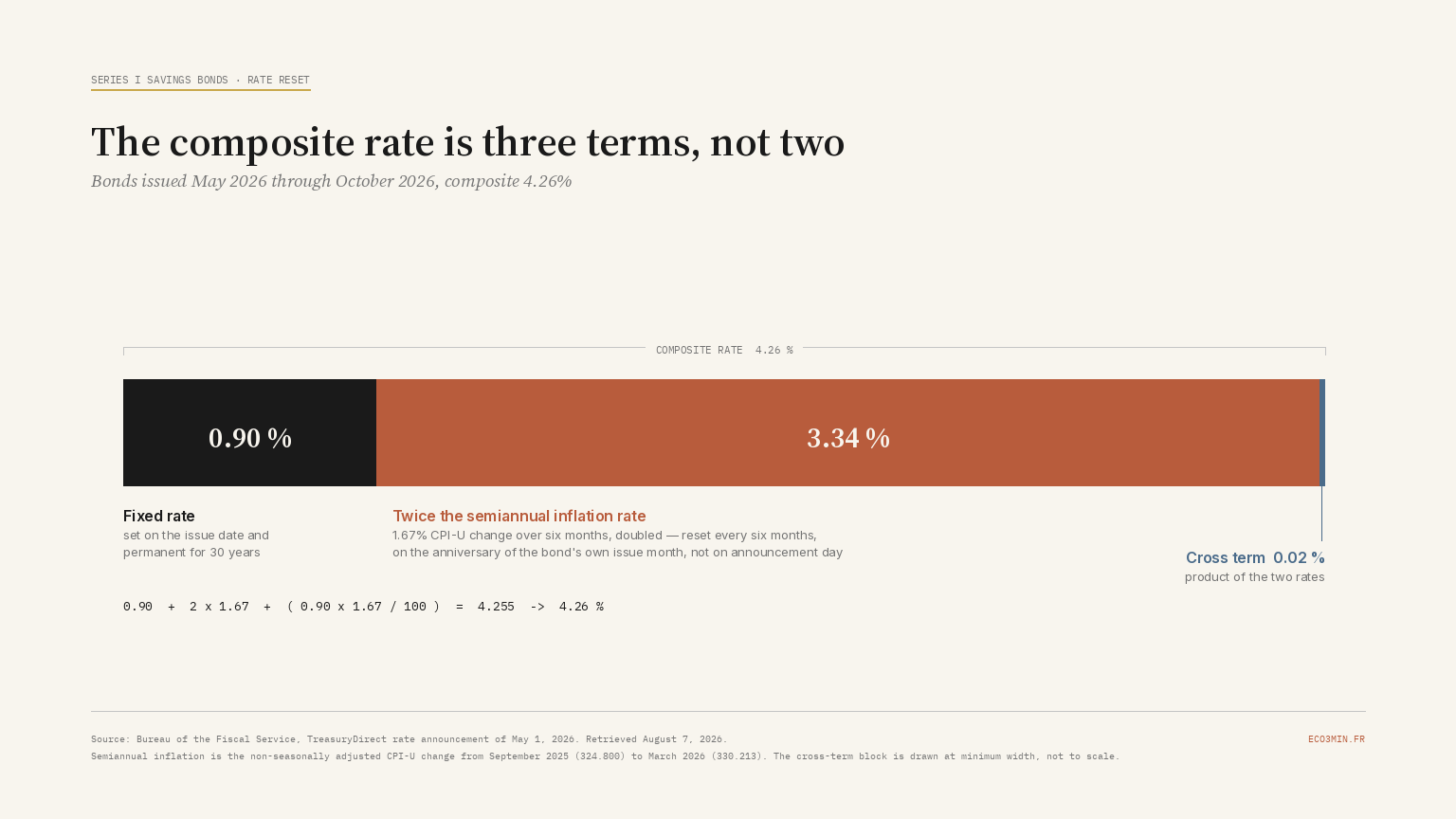
Treasury sets a new Series I savings bond rate every May 1 and November 1. Neither date is when the rate on a bond already outstanding changes. A bond resets on the six-month anniversary of its own issue month, so the rate announced on May 1 can take until October to reach a given holder, and the headline composite rate belongs only to bonds issued inside the announcement window. This page gives the composite rate currently in force, the three terms it is built from, the month-by-month table of when the current rate reaches each issue cohort, and what a reset leaves untouched.
Current composite rate
4.26 %
Bonds issued May 1, 2026 – October 31, 2026
in 17 days
0.90 % + 2 × 1.67 % + 0.02 % = 4.26 % · CPI-U 324.800 → 330.213 (2025-09 → 2026-03)
How the composite rate is built
A Series I savings bond carries two separate rates. The fixed rate is set on the day the bond is issued and applies for the full 30-year interest-bearing life of that bond; it never changes. The semiannual inflation rate is the percentage change in the non-seasonally adjusted Consumer Price Index for all Urban Consumers over a six-month window, and it is reset for every outstanding bond twice a year. Treasury combines the two with a formula that is not a simple addition: composite equals the fixed rate, plus twice the semiannual inflation rate, plus the product of the two.
The November 1, 2025 announcement is a closed example. Treasury reported CPI-U rising from 319.799 in March 2025 to 324.800 in September 2025, a six-month change of 1.56%. Applied to the 0.90% fixed rate then in force, the formula gives 0.90 plus 3.12 plus 0.014, or 4.03% once rounded, which is the composite rate published for bonds issued from November 2025 through April 2026.
Two features of that arithmetic are worth isolating. The inflation figure quoted in Treasury releases as an annualized rate is the six-month change multiplied by two, not a twelve-month CPI print; a bond earns half of the composite rate over the six months the rate applies to it. And the composite rate is floored: Treasury states that when a negative inflation rate would pull the combined rate below zero, the calculation stops at zero. Deflation can therefore erase the inflation component of a bond, but not its accrued principal.
Why the announcement date is not your reset date
The May 1 and November 1 announcements set the inflation component that will apply, for six months, to every I bond Treasury has ever issued. What differs from holder to holder is the month in which that component takes effect. Treasury states the rule directly: the date on which the rate changes for a bond falls every six months from that bond’s issue date. Because a bond earns interest from the first day of the month in its issue date, the reset months are the issue month and the month six months later.
The practical consequence runs against the way the announcement is usually reported. A bond issued in February resets on February 1 and August 1, so the component announced on May 1 first reaches it on August 1. A bond issued in April resets on April 1 and October 1 and waits until October 1. Only bonds whose issue month is May or November pick up a May 1 announcement on the day it is made. Across the six announcement windows, the same published number arrives on six different dates.
A second, related distinction concerns the headline itself. The composite rate carried in the press release is the rate for bonds issued inside the announcement window, because it combines the newly set inflation component with the newly set fixed rate. A bond issued in an earlier window keeps its own fixed rate for life and combines it with the same inflation component, producing a different composite. Two bonds resetting on the same day, bought years apart, therefore earn different rates from identical inflation data.
| Issue month | Current rate starts on | Status |
|---|---|---|
| May / November | May 1, 2026 | Already started |
| June / December | June 1, 2026 | Already started |
| July / January | July 1, 2026 | Already started |
| August / February | August 1, 2026 | Already started |
| September / March | September 1, 2026 | Already started |
| October / April | October 1, 2026 | Already started |
What a reset does not change
A reset moves the inflation component and nothing else. The fixed rate attached to a bond at issue is permanent, the 30-year interest-bearing life is unchanged, and the redemption rules are unaffected: a bond cannot be redeemed in its first twelve months, and a redemption before five years forfeits the last three months of interest. Interest accrues monthly and compounds semiannually, so the interest credited over a six-month period is added to principal and the following rate applies to the larger balance.
The purchase side is equally fixed by rule rather than by rate. Electronic Series I bonds are limited to 10,000 dollars per person per calendar year through TreasuryDirect, and the option of buying paper Series I bonds with a federal tax refund ended on January 1, 2025. For the inflation and policy context that drives the CPI-U window used in these calculations, see our overview of macro-financial regimes and the series catalogued in research and data.
Frequently asked questions
When does the rate on my I bond actually change?
Every six months from the issue date of that specific bond, which means on the first day of the issue month and on the first day of the month six months later. The May 1 and November 1 announcements set the number; the issue month sets the date on which it starts applying. The table above lists the six possible dates for the component announced in the current window.
Is the announced composite rate the rate my existing bond will earn?
Not usually. The published composite pairs the new inflation component with the fixed rate set for that same window, so it describes bonds issued inside the window. An older bond keeps its own fixed rate permanently and combines it with the identical inflation component, which produces a different composite. Only the inflation half of the calculation is shared across cohorts.
Why is the announced inflation figure not a twelve-month CPI number?
Because the calculation measures a six-month change and reports it doubled. Treasury takes the CPI-U level six months apart, expresses the change as a semiannual rate, then annualizes it by multiplying by two. Over the six months the rate is in force, a bond earns approximately half of the composite figure, which is why the annualized presentation and the amount actually credited differ.
Which CPI months does each announcement use?
The May 1 announcement uses the change from the September index to the March index, and the November 1 announcement uses the change from March to September. The index for a given month is published in the month that follows it, which is why the March figure is already available when the May 1 announcement is made and the September figure when the November 1 announcement is made.
Can the composite rate go below zero?
No. Treasury states that when a sufficiently negative inflation rate would pull the combined rate below zero, the calculation stops at zero. A period of deflation can therefore reduce a bond’s rate to the fixed rate or to zero, but the accrued value of the bond does not fall.
Does a reset change the fixed rate?
No. The fixed rate is determined on the issue date and applies for the whole 30-year interest-bearing life of the bond. Treasury announces a new fixed rate every May 1 and November 1, but that new figure applies only to bonds issued during the following six months. What resets on an existing bond is the inflation component alone.
Last updated — 12 August 2026
Disclaimer – Financial and Legal Information: The analyses, commentary, and content published on eco3min.fr are provided for informational and educational purposes only. They do not constitute investment advice or a solicitation to buy or sell financial instruments. Past performance is not indicative of future results. All investment decisions involve risk and are the sole responsibility of the reader. Data, charts and calculated series are provided as is and may contain errors or lag behind their source: check any figure against the primary source cited before relying on it. Content describing laws, regulations or contracts reflects the law as of its publication date and does not constitute legal or tax advice; applying it to a specific situation requires a qualified legal or tax professional.