
WSJ Prime Rate: Current Level and How It Is Set
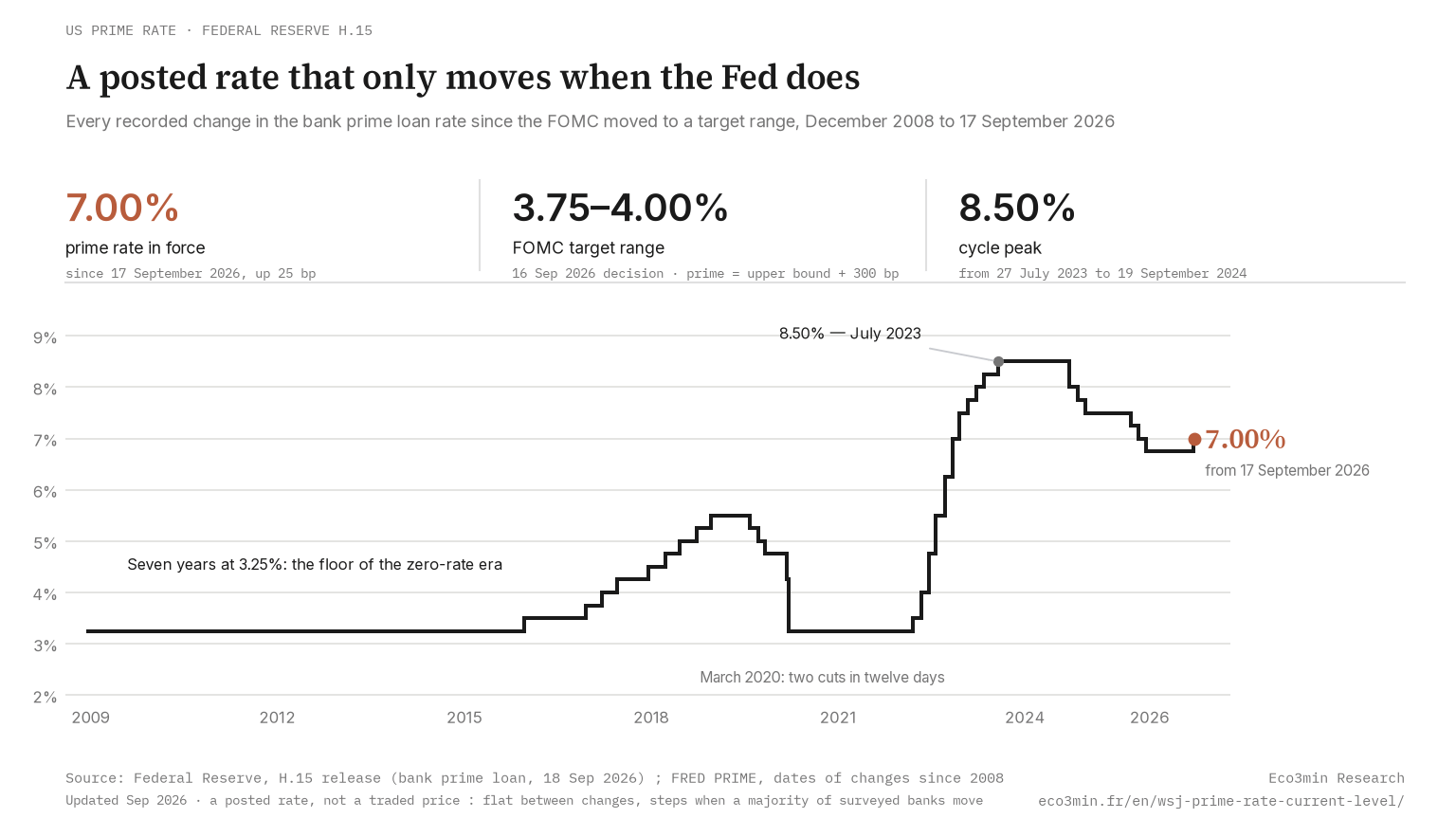
Most US consumer and small-business credit is indexed to the prime rate, and most contracts point at one specific version of it: the figure printed in The Wall Street Journal’s Money Rates column. That figure is a private survey, not an official statistic. The Federal Reserve publishes its own bank prime loan rate in the H.15 release, built from a different sample of banks, and the two have carried the same number. This page gives the level the Fed publishes, the arithmetic that ties it to the FOMC target range, and the gap between a policy decision and the date the new rate actually takes effect.
Prime rate published by the Federal Reserve
7.00%
Source: Federal Reserve, H.15 release and FOMC statements. H.15 reading of October 2, 2026
Two prime rates, one number
The Federal Reserve’s H.15 release defines its bank prime loan rate in a single line: the rate posted by a majority of the top 25 insured US-chartered commercial banks, ranked by assets in domestic offices. The release adds that prime is one of several base rates banks use to price short-term business loans — a caveat worth keeping, since prime is often described as the rate charged to the best borrowers, which the Fed does not claim.
The Wall Street Journal rate is a separate construction. It is a survey published in the Money Rates column, and the Journal is the only authoritative source for its own definition. Descriptions of that definition diverge across the documents that reference it: credit agreements filed with the SEC over the past two decades describe a base rate on corporate loans posted by at least three quarters of the thirty largest banks, while other widely circulated descriptions refer to seventy percent of the ten largest. This page does not resolve that divergence and does not use either version in any calculation — the figure shown above is the Federal Reserve series, and it is labelled as such.
The practical consequence is narrow but real. A contract that indexes on the Journal’s column is indexed on a private publication, with the Journal’s own continuity risk; several credit agreements anticipate this by naming the Fed’s H.15 bank prime loan rate as the fallback if the Journal stops quoting. In practice both numbers have moved together, which is why the distinction rarely surfaces.
The friction: the effective date is not the decision date
The arithmetic tying prime to policy is simple. The rate sits a fixed distance above the upper bound of the FOMC’s target range for the federal funds rate, and the card at the top of this page shows that distance computed from the two published figures rather than asserted. When the Committee moves the range by a quarter point, prime moves by a quarter point.
What is not mechanical is the timing. The Fed records prime as the rate posted by a majority of the surveyed banks, so the effective date is the date that majority arrives — not the date of the statement. Across the three most recent changes, recorded below, one landed on the decision day itself and two landed the following day. Credit agreements typically make a change effective on the date it is publicly announced or quoted as effective, so a billing cycle can straddle the difference.
The wider point is that the spread has no regulatory basis. It is a posting convention among large banks, not a rule; nothing compels them to maintain it, and the Federal Reserve neither sets prime nor endorses a formula linking the two. A page that presents prime as a derived quantity is describing an observed regularity, which is why this one shows the gap as a computed figure that can change rather than as a constant written into the text.
The three most recent changes
| FOMC decision | Upper bound | Prime effective date | Prime rate |
|---|---|---|---|
| September 17, 2025 | 4.25% | September 17, 2025 | 7.25% |
| October 29, 2025 | 4.00% | October 30, 2025 | 7.00% |
| December 10, 2025 | 3.75% | December 11, 2025 | 6.75% |
| September 16, 2026 | 4.00% | September 17, 2026 | 7.00% |
Source: Federal Reserve, H.15 release and FOMC statements.
Reading prime against the policy cycle
Because prime follows the target range, watching it adds nothing to what the FOMC statement already said. What varies, and what is worth tracking, is the lag onto the instruments indexed to it: revolving credit repricing typically applies at the next statement cycle rather than on the effective date, so the pass-through to a household or a small business arrives later than the headline. The transmission mechanism behind that lag is covered across the monetary regimes and interest rates pillar, and the meeting dates that anchor the timing are listed on the FOMC meeting calendar. The underlying rate series, including the H.15 components, are available in the research data hub.
One limit is worth stating. The step chart above records changes, not a continuous market price: prime is a posted rate, so it holds flat for long stretches and then jumps by a quarter point or more. Comparing it to a traded yield without accounting for that step structure produces artefacts, particularly in any calculation that averages across a change date.
Frequently asked questions
Who sets the prime rate?
No single institution does. Each bank posts its own prime rate; what gets published is an aggregation. The Federal Reserve reports the rate posted by a majority of the twenty-five largest insured US-chartered commercial banks, and The Wall Street Journal publishes a separate survey in its Money Rates column. Neither is a policy rate, and neither is set by the FOMC.
Is the WSJ prime rate the same as the Fed’s bank prime loan rate?
They are different constructions that have carried the same figure. The Fed’s version rests on the top twenty-five insured US-chartered commercial banks by domestic assets; the Journal’s rests on its own survey, whose published definition is quoted inconsistently across the documents that reference it. If a contract names one of them, that one governs, and the distinction only becomes material if the two ever diverge.
Why does prime sit three percentage points above the fed funds target?
By convention rather than by rule. Large banks have posted prime at that distance above the upper bound of the target range, and the relationship has held through the recent tightening and easing cycles. It carries no regulatory force: the spread is an observed regularity that could widen or narrow without any change in policy.
When does a prime rate change reach a credit card or a HELOC?
Not on the effective date. Variable-rate revolving credit is typically repriced at the start of a billing cycle, so the change reaches a statement days or weeks after prime moves, depending on where the cycle falls. The contract sets that mechanism, and the interval varies between issuers.
Can the prime rate change between FOMC meetings?
Yes, in principle. Prime is a posted rate, so banks can move it whenever they choose, and the FOMC can itself act outside its scheduled calendar, as it did twice in March 2020. In practice, changes have clustered on and immediately after scheduled decision days.
Where can the published figure be checked directly?
In the Federal Reserve’s H.15 release, updated each business day at 4:15 p.m. Eastern Time, where the bank prime loan line appears alongside the effective federal funds rate and Treasury yields. The Journal’s figure appears in its Money Rates column. Where a contract names one source, that source is the one to check, not a third-party quotation of it.
Last updated — 6 October 2026
Disclaimer – Financial and Legal Information: The analyses, commentary, and content published on eco3min.fr are provided for informational and educational purposes only. They do not constitute investment advice or a solicitation to buy or sell financial instruments. Past performance is not indicative of future results. All investment decisions involve risk and are the sole responsibility of the reader. Data, charts and calculated series are provided as is and may contain errors or lag behind their source: check any figure against the primary source cited before relying on it. Content describing laws, regulations or contracts reflects the law as of its publication date and does not constitute legal or tax advice; applying it to a specific situation requires a qualified legal or tax professional.