
France Economic Data Releases: When INSEE Publishes, and What Each Number Is Worth
A reader who knows the US release calendar arrives in France with three assumptions that do not hold: that the schedule is published a year out, that unemployment is monthly, and that one inflation number is released at a time.
This page maps the French statistical calendar for someone anchored on BLS and BEA practice: what INSEE commits to, at what hour, and how long each number stays open to revision.
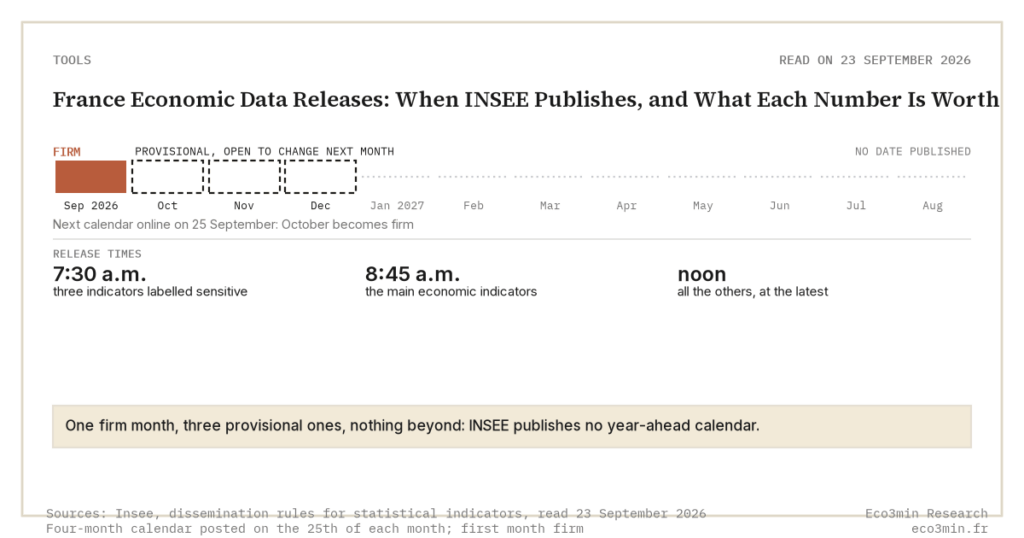
France has no year-ahead release schedule: INSEE commits firmly to one month of dates at a time, and treats the following three as provisional.
- French CPI arrives twice for each reference month, a provisional estimate at month end and a final figure around the 15th of the following month, both at 8:45 a.m. Paris time.
- The same release carries two indices with opposite revision rules: the national IPC is never revised once final, while the harmonised HICP is revisable under EU Regulation 2016/792.
- Three indicators only are released at 7:30 a.m. rather than 8:45, and INSEE publishes the list of who receives them the evening before.
The question that brings most non-French readers here is narrow: when does French inflation print. The institutional answer is that it prints twice, that the second print is legally frozen, and that a second index travels alongside it under a different revision regime. Everything else about the French calendar follows from the same logic, which is not the American one. What follows sets out where the two systems diverge, and what each divergence changes for reading the numbers.
There is no annual INSEE release schedule
This is the first and largest difference. The BLS maintains a published release calendar covering the year ahead, which is why a US macro diary can be built in January and still be right in November. INSEE does not do this. Under its own dissemination rules, the institute publishes a four-month calendar, put online at the end of each month, on the 25th. Only the dates for the first month are firm. The dates for the following three months are explicitly liable to change in the programme issued the month after.
The horizon is not an editorial choice. France signed up to the IMF’s Special Data Dissemination Standard in 1996 and to its enhanced version, SDDS Plus, in 2014. That standard requires adhering countries to maintain a dissemination calendar covering the next four months. Four, not twelve. The French statistical service meets that obligation and does not go beyond it. What INSEE does refresh annually is not the list of dates but the list of indicators subject to embargo rules, the version in force being the one drawn up at 31 December of the previous year.
The practical consequence for anyone maintaining a calendar: any French date beyond a one-month horizon is an extrapolation from past regularity, not a commitment by the statistical office. Regularities exist and are strong, which is exactly what makes them easy to mistake for schedules.
7:30 or 8:45 Paris time, and a published list of who sees it first
US majors cluster at 8:30 a.m. Eastern. France has two tiers. The principal economic indicators produced by INSEE are released at 8:45 a.m. Paris time. Three of them, designated sensitive in the framework document of the French statistical service, are released at 7:30 a.m.: the first estimate of the quarterly national accounts, the first results of the general government accounts, and unemployment on the ILO definition together with the labour market indicators. Indicators outside the principal economic category are released at noon at the latest.
Paris runs six hours ahead of Eastern Time for most of the year, apart from the few weeks when the European and American daylight saving switches do not coincide. A French release therefore lands well before the US cash session, which is one reason euro rates markets, rather than equities, tend to be where the French print is first visible.
The pre-release chain is documented by INSEE itself, in application of the impartiality principle of the European Statistics Code of Practice. An 8:45 indicator may be transmitted to the office of the minister for the economy from 6 p.m. the evening before, and to news agencies at 8:15. A sensitive 7:30 indicator goes to the minister’s office from 9 p.m. the evening before, and to news agencies at 7:00. For ILO unemployment, the labour minister’s office and the labour ministry statistical service are also on the evening list. INSEE describes this access as limited, controlled and made public, and states that it constitutes a tolerance rather than a norm. A US reader used to a lock-up measured in minutes will note that the French window is measured in hours, and that its existence is disclosed rather than inferred.
Release times are not stable properties of an indicator either. Household consumption of goods is published at 8:45, except in January, April, July and October, when it moves to 7:30 because it is released alongside the quarterly accounts. Quarterly Maastricht debt follows the same logic in March. The hour depends on what else is published that morning.
Two inflation indices, opposite revision rules
Both countries face the same problem: an inflation index is used simultaneously for macroeconomic analysis, which rewards revision, and for legal indexation, which forbids it. France and the United States solved it along different seams, and the seam is what a cross-border reader keeps missing.
France splits the problem across two separate indices published in the same release. The national IPC and the harmonised HICP follow one identical calendar: a provisional estimate at the end of the reference month, final results around the 15th of the following month, both at 8:45. Since January 2016 the provisional estimate has been published two weeks ahead of the usual release and covers the national and the harmonised index together. The final IPC is then never revised, because it underpins the indexation of a long list of French contracts and administrative scales, from the minimum wage to social benefits. The HICP, by contrast, may be revised under Article 7(5) of EU Regulation 2016/792, with the procedures set out in Articles 17 to 19 of Implementing Regulation 2020/1148.
The United States splits the same problem inside one index family. In its technical note, the BLS states that CPI-U and CPI-W are considered final when released, while the chained C-CPI-U is issued in preliminary form and subject to three subsequent quarterly revisions. Within CPI-U, the seam runs between adjustment regimes rather than between indices: seasonally adjusted data remain subject to revision for up to five years, with new seasonal factors applied each year to the last five years of data, and the BLS explicitly advises against using seasonally adjusted series in escalation agreements for that reason. For January 2026, revised seasonal factors and seasonally adjusted indexes covering 2021 to 2025 were calculated and published.
The French frozen number is a different index. The American frozen number is a different treatment of the same index. That difference decides which figure a cross-country comparison should use, and it is invisible from a release calendar alone. The construction of the French basket and its weights sets out what the national index actually measures.
Assuming the HICP appears on a separate European timetable. It does not: the French HICP is published in the same INSEE release as the national index, at the same hour, at both the same stages. What differs is the revision regime and the scope, the harmonised index excluding life insurance and financial intermediation services indirectly measured. A further break sits in January 2026, when both indices moved to a 2025 reference base, adopted the ECOICOP version 2 classification, and saw games of chance brought into the harmonised index, where they had previously sat only in the national one.
French GDP arrives twice, not three times
A US reader expects three successive estimates of quarterly GDP, roughly a month apart. France runs two. Since May 2019, each quarter produces a first estimate, published at the end of the first month of the following quarter, around thirty days after the period closes, covering GDP growth and transactions in goods and services. Detailed results follow less than sixty days after quarter end, updating the first estimate and adding a first reading of the household and corporate accounts.
That calendar is the product of compression. Detailed results were moved forward from eighty-five to sixty days starting with the second quarter of 2019, under Eurostat transmission deadlines. INSEE documents the methodological cost plainly: the estimation method is identical across both publications, and only the number of extrapolated indicators and of published series separates them. The first estimate is explicitly described as an advance estimate, produced while some indicators are not yet available for the full quarter, with econometric techniques filling the gap.
The two prints also carry different release times: the first estimate at 7:30 as a sensitive indicator, the detailed results at 8:45. Two GDP numbers, two hours, two information sets. The macro-financial dataset library holds the published series.
French unemployment is quarterly, and comes with a published confidence interval
This is the trap that catches most US-anchored readers. There is no monthly French unemployment rate on the ILO definition. The measure is quarterly, drawn from the Labour Force Survey. INSEE published the second quarter of 2026 on 7 August 2026, thirty-eight days after the quarter closed, and announced in that same release that the third quarter of 2026 is scheduled for 10 November 2026 at 7:30. The working cadence is roughly six weeks.
The monthly French labour figures that do circulate come from a different producer and measure a different thing: registered jobseeker counts published by the labour ministry statistical service, an administrative headcount rather than a survey-based rate. Treating the two as a French equivalent of the monthly US jobs report conflates a rate with a register.
INSEE also does something the US establishment survey does in its technical note but which rarely survives into coverage on either side: it prints the sampling uncertainty next to the number. Under its tables, the institute states that the estimate is given to within plus or minus 0.3 percentage point, on the level of the unemployment rate and on its quarter-on-quarter change alike. A 0.2 point quarterly move therefore sits inside a margin wider than itself.
The number is not fixed once out. Each release carries a Revisions section documenting movements in past quarters arising from the routine update of seasonal adjustment coefficients; for the second quarter of 2026, INSEE reports that the unemployment, participation and employment rates were not revised relative to the first quarter. Scope can move too: from the second quarter 2026 release, the main labour market indicators cover France including Mayotte, extending the previous France excluding Mayotte scope, with all series backcast to stay comparable. A series can change definition without changing name.
The shape of a French data month
The table below gives frequency and release hour for the most followed French cyclical indicators, as they appear in the list of indicators subject to the embargo rules of the French statistical service. It deliberately carries no future release dates. INSEE makes only the current month’s dates firm, and a date reconstructed by deduction would not be an INSEE date.
| Indicator | Frequency | Release hour (Paris) |
|---|---|---|
| Quarterly national accounts, first estimate | Quarterly | 7:30 (sensitive) |
| ILO unemployment and labour market indicators | Quarterly | 7:30 (sensitive) |
| General government accounts, first results | Annual | 7:30 (sensitive) |
| Quarterly national accounts, detailed results | Quarterly | 8:45 |
| Consumer price index, provisional results | Monthly | 8:45 |
| Consumer price index, final results | Monthly | 8:45 |
| Industrial production index | Monthly | 8:45 |
| Business climate | Monthly | 8:45 |
| Household consumption of goods | Monthly | 8:45, except January, April, July, October: 7:30 |
| Flash estimate of payroll employment | Quarterly | 8:45 |
| Monthly household confidence survey | Monthly | 8:45 |
| Notaires-Insee existing home price indices | Quarterly | 8:45 |
Firm dates for the current month sit in INSEE’s dissemination agenda and in the four-month calendar posted on the 25th of each month. For the American side of the diary, the same questions of measurement window and provisional status are set out in what period each US release actually covers, and central bank meeting dates in the Fed and ECB meeting agenda.
A release date says less about the French economy than about how finished the number being released is.
What the calendar changes when reading French data
Three habits follow, none of them a decision rule. Identify which stage the figure belongs to, provisional or final, first estimate or detailed results, before comparing it with anything. Treat revision as designed rather than accidental, since the French apparatus provides for it in the HICP, in the quarterly accounts and in seasonally adjusted series, while prohibiting it for the final IPC. And read the published confidence interval where one exists, which for French data means the labour market series.
Over long horizons these distinctions fade and regimes become legible again, which is where cross-country comparison is on firmer ground. The full inflation guide sets out that longer frame, in which a tenth of a point of revision no longer carries the argument.
Frequently asked questions
When is the France CPI release date each month?
There are two dates for each reference month. A provisional estimate is released at the end of the reference month itself, and the final result around the 15th of the following month, both at 8:45 a.m. Paris time. INSEE does not publish firm dates more than one month ahead, so the exact day is confirmed in the four-month calendar posted on the 25th of the preceding month.
Does the French HICP follow a different schedule from the national CPI?
No. Both indices appear in the same INSEE release, at the same hour, at both the same stages. The difference is the revision regime: the final national IPC is not revised, because it underpins the indexation of contracts and administrative scales, whereas the HICP may be revised under Article 7(5) of EU Regulation 2016/792 and Articles 17 to 19 of Implementing Regulation 2020/1148.
Does INSEE publish a release calendar a year in advance, like the BLS?
No. INSEE posts a four-month calendar at the end of each month, on the 25th, in which only the first month’s dates are firm; the following three may be changed in the next programme. The four-month horizon reflects the IMF’s SDDS standard, which France has followed since 1996 and in its enhanced SDDS Plus form since 2014.
Is there a monthly French unemployment rate?
Not on the ILO definition. That rate is quarterly and comes from the Labour Force Survey, released roughly six weeks after quarter end at 7:30 a.m. The monthly French labour figures in circulation are registered jobseeker counts from the labour ministry statistical service, an administrative headcount rather than a survey-based rate.
Why do some French statistics come out at 7:30 and others at 8:45?
Because the French statistical service designates three indicators as sensitive and releases them at 7:30: the first estimate of the quarterly national accounts, the first results of the general government accounts, and ILO unemployment with the labour market indicators. Other principal economic indicators are released at 8:45, and indicators outside that category at noon at the latest.
How many estimates does French quarterly GDP go through?
Two, not three. A first estimate around thirty days after the quarter closes, then detailed results less than sixty days after. INSEE states that the estimation method is the same in both, and that they differ only in the number of extrapolated indicators and published series, the first estimate being explicitly an advance estimate built while some indicators are still incomplete.
Last updated — 6 October 2026
Disclaimer – Financial and Legal Information: The analyses, commentary, and content published on eco3min.fr are provided for informational and educational purposes only. They do not constitute investment advice or a solicitation to buy or sell financial instruments. Past performance is not indicative of future results. All investment decisions involve risk and are the sole responsibility of the reader. Data, charts and calculated series are provided as is and may contain errors or lag behind their source: check any figure against the primary source cited before relying on it. Content describing laws, regulations or contracts reflects the law as of its publication date and does not constitute legal or tax advice; applying it to a specific situation requires a qualified legal or tax professional.
Regulated and tax values: the rates, indices, caps and brackets with legal effect cited on this page are set by official decision, change over time and apply according to individual circumstances. Only the official publication in force on the relevant date is authoritative (for example the Journal officiel, INSEE, Banque de France, the IRS or the Social Security Administration). To revise a rent, sign or challenge a contract, or file a return, check the value at the source or with a professional.