
Social Security COLA: announcement date and formula
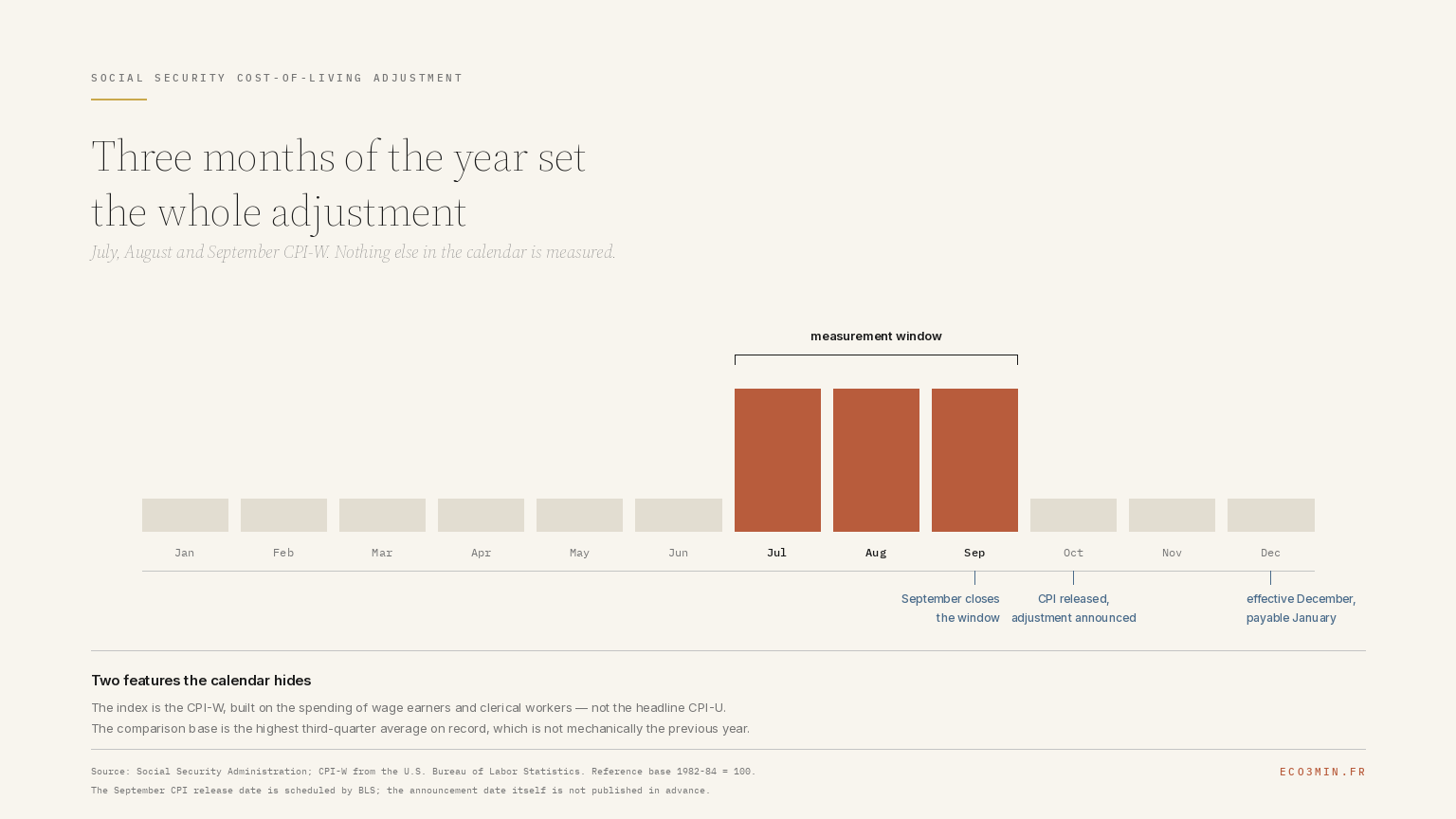
The Social Security cost-of-living adjustment is announced once a year, in October, and shows up in benefits paid the following January. The number itself is not a forecast or a policy decision: it falls out of a formula fixed in statute, applied to three months of price data. Two features of that formula are almost never spelled out — the index is the CPI-W rather than the headline CPI-U, and the comparison base is not mechanically the previous year. This page gives the current adjustment and the next determination date, then sets out the calculation, the calendar that produces it, and what happens in the years the formula returns nothing.
Current adjustment
2.8%
Payable from January 2026
Third-quarter CPI-W, 2025 vs 2024
Next determination — September CPI released October 14, 2026, 8:30 a.m. ET . The announcement date itself is not published in advance.
The September CPI has since been released. This page has not been updated yet.
CPI-W reference base 1982-84 = 100. Percentages rounded to the nearest 0.1 point, as required by law.
How the adjustment is calculated
Automatic adjustments were created in 1972 by P.L. 92-336, which added Section 215(i) to the Social Security Act, and took effect in 1975. The original text required inflation of at least three percent over the base period before an adjustment could be triggered; the Omnibus Budget Reconciliation Act of 1986 removed that threshold and replaced it with a requirement that the measured increase simply be greater than zero.
The statute compares two third-quarter averages of the Consumer Price Index for Urban Wage Earners and Clerical Workers. The Bureau of Labor Statistics publishes the CPI-W monthly; the Social Security Administration averages the July, August and September readings of the current year and measures the increase over the average for the cost-of-living computation quarter. The percentage is rounded to the nearest tenth of a percentage point, and the resulting benefit amount is rounded down to the next lower dime. The adjustment becomes effective in December and is payable in January, which is why an adjustment described everywhere as belonging to one year is technically effective in the preceding December.
How the current adjustment was determined
COLA = (current Q3 average − computation-quarter average) ÷ computation-quarter average, rounded to the nearest tenth of a percentage point.
- Q3 average, determination year (2025)
- 317.265
- Q3 average, computation quarter (2024)
- 308.729
- Unrounded increase
- 2.7649%
- Adjustment applied
- 2.8%
The computation quarter is the highest third-quarter CPI-W average on record, not mechanically the previous year.
The friction: three months, a narrower index, and a base that does not always move
The measurement window is three months long. Prices in the other nine months of the year enter the calculation only to the extent that they carry into July, August and September levels. A price shock in the fourth quarter has no effect on the adjustment announced two months earlier, and no effect on the following year’s either, except through its persistence into the next third quarter. This is a structural feature of the statute rather than an artefact, and it is the reason forecasts published before the September data are estimates and nothing more.
The index is the second point of divergence. The CPI-W is built on the spending patterns of households drawing at least half their income from hourly wages or clerical work, with at least one member employed for thirty-seven weeks of the previous twelve months — roughly thirty percent of the U.S. population. The headline CPI-U covers all urban consumers. The two indexes weight housing, medical care and transportation differently, so the CPI-W reading in any given month can differ from the number that leads the monthly inflation coverage. The Social Security Administration has no discretion here: the CPI-W is specified in regulation.
The third point is the comparison base. The statute does not compare the current third quarter to the previous third quarter; it compares it to the highest third-quarter average on record, known as the cost-of-living computation quarter. In most years these are the same thing. When the CPI-W falls or fails to exceed the prior benchmark, no adjustment is payable, benefits are held at their previous level, and the benchmark quarter is retained rather than reset. That happened after the third quarter of 2009 and again after 2010, so the adjustment payable in January 2012 was measured against the third quarter of 2008, three years earlier. The same mechanism applied after 2015: the adjustment payable in January 2017 was measured against the third quarter of 2014. Three payable years since 1975 have carried no adjustment at all.
The calendar that produces the number
The announcement date is not a scheduling decision so much as a consequence. The last input to the calculation is the September CPI, and the BLS publishes it at 8:30 a.m. Eastern Time on a date set in its annual release calendar, usually in the first half of October. The Social Security Administration has historically announced the adjustment the same day, but the announcement date itself is not published in advance and is not guaranteed to coincide.
The distinction matters when the release slips. The September 2025 CPI was published on 24 October 2025, later than the usual pattern, and the announcement of the adjustment payable from January 2026 came the same day. A lapse in appropriations had disrupted the BLS release calendar that autumn, shifting or cancelling a long list of releases; the September CPI was not among those BLS listed as formally rescheduled, so the two facts are stated here side by side rather than as cause and effect. Anyone building a calendar around the announcement rather than around the BLS release is anchoring on the wrong event.
| Payable January | COLA | Q3 CPI-W average | Computation quarter |
|---|---|---|---|
| 2026 | 2.8% | 317.265 (2025) | new benchmark set — 2024 |
| 2025 | 2.5% | 308.729 (2024) | new benchmark set — 2023 |
| 2024 | 3.2% | 301.236 (2023) | new benchmark set — 2022 |
| 2023 | 8.7% | 291.901 (2022) | new benchmark set — 2021 |
| 2022 | 5.9% | 268.421 (2021) | new benchmark set — 2020 |
| 2021 | 1.3% | 253.412 (2020) | new benchmark set — 2019 |
| 2020 | 1.6% | 250.200 (2019) | new benchmark set — 2018 |
| 2019 | 2.8% | 246.352 (2018) | new benchmark set — 2017 |
| 2018 | 2.0% | 239.668 (2017) | new benchmark set — 2016 |
| 2017 | 0.3% | 235.057 (2016) | new benchmark set — 2014 |
| 2016 | no COLA | 233.278 (2015) | benchmark retained — 2014 |
| 2015 | 1.7% | 234.242 (2014) | new benchmark set — 2013 |
| 2014 | 1.5% | 230.327 (2013) | new benchmark set — 2012 |
| 2013 | 1.7% | 226.936 (2012) | new benchmark set — 2011 |
| 2012 | 3.6% | 223.233 (2011) | new benchmark set — 2008 |
| 2011 | no COLA | 214.136 (2010) | benchmark retained — 2008 |
| 2010 | no COLA | 211.001 (2009) | benchmark retained — 2008 |
| 2009 | 5.8% | 215.495 (2008) | new benchmark set — 2007 |
| 2008 | 2.3% | 203.596 (2007) | new benchmark set — 2006 |
| 2027 | September CPI released October 14, 2026, 8:30 a.m. ET | ||
CPI-W reference base 1982-84 = 100. Percentages rounded to the nearest 0.1 point, as required by law. Source: Social Security Administration; CPI-W from the Bureau of Labor Statistics.
What moves alongside it
The adjustment does not stop at Social Security benefits. Supplemental Security Income payments and railroad retirement tier 1 benefits are raised by the same percentage, and railroad retirement tier 2 benefits by roughly a third of it. Veterans’ pension benefits, survivors pension benefits and Dependency and Indemnity Compensation for parents are adjusted automatically by the same percentage under Title 38; disability compensation and Dependency and Indemnity Compensation for spouses and children usually follow, but require annual legislation. Civil Service Retirement System and military retirement adjustments are not triggered by the Social Security figure, yet use the same measuring period and formula. Federal Employees Retirement System adjustments match it only when inflation is at or below two percent, and fall short of it otherwise.
Several program parameters indexed to wages rather than prices — the taxable maximum, the retirement earnings test exempt amounts, the substantial gainful activity amount for the blind — can only be increased in a year when an adjustment is payable. In 2010, 2011 and 2016 they were frozen alongside benefits, then jumped when the sequence resumed, catching up on the wage growth of the intervening years.
The index that drives all of this is the same CPI series that shapes rate expectations, discussed across the macro-financial regimes pillar. The underlying series and releases Eco3min tracks are collected in research and data, and the current reading of U.S. and European indicators is kept in macro watch. For another calendar question where the published rule and the observed practice diverge, see is the U.S. stock market open today.
Frequently asked questions
When is the Social Security COLA announced?
In October, on the day the Bureau of Labor Statistics publishes the September Consumer Price Index, which supplies the final month of the measurement window. That release is scheduled in advance in the BLS annual calendar and takes place at 8:30 a.m. Eastern Time. The Social Security Administration has historically announced the adjustment the same day, but its own announcement date is not published ahead of time.
Why is the CPI-W used rather than the CPI-U?
Because the legislation enacted in 1972 referred to the price index for urban wage earners and clerical workers, which at the time was the only consumer price index the BLS produced. When the Bureau introduced the CPI-U for all urban consumers in 1978 and renamed the older series CPI-W, the Social Security Administration retained the CPI-W in regulation. The choice has been debated since, but changing it would require legislation.
Can the adjustment be negative?
No. The statute provides for an increase when the measured change is positive and for no change otherwise. Benefit levels are held at their previous amount when the CPI-W falls, and are never reduced to mirror a decline in measured prices.
What happens in a year with no adjustment?
The benchmark quarter is retained rather than reset. The following year’s calculation is measured against that retained quarter, not against the intervening one, so the eventual adjustment reflects the cumulative increase over the whole gap rather than a single year. Three payable years since automatic adjustments began have carried no increase.
Does the adjustment announced in October apply to that same year?
No. It becomes effective for December of the announcement year and is payable in January of the following year, since Social Security payments reflect benefits due for the preceding month. Supplemental Security Income recipients receive their increased payment slightly earlier, at the very end of December.
Does the announced percentage equal the change in a beneficiary’s payment?
Not necessarily. The percentage applies to the benefit amount, while the amount actually deposited is net of Medicare Part B and Part D premiums, which are set separately and on their own schedule. A hold-harmless provision in the Social Security Act limits the effect of a Part B premium increase for many enrollees whose premiums are withheld from their benefit, and applies to a far larger share of enrollees in years when the adjustment is small or absent.
Last updated — 6 October 2026
Disclaimer – Financial and Legal Information: The analyses, commentary, and content published on eco3min.fr are provided for informational and educational purposes only. They do not constitute investment advice or a solicitation to buy or sell financial instruments. Past performance is not indicative of future results. All investment decisions involve risk and are the sole responsibility of the reader. Data, charts and calculated series are provided as is and may contain errors or lag behind their source: check any figure against the primary source cited before relying on it. Content describing laws, regulations or contracts reflects the law as of its publication date and does not constitute legal or tax advice; applying it to a specific situation requires a qualified legal or tax professional.
Regulated and tax values: the rates, indices, caps and brackets with legal effect cited on this page are set by official decision, change over time and apply according to individual circumstances. Only the official publication in force on the relevant date is authoritative (for example the Journal officiel, INSEE, Banque de France, the IRS or the Social Security Administration). To revise a rent, sign or challenge a contract, or file a return, check the value at the source or with a professional.