
The US Current Account Deficit: Weak Link of Global Finance?
The US current account deficit: why this structural imbalance can reshape financial markets and the hierarchy of global risks.

The US current account deficit: why this structural imbalance can reshape financial markets and the hierarchy of global risks.
TL;DR
The US needed $930 billion to $1.2 trillion a year in foreign financing over 2022-2025; with real rates positive and global savings tighter, that dependence can turn its safety premium into a volatility source.
- The financing need stacks on heavy issuance: federal debt held by the public rose by $1.37 trillion in 2022 and by $1.9-2.4 trillion a year in 2023-2025 (US Treasury), leaving a non-trivial share dependent on foreign demand for Treasuries.
- What makes the imbalance consequential is its interaction with three forces: elevated real rates, federal deficits above 5% of GDP in almost every year since 2020, and geopolitical fragmentation that can reprice US assets at the margin.
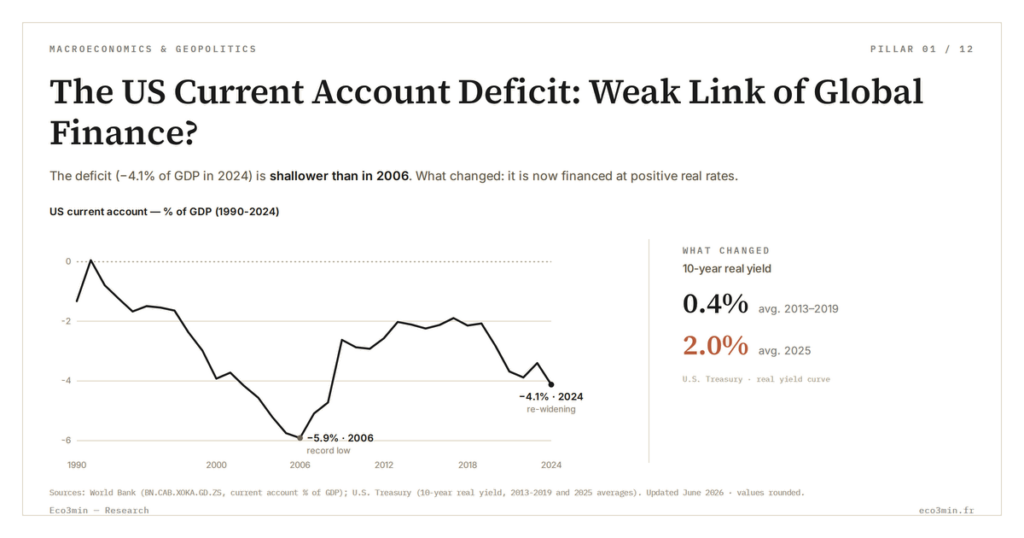
- The 10-year real Treasury yield averaged 2.0% in 2025 and stood at 2.9% in early October 2026, against 0.4% on average in 2013-2019, raising the bar for financing the external gap.
One detail has gone relatively unnoticed: after an exceptional first quarter of 2025 (−$438 billion), the US current account deficit has narrowed toward 3% of GDP, but it is now financed at a 10-year real yield of 2.9% (early October 2026), against 0.4% on average in 2013-2019. What prices imperfectly reflect is not so much the absolute level of the deficit, but rather the unprecedented combination of a massive external financing need, a more durably elevated cost of capital, and increased geopolitical polarization around the dollar.
Research intent: understanding the structural macro risk
The central angle is unique: analyzing how the US current account deficit constitutes a structural macroeconomic risk for global financial markets. The aim is to decode a mechanism, not to propose a strategy or a recommendation.
Where does the US current account deficit stand today?
The US current account deficit measures the difference between what the United States buys from and sells to the rest of the world in goods, services, income and transfers. In concrete terms, a deficit means that the economy consumes and invests more than it produces, with the gap financed by foreign savings.
After averaging around −2.3% of GDP between 2010 and 2019, the current account deficit widened to −3.8% in 2022, −3.3% in 2023 and −4.1% in 2024, before −3.6% in 2025 (World Bank), still shallower than the 2006 trough (−5.9%). After a first quarter of 2025 at −$438 billion, it came back to between −2.7% and −3.0% of GDP at an annualized rate in the first half of 2026.
In dollar terms, this represented $930 billion to $1.2 trillion per year of net external financing needs over 2022-2025 (BEA). In other words, the US economy depends each year on hundreds of billions of foreign capital to balance its macroeconomic equation.
This imbalance fits within a broader framework already discussed in the general framework on monetary policy and real rates, which conditions the cost of this financing and the trade-offs faced by international investors.
The macro mechanism: how a current account deficit becomes a market risk
From an accounting standpoint, a current account deficit is always the mirror of either excess investment or insufficient domestic savings. For the United States, the dominant configuration for more than two decades has been that of a country attracting global capital to finance simultaneously:
- a chronic federal budget deficit, above 5% of GDP almost every year since 2020;
- an elevated level of private consumption, sustained by credit;
- and massive investment in technology, infrastructure and the industrial transition.
In markets, this translates into three key mechanisms:
- Accumulation of US assets: surplus economies (Northern Europe, Asia, commodity exporters) recycle their surpluses into Treasuries, equities, real estate or US private assets.
- Structural upward pressure on asset prices: capital inflows push valuations higher, as long as confidence in liquidity and institutional stability remains strong.
- Vulnerability to flow reversals: if appetite for US assets fades, the adjustment must come either through higher rates, a currency move, or a sharper slowdown in domestic demand.
Most of the time, this configuration is perceived as an “exorbitant privilege”: the United States issues in its own currency, which serves as the global reference. The implicit assumption is that the current account deficit can remain elevated for a long time without major consequences. Structural risk emerges if this assumption is challenged at the margin. Decades of tolerance that can snap on a marginal shift in perception give the external deficit the nonlinear profile typical of the fault lines that threaten financial stability.
Why this issue is becoming more sensitive now
Several cyclical factors amplify the significance of this current account deficit in 2025:
- Persistent positive real rates: the federal funds target range, cut to 3.50-3.75% by late 2025, was raised to 3.75-4% on September 17, 2026, with CPI inflation at 3.7% year on year in August 2026 (BLS). The 10-year real (TIPS) yield averaged 2.0% in 2025 and reached 2.9% in early October 2026, against 0.4% on average in 2013-2019.
- Slowing global demand: world growth has returned to around 3% (versus 3.5% to 4% in the 2000s), limiting partners’ capacity to indefinitely accumulate new dollar claims.
- Geopolitical fragmentation: some countries seek to diversify their reserves and trade flows, slightly reducing mechanical reliance on the dollar for trade and finance.
Taken individually, these developments remain gradual. Combined with the structural current account deficit, they nonetheless alter the balance of power between US financing needs and the availability of global savings ready to absorb them.
What readers are really asking behind this question
The real question is not whether the US current account deficit will mechanically trigger a crisis, but whether this imbalance makes global markets more fragile in the event of a shock. What many seek to clarify is whether this regime of tension-free deficit financing can persist, or whether it exposes portfolios, exporting companies and public finances to an abrupt regime change in capital flows.
Dominant consensus: why markets show little concern about the current account deficit
Mainstream projections generally consider the US current account deficit “manageable” as long as three conditions remain in place:
- potential growth higher than most other major economies;
- the central role of US markets as the main pool of liquid capital;
- the dollar’s status as a reserve currency and as the invoicing currency for commodities.
Within this framework, the current account deficit is seen as a reflection of global demand for US assets considered safe and deep. Part of the consensus expects an “automatic” stabilization of the deficit around −3% of GDP, driven by a partial rebalancing of industrial production (reshoring, industrial policy) and by a structurally firm dollar.
The analysis offered here diverges slightly: the risk is less the level of the deficit than its interaction with three other parameters — elevated real rates, rising public debt, and geopolitical fragmentation. If this dynamic continues, the current account deficit could become an amplifier of volatility rather than merely a symptom of US power.
Three transmission channels to financial markets
1. The US bond market: quiet pressure
The external financing need tied to the current account deficit comes on top of the substantial volume of public debt to be issued each year. Federal debt held by the public rose by $1.37 trillion in 2022, then by $1.9-2.4 trillion a year from 2023 to 2025 (US Treasury). A significant share is absorbed by domestic savings, but a non-negligible portion depends on foreign investors. Dependence of that kind has a fiscal twin in federal deficits above 5% of GDP at full employment, the other gap foreign savings are asked to fill.
If those investors demand a higher risk premium (for instance, a 10-year Treasury yield stabilizing well above 4%), the cost of capital rises across the economy: household credit, corporate financing, equity valuations. The sensitivity of risk assets to this move has been visible since the tightening cycle that began in 2022.
The broader macro and geopolitical framework helps situate this tension within a wider set of forces: demographics, productivity, great-power rivalry and the trajectory of public debt.
2. Currencies and capital flows: the exchange rate adjustment
A persistent current account deficit implies that, sooner or later, one of two things will happen: either capital flows remain massively inward, or the exchange rate adjusts to reduce the gap between domestic savings and investment.
Historically, periods of US current account correction have often coincided with:
- either a phase of relative dollar weakness (the late 1980s after the Plaza Accord, when the balance moved from −3.3% of GDP in 1987 to balance in 1991; then 2007-2009, after six years of dollar decline);
- or a more pronounced cyclical slowdown that reduces imports and domestic appetite for foreign goods.
An exchange rate adjustment can have contrasting effects on markets: support for US exporters, pressure on importers, revaluation of foreign-currency debt for the rest of the world. The point is not the short-term direction, but the way a prolonged imbalance can make these moves sharper when a trigger emerges. For the corresponding cross-read, see gold’s behaviour during phases of dollar stress.
Mainstream scenarios rest on the idea that US assets remain the bedrock of global finance, with a structural safety premium. If the structural current account deficit comes to be perceived as a fragility rather than a simple reflection of capital demand, this premium could be repriced at the margin.
This could translate into:
- higher currency hedging costs for international investors;
- stronger correlation between US rate moves and global equity volatility;
- a partial shift of global savings toward other economic blocks or toward real assets (real estate, commodities, infrastructure).
This is not the central scenario today, but it shows how an indicator deemed “technical” can redraw the hierarchy of risks if perception changes.
Indicators to watch to gauge the risk
Several KPIs allow this structural risk to be tracked concretely:
- Current account deficit / GDP ratio: a sustained level above ≈4% of GDP, especially during a soft-growth phase, points to a more vulnerable imbalance.
- Foreign holdings of Treasuries: if this share declines while the current account deficit remains elevated, it indicates a growing need for domestic savings to finance the federal economy.
- Long-term real rates (10-year Treasury yield minus expected inflation): persistently positive real rates raise the cost of this externally financed model.
- Primary income balance: the difference between what the United States receives and pays in interest and dividends. Long positive, it cushioned the weight of the negative net international investment position; it turned negative in 2024 (−$69 billion) and 2025 (−$48 billion), a first since at least 1999 in BEA data.
Tracking these indicators within the framework of the regular macroeconomic barometer helps identify inflection points rather than only reacting to stress episodes.
Common reading errors
- Confusing the current account deficit with the budget deficit: the two are linked but distinct. The current account deficit covers exchanges with the rest of the world, not just public finances. Conflating them obscures the role of global capital flows.
- Assuming a high current account deficit automatically triggers a crisis: some countries live with a large deficit for decades. The risk depends on the exchange rate regime, the currency of debt issuance and institutional credibility — not on the raw figure.
- Ignoring the role of foreign investment income: despite a negative net international investment position, the United States long earned more than it paid out, thanks to the nature of its assets. That cushion reversed in 2024 and 2025: overlooking the shift now understates the risk.
Two plausible trajectories for the coming years
Scenario 1: orderly management of the imbalance
This scenario assumes US growth remains modestly above that of other major regions, with sustained productivity, notably through AI adoption and partial reindustrialization. The current account deficit stays around −3% to −3.5% of GDP, financed without major tension by portfolio and direct investment flows.
In this case, bond markets demand a slightly higher term premium than before 2020, but without rupture, and the dollar remains the dominant reference. Structural risk is still present, but it primarily expresses itself through heightened sensitivity to monetary policy cycles, in line with the framework set out on the fundamentals of financial markets.
Scenario 2: tension on global savings and a sharper readjustment
A less consensus scenario, but one worth attention: the combination of high public debt, massive financing needs for the energy transition, and modest global growth reduces the savings available to fund recurring US deficits.
If this dynamic persists, several adjustments could compound:
- a sharper rise in long-term US yields to attract capital;
- a partial reflux of flows from US assets toward other economic blocks;
- a gradual depreciation of the dollar, aimed at narrowing the trade deficit through external competitiveness.
Such a scenario does not necessarily imply a sudden crisis, but it would change the hierarchy of risks perceived by investors, companies and households dependent on dollar funding.
Counter-scenarios and factors that could limit the risk
Several elements could mitigate or delay the expression of this structural risk:
- Positive productivity shock: if AI and process innovations sharply improve US productivity between 2025 and 2030, higher real growth makes the debt stock and current account deficit more sustainable.
- Gradual reduction of the budget deficit: a phased fiscal adjustment that curbs public demand could marginally narrow the current account deficit by limiting imports and aggregate demand.
- Persistent demand for US legal and financial security: even in a more fragmented world, the depth of US markets can continue to attract savings seeking liquidity and relative protection.
Conversely, a markedly more restrictive monetary policy than expected, a major geopolitical shock or an unexpected global recession could accelerate the adjustment by forcing an abrupt retreat in US domestic demand or in capital flows.
Concrete consequences for different actors
For economic actors, the US current account deficit is not an abstract figure: it indirectly shapes financing conditions, currency hedging costs and the stability of growth scenarios.
- For investors: the US current account deficit influences the trajectory of long-term rates, and therefore the valuation of equities, listed real estate and private assets. It can also shift the correlation between US assets and the rest of the world, particularly during stress phases.
- For companies: groups exposed to international trade (importers and exporters alike) are sensitive to a potential dollar adjustment driven by the current account deficit. Dollar funding conditions for foreign subsidiaries can also evolve.
- For individuals: although the current account deficit may seem distant, it indirectly influences borrowing rates, the real return on savings and the stability of the macroeconomic framework underpinning household and professional decisions.
The risk is less visible than others — such as an immediate recession or a banking crisis — and therefore easier to ignore. Yet it conditions, in the background, the regime of rates, liquidity and valuation underlying many economic decisions.
Frequently asked questions about the US current account deficit
- Can the US current account deficit remain elevated indefinitely?
There is no precise mechanical limit, especially for a country issuing the world’s main reserve currency. However, the longer the deficit remains elevated, the greater the dependence on foreign capital flows and the sensitivity to changes in confidence or global monetary policy. - Would a rapid decline in the current account deficit necessarily be positive for the global economy?
An orderly reduction, driven by productivity gains or fiscal rebalancing, would be relatively neutral. A sharp adjustment tied to a US recession or a confidence shock, by contrast, could weigh on global trade and financial markets. - Does the US current account deficit threaten the dollar’s reserve currency status?
In the short term, this is not the main driver: market depth and institutional credibility remain decisive. Over the long term, however, the accumulation of imbalances can accelerate gradual diversification strategies in some countries. - How can one tell if markets are starting to “price” this risk?
A combination of signals — persistently rising US real rates, declining foreign holdings of US debt, increased dollar volatility — can suggest that the current account deficit is being incorporated as a risk factor rather than a mere background parameter.
3 takeaways
- The US current account deficit, between −3.3% and −4.1% of GDP from 2022 to 2025 and close to −3% in the first half of 2026, is less an isolated figure than a marker of structural dependence on foreign capital.
- With real rates back in positive territory and global growth subdued, this deficit can gradually turn the safety premium on US assets into a source of volatility.
- This is not the central scenario today, but markets do not fully price the hypothesis of a sharper adjustment in capital flows and the dollar.
Last updated — 6 October 2026
Disclaimer – Financial and Legal Information: The analyses, commentary, and content published on eco3min.fr are provided for informational and educational purposes only. They do not constitute investment advice or a solicitation to buy or sell financial instruments. Past performance is not indicative of future results. All investment decisions involve risk and are the sole responsibility of the reader. Data, charts and calculated series are provided as is and may contain errors or lag behind their source: check any figure against the primary source cited before relying on it. Content describing laws, regulations or contracts reflects the law as of its publication date and does not constitute legal or tax advice; applying it to a specific situation requires a qualified legal or tax professional.
Read next
Full pillar →US Federal Deficits Above 5% of GDP at Full Employment (1929–2025)
Eco3min Research · Fiscal Policy A large deficit used to mean one of two things: a war, or…
US–China Semiconductor War: The Real 2026 Battlefield
Late-2025 US restrictions still target ≈40% of China's advanced AI compute capacity, while Beijing tightens critical-mineral exports. The…
Hidden Unemployment: What Labor Slack Says Beyond the Jobless Rate
The gap between US broad and official unemployment, 3.4 points in September 2026, is practically where it stood…