
Which countries are members of OPEC, and who belongs to OPEC+?
OPEC's website lists 12 member countries, while the UAE announced its exit from 1 May 2026. Who sits in OPEC+, and what share of world crude they pump.
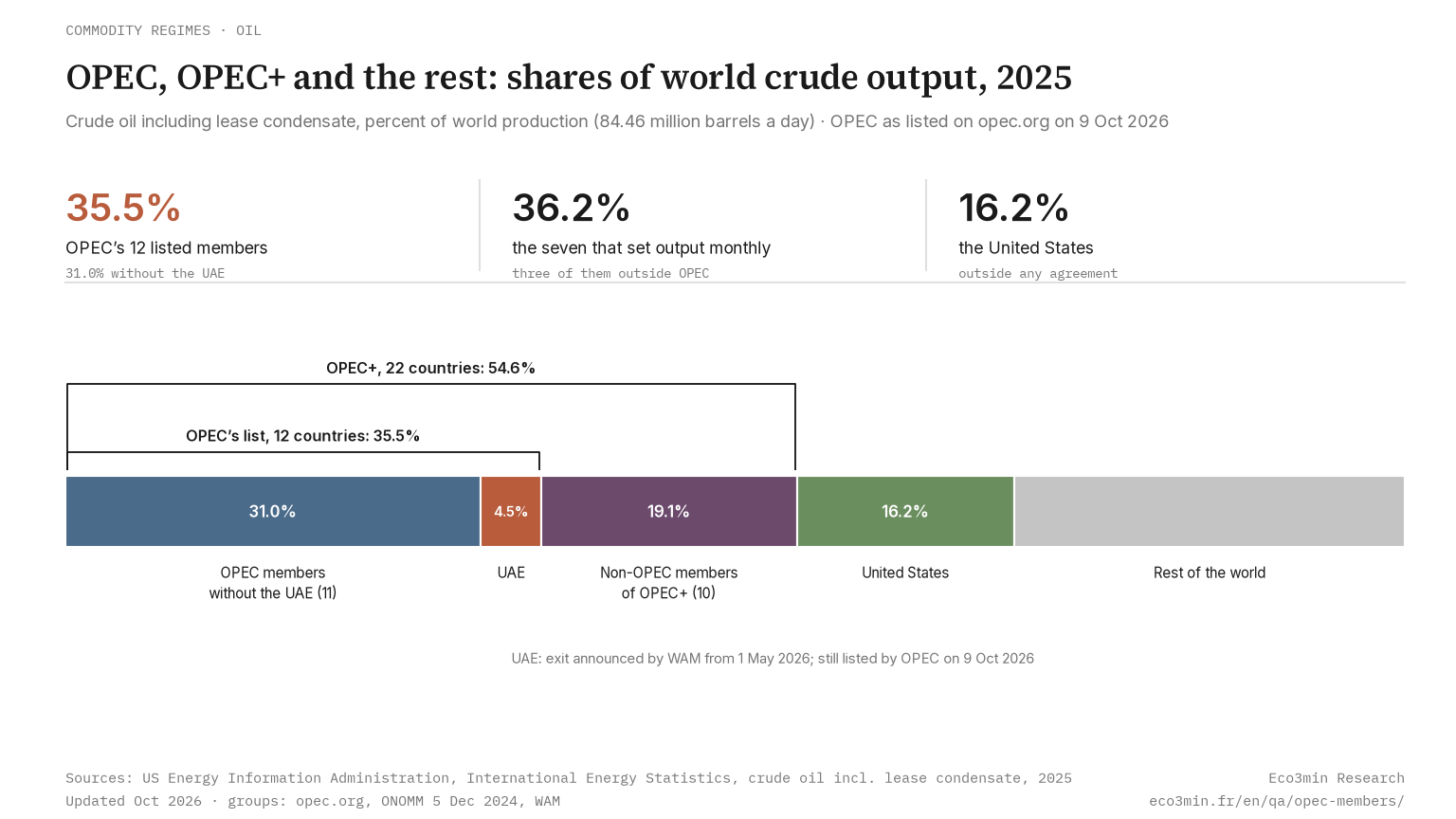
OPEC, founded in Baghdad in 1960, lists 12 member countries on its website as of 9 October 2026, the United Arab Emirates included, although the UAE’s state news agency WAM announced its exit from OPEC and OPEC+ effective 1 May 2026. OPEC+ adds the ten non-member countries taking part in the Declaration of Cooperation, the largest of them Russia, and since May 2026 the monthly production decisions have come from seven countries, three of them outside OPEC. On EIA data for 2025, the twelve listed members pumped 35.5% of the world’s crude, 31.0% without the UAE, while the seven pumped 36.2%.
In this article
The short answer
Twelve, by OPEC’s own count. Its list of member countries, read on 9 October 2026, names Algeria, Congo, Equatorial Guinea, Gabon, Iran, Iraq, Kuwait, Libya, Nigeria, Saudi Arabia, the United Arab Emirates and Venezuela. Five of them founded the organization in Baghdad in September 1960: Iran, Iraq, Kuwait, Saudi Arabia and Venezuela.
That count is disputed. On 28 April 2026 the UAE announced through its state news agency, WAM, that it would leave OPEC and OPEC+ from 1 May 2026. OPEC has published no statement on the departure and still lists the country.
OPEC+ is the wider circle. It adds the ten producers outside OPEC that take part in the Declaration of Cooperation, signed in Vienna on 10 December 2016, among them Russia, Kazakhstan, Mexico and Oman. Monthly decisions come from a narrower group: Saudi Arabia, Russia, Iraq, Kuwait, Kazakhstan, Algeria and Oman. Three of the seven countries setting OPEC+ output are not OPEC members.
→ Where each producer ranks: output rankings of oil producers
What the data shows
The shares below come from the EIA international data for crude oil including lease condensate, one definition applied to every country. World output averaged 84.46 million barrels a day in 2025.
Shares of world crude output in 2025 (EIA):
- The twelve countries on OPEC’s list: 35.5%. Without the UAE, which pumped 3.77 million barrels a day on its own (4.5%), the share falls to 31.0%.
- The ten non-OPEC participants in the Declaration of Cooperation: 19.1%, of which Russia alone 11.7%.
- OPEC+ as a whole, 22 countries: 54.6%, or 50.2% without the UAE.
- The seven countries that decide each month: 36.2%, or 613,000 barrels a day more than the twelve listed OPEC members combined.
The largest producer sits in neither group. The United States pumped 16.2% of world crude, more than any country of OPEC or OPEC+.
→ Dataset: US crude output, outside OPEC+
How OPEC+ decides
OPEC+ output is governed at three levels, and only the first is a matter of OPEC membership.
A membership set by statute. The OPEC Statute opens full membership to a country with a substantial net export of crude petroleum, admitted by a three-quarters majority of full members that includes every founder. Members can also leave. Qatar did so on 1 January 2019, Ecuador on 1 January 2020 and Angola on 1 January 2024.
Collective levels set by ministers. The OPEC and non-OPEC Ministerial Meeting sets a required production level for each participating country. Its 41st session, on 7 June 2026, kept the overall levels until the end of 2026. Iran, Libya and Venezuela, 7.6% of world crude between them, do not appear in the table of required levels for 2025 and 2026.
Monthly adjustments by seven countries. On top of these levels, a sub-group manages the voluntary adjustments announced in April and November 2023. It counted eight countries, the UAE included, on 5 April 2026, and seven since 3 May 2026; on 4 October 2026 the seven kept their required production for November at the September level. Russia, Kazakhstan and Oman pumped 42.3% of the group’s crude in 2025. The usual shorthand, that OPEC sets oil output, misses the club that moves it from month to month.
The weight behind each decision has changed with the regime.
In 2008, a recession year in the United States, US output fell to its lowest since 1946, or 6.7% of world crude, against 40.4% for the twelve countries now on OPEC’s list. In 2016, OPEC’s thirteen members and eleven other producers signed the Declaration in answer, by OPEC’s account, to the instability of the market. Together they pumped 65.3% of world crude, the United States 10.9%. In 2025 the 22 countries of OPEC+ pumped 54.6%, and the United States, bound by no quota, 16.2%. The share of world supply outside any agreement is the parameter that separates these regimes.
Three of the seven countries that set OPEC+ output each month are outside OPEC, and the seven together pump more crude than OPEC does.
→ Framework: commodity markets, oil and gas
What it means for different economic actors
Importing economies. Part of their supply depends on decisions taken without the largest producer, the United States, at 13.66 million barrels a day in 2025. Emergency stocks are the other instrument, and the US emergency crude stockpile held 283.0 million barrels on 2 October 2026, according to the EIA.
Investors and analysts. An OPEC decision can mean the monthly statement of the seven (36.2% of world crude) or a revision of the collective levels (54.6%). OPEC+ states its levels in crude oil production, while the EIA series behind these shares includes lease condensate, so the two do not compare term by term.
Producers outside the agreement. Canada, China and Brazil, ranked 4th, 6th and 9th among producers in 2025, stand outside the Declaration and have no required level. In February 2025 Brazil joined only the Charter of Cooperation, a framework for dialogue.
A common error is to treat the UAE’s status as settled. Depending on the source retained, OPEC’s share of world crude moves by 4.5 points.
Practical observation
What the data suggests for understanding your situation:
- Question to ask yourself: when a figure is attributed to OPEC, does it cover the twelve listed members, the eleven without the UAE, the 22 countries of OPEC+ or the seven that decide each month?
- Data to monitor: the countries named in the title of OPEC’s monthly statement, and the member page of opec.org, where a change would show how OPEC itself records the UAE’s exit.
- Historical parallel: Angola left OPEC on 1 January 2024 after pumping 1.14 million barrels a day of crude in 2023, according to the EIA. The UAE pumped 3.77 million in 2025, about 3.3 times as much.
- What the literature documents: Jeff Colgan (International Organization, 2014) finds that from 1982 to 2009 OPEC as a whole produced above its quotas 96% of the time, its nine main members by 10% on average, and concludes that OPEC has little or no effect on its members’ output.
This is descriptive information to help you frame your own analysis. Eco3min does not provide investment advice.
Go deeper
📊 Full study: the oil shocks of the past 50 years
📖 Related analysis: Middle East risk, from shipping routes to price
📁 Dataset: Brent crude spot prices since 1987
Related questions
Frequently asked questions
Is the UAE still a member of OPEC?
The two primary sources disagree. The UAE’s announcement, carried by WAM on 28 April 2026, sets its exit from OPEC and OPEC+ on 1 May 2026. OPEC’s member page, read on 9 October 2026, still counts 12 members including the UAE, as did OPEC’s release on its Annual Statistical Bulletin of 29 April 2026. OPEC’s output statements placed the UAE among the eight and in the monitoring committee on 5 April 2026, and in neither in October 2026. No OPEC text dates the exit.
Why do three non-members sit among the seven that decide each month?
Because the monthly group was formed around voluntary adjustments, and OPEC membership is not a condition for taking part. Russia, the largest crude producer of OPEC+ on EIA data, pumps slightly more than Saudi Arabia. With Kazakhstan and Oman, the non-members account for 42.3% of the group’s output, which is enough for the seven to outweigh the twelve listed members.
How do OPEC, OPEC+ and the Charter of Cooperation differ?
OPEC is the organization founded in 1960, whose members are admitted under its statute. OPEC+ refers to the Declaration of Cooperation of 10 December 2016, which joins OPEC members and ten other producers in required production levels. The Charter of Cooperation, signed on 2 July 2019, is a commitment to dialogue among the same participants, joined by Brazil. OPEC presents it as a complement to the Declaration.
Last updated — 9 October 2026
Disclaimer – Financial and Legal Information: The analyses, commentary, and content published on eco3min.fr are provided for informational and educational purposes only. They do not constitute investment advice or a solicitation to buy or sell financial instruments. Past performance is not indicative of future results. All investment decisions involve risk and are the sole responsibility of the reader. Data, charts and calculated series are provided as is and may contain errors or lag behind their source: check any figure against the primary source cited before relying on it. Content describing laws, regulations or contracts reflects the law as of its publication date and does not constitute legal or tax advice; applying it to a specific situation requires a qualified legal or tax professional.