
Asset Tokenization: What Is Recorded on Chain, and What Actually Moves
On 8 October 2026, RWA.xyz counted $38.88 billion of transferable tokenized real-world assets, against $361.62 billion recorded on chain but unable to leave the issuing platform. Tokenized US Treasury funds are the largest block that moves.

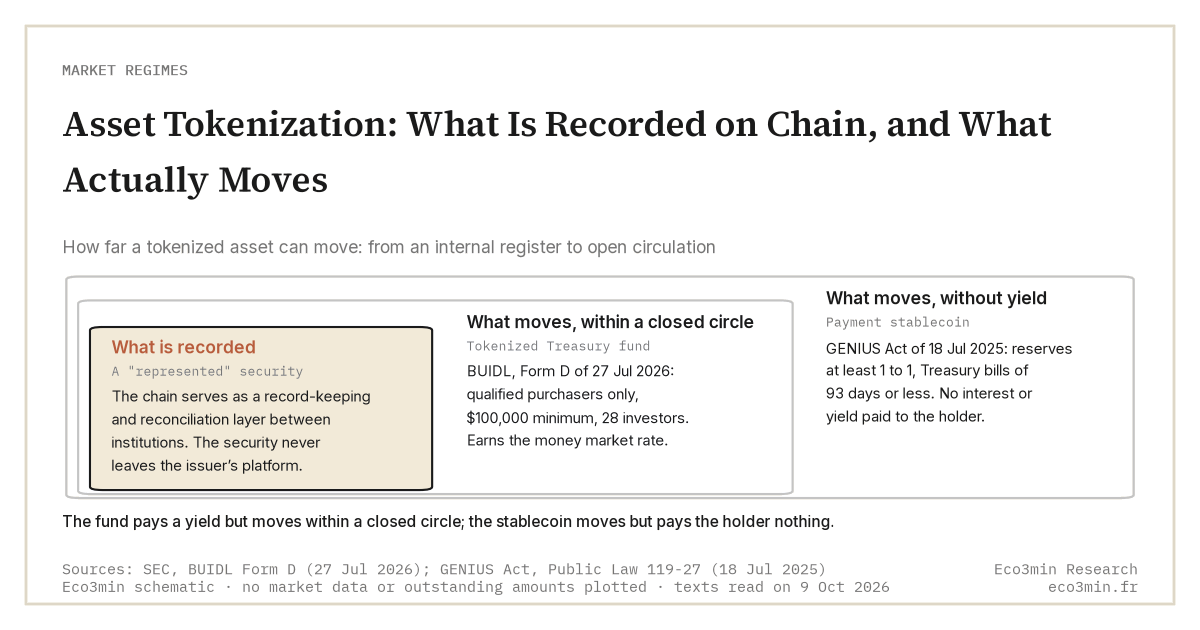
Putting an asset on a blockchain does not mean it will trade there: most tokenized securities sit on chain as entries in an internal register. Measured size therefore depends on what is counted, and the two counts differ ninefold.
A snapshot as of 8 October 2026: what is recorded, what actually moves, what tokenized money market funds hold, and what European and US law now covers.
TL;DR
Tokenized real-world assets are still mostly an institutional record-keeping tool, and the share that moves freely between wallets is about a tenth of the total.
- On 8 October 2026, RWA.xyz counted $38.88 billion of transferable tokenized real-world assets excluding stablecoins, against $361.62 billion recorded on chain but unable to leave the issuing platform.
- Funds holding US Treasuries are the largest transferable block, at $14.95 billion, with the Fed’s target range back up to 3.75-4.00% since 17 September 2026.
- In the EU, ESMA counted only three infrastructures authorised under the DLT pilot regime by 31 May 2025, two years after it took effect on 23 March 2023.
Two measures of one market
On 8 October 2026, the data aggregator RWA.xyz counted $38.88 billion of tokenized real-world assets it classes as “distributed”, stablecoins excluded. Under the “represented” label, it counted $361.62 billion. The first is the platform’s default view.
The gap comes down to a definition. A distributed asset can leave the platform that issued it and move from one wallet to another, sometimes only between pre-approved holders. A represented asset cannot: in RWA.xyz’s own documentation, the blockchain then acts as a record-keeping and reconciliation layer for institutions. The security exists on chain, yet nobody trades it outside the issuer’s own circuit.
The familiar pitch for tokenization is open, always-on markets in which any asset becomes liquid. The numbers describe something else. For every dollar of tokenized assets that moves, more than nine stay on the ledger, used by institutions that already deal with one another. For a reader of headline figures, the practical consequence is simple: a claim about the size of tokenization needs to say which of the two totals it uses, because one is roughly a tenth of the other.
Stablecoins, counted separately, stood at $295.09 billion on the same date, nearly eight times the distributed real-world assets. They are payment instruments rather than securities, and they fall under a different body of rules, covered below.
Treasury funds lead what actually moves
Among distributed assets, funds invested in US government debt form the largest block. RWA.xyz listed 109 such funds holding $14.95 billion on 8 October 2026, down 5.91% over thirty days and equal to 38% of distributed real-world assets (Eco3min calculation on RWA.xyz figures). Tokenized credit comes next with $7.99 billion in transferable form, against $37.55 billion in its represented version: most loans recorded on a blockchain never leave it.
Interest rates explain why money market funds lead. A dollar held as a stablecoin earns nothing from its issuer. A money market fund token earns the money market rate, and doubles as a cash reserve and as collateral for firms already operating on chain, without routing funds back through a bank account.
The Federal Reserve’s target range has stood at 3.75-4.00% since 17 September 2026 (series DFEDTARU). RWA.xyz shows a seven-day annualised yield of 3.65% for tokenized Treasury funds, net of fees. That gap with the stablecoin is the token’s appeal: money market yield that can be transferred at any hour.
Lower rates would shrink the gap between an idle dollar on chain and an invested one, and with it the reason these funds exist. The rate that keeps them alive is the one watched elsewhere for the level at which rates turn dangerous for markets.
BUIDL in its own filings
BlackRock’s fund is the reference case. Its launch announcement of 20 March 2024 describes a token that seeks a stable value of $1, pays dividends monthly as new tokens and invests all of its assets in cash, Treasury bills and repurchase agreements. Tokens can be transferred around the clock, but only between pre-approved investors: a whitelist, not an open order book. BNY Mellon holds the assets and Securitize keeps the share register.
The SEC filings add more. The amended Form D filed on 27 July 2026 shows a fund domiciled in the British Virgin Islands, open to qualified purchasers, with a $100,000 minimum. First sale: 4 March 2024. Cumulative sales reach $5.14 billion, from 28 investors.
RWA.xyz puts the fund’s size at about $2.2 billion on 8 October 2026. Form D adds up subscriptions and says nothing about assets outstanding: the $5.14 billion sold since launch is 2.3 times the current balance (Eco3min calculation), the difference being redemptions.
Twenty-eight investors and a six-figure minimum: the best-known tokenized asset is a wholesale product.
Adding stablecoins, represented assets and distributed assets together to get “the size of tokenization”. The three aggregates measure different things: a means of payment, an internal register and a transferable security. Only the last matches the idea of an open secondary market.
An EU experiment and a US payments law
In the EU, Regulation (EU) 2022/858 of 30 May 2022 created a pilot regime for market infrastructures based on distributed ledger technology, applicable since 23 March 2023. It keeps the experiment small: shares of issuers worth less than €500 million, bonds issued for less than €1 billion, at most €6 billion of instruments per infrastructure, and a transition strategy to trigger at €9 billion. The tokenized US Treasury fund segment alone, at $14.95 billion, would exceed the cap of a single pilot infrastructure.
The ESMA report of 25 June 2025 on how the regime works shows how little has used it. Between 23 March 2023 and 31 May 2025, three infrastructures were authorised (CSD Prague, 21X and 360X), with what ESMA calls minimal live trading. CSD Prague recorded six share issues worth €11.9 million, and 21X one bond issue of up to $500 million. ESMA finds the thresholds too restrictive and proposes adjustable limits, then a path to a permanent regime. Put differently, two years into the pilot, the EU had built the legal plumbing for tokenized securities markets and attracted very little flow through it.
In the US, the GENIUS Act of 18 July 2025 (Public Law 119-27) regulates payment stablecoins. The Act requires issuers to hold reserves at least equal to the tokens outstanding, in cash, deposits, Treasury bills maturing within 93 days or repos. It bars them from paying holders any interest or yield for simply holding the coin. The law takes effect by 18 January 2027 at the latest, or 120 days after final implementing rules if those come first.
That ban draws a clear line. A stablecoin pays for things and its issuer pays the holder nothing, whereas a tokenized money market fund earns a yield but moves within a closed circle. Stablecoin reserves can sit in the same bills the funds hold, hence stablecoin issuers as Treasury bill buyers. How the federal and state layers fit together is set out in the US stablecoin rulebook.
What could change the picture
These orders of magnitude are fragile. RWA.xyz notes that a represented asset can be reclassified as distributed once it becomes transferable, so an issuer’s decision or a change of method can shift the totals without a dollar changing hands. The rest depends on forces outside the market: the rate level for Treasury funds, then the European Commission’s response to ESMA’s recommendations and the implementing rules under the GENIUS Act.
One ratio sums up the question: represented over distributed assets. At 9.3 on 8 October 2026 (Eco3min calculation on RWA.xyz figures), it says the blockchain serves mainly as a ledger. A decline driven by reclassification into transferable assets would bring tokenization closer to a market. At its current level, it looks more like institutional book-keeping infrastructure, closer to the dematerialisation of securities than to retail access. The wider shift in market plumbing is mapped in financial innovation and market infrastructure, and the basics in what tokenization changes for markets.
Last updated — 8 October 2026
Disclaimer – Financial and Legal Information: The analyses, commentary, and content published on eco3min.fr are provided for informational and educational purposes only. They do not constitute investment advice or a solicitation to buy or sell financial instruments. Past performance is not indicative of future results. All investment decisions involve risk and are the sole responsibility of the reader. Data, charts and calculated series are provided as is and may contain errors or lag behind their source: check any figure against the primary source cited before relying on it. Content describing laws, regulations or contracts reflects the law as of its publication date and does not constitute legal or tax advice; applying it to a specific situation requires a qualified legal or tax professional.
Read next
Full pillar →When Interest Rates Truly Become Dangerous for Markets
Interest rates do not become dangerous through their level alone, but through the moment in the cycle when…
Weak or Strong Euro: Imported Inflation and Competitiveness
The euro's level acts on the area's economy through two opposing channels: it changes the price of imports,…
How to Read EUR/USD: What Moves a Currency Pair
EUR/USD is the price of one euro expressed in dollars: when it reads 1.14, one euro trades for…