
Dollar-Cost Averaging: Mechanics, Benefits and Limits
Dollar-cost averaging invests a fixed amount at regular intervals to smooth the entry price. Its main advantage is behavioural, neutralising timing paralysis, but its effectiveness assumes a long horizon and a market that recovers.

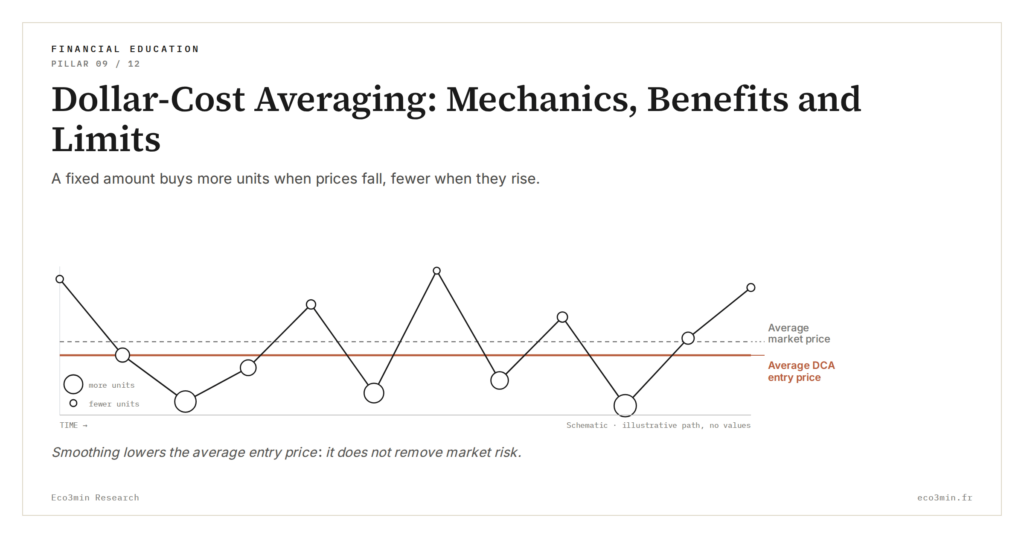
Dollar-cost averaging means investing a fixed amount at regular intervals. The strategy smooths the entry price, but its effectiveness assumes a long horizon.
TL;DR
DCA invests a fixed sum at regular intervals, mechanically lowering the average entry price; its real edge is behavioural, and it works only over a long horizon.
- By buying more units when prices fall and fewer when they rise, DCA mechanically lowers the average entry price relative to the average market price over the period.
- The edge is behavioural more than mathematical: lump-sum beats a 12-month DCA in roughly two-thirds of rolling ten-year periods (Vanguard, 2012 and February 2023 update, across US, UK and Australia), yet only 14% of French adults see the current period as a good time to invest in equities (AMF savings barometer, 2025).
- Smoothing offers no protection in a sustained bear market: a “lost decade” like Japan from the 1990s, or the S&P 500 in real terms between 2000 and 2013, would have left DCA mediocre despite discipline.
Dollar-cost averaging (DCA), known in French as “investissement progressif”, consists of investing a fixed amount at regular intervals, regardless of market levels. The criteria are reviewed in our mapping of returns from prior highs. This mechanism smooths the average entry price and neutralises timing risk, the risk of investing at the peak. Its effectiveness rests on a condition often overlooked: a horizon long enough for the smoothing to produce its effect. Without that duration, DCA can amount to little more than spreading losses out over time.
The factor that shifts the usual debate on DCA: most analyses compare DCA and lump-sum investing as if the choice were purely mathematical. In practice, the main advantage of DCA is behavioural: it neutralises the decision paralysis triggered by volatility, an effect that quantitative models do not capture.
The smoothing mechanic: how DCA works
The principle is arithmetic. By investing a fixed amount each month, the investor buys more units when prices are low and fewer when they are high. This is unpacked carefully in this question on dollar cost averaging vs lump sum. The average entry price is mechanically lower than the average market price over the period. Vanguard’s study “Dollar-Cost Averaging Just Means Taking Risk Later” (2012) does not quantify this smoothing as a reduction in entry-price dispersion: it measures its cost, since phasing a lump sum in over six to thirty-six months leaves part of it in cash meanwhile.
This mechanic belongs to an investment logic, not a savings logic. DCA assumes deliberate exposure to market risk: it smooths the entry point, it does not eliminate it. Conflating the two means ignoring the savings-placement-investment framework that structures any allocation.
A behavioural advantage more than a mathematical one
Strictly from a quantitative standpoint, academic research shows that lump-sum investing outperforms DCA in roughly two-thirds of cases. The Vanguard study of 2012 establishes it over rolling ten-year periods in the US, UK and Australia (all-equity portfolio with a 12-month DCA), and its February 2023 update, “Cost averaging: Invest now or temporarily hold your cash?”, finds a similar result. But this conclusion assumes the investor has the full capital available at the outset and is able to deploy it without hesitation.
In practice, that condition is rarely met. The AMF’s 2025 savings and investment barometer does not measure delayed decisions, but it describes the ground they grow on: only 14% of French adults see the current period as a good time to invest in equities, 33% see it as a bad time and 20% do not know. DCA addresses that block: by automating investment, it removes the timing decision and reduces the risk of prolonged inaction, which is often more costly than a poor entry point. On this point: the Eco3min view of the toolkit for testing financial choices.
This wait-and-see reflex frequently rests on the idea that one can identify the “right moment” by observing recent performance. That is precisely the trap of retrospective reading: extrapolating the past to anticipate the future leads to entering after rallies and exiting after declines.
The limits: when DCA does not protect
DCA does not protect against a sustained bear market. If prices fall steadily across the entire investment horizon, smoothing simply spreads purchases at successively lower levels, without a compensating rebound. The dominant consensus presents DCA as a “universal” strategy. The nuance is that its effectiveness depends on two conditions: a sufficiently long horizon and a market that ultimately recovers within that timeframe.
What would invalidate the relevance of DCA is a scenario of prolonged equity market stagnation: a “lost decade” comparable to Japan from the 1990s to the 2010s, or to the S&P 500 between 2000 and 2013 in real terms. In those cases, DCA would have produced a mediocre outcome, even with discipline. Such a scenario is not the most frequent in the history of developed markets, but it remains possible.
Believing that DCA guarantees a positive return. DCA smooths the entry price, it does not remove market risk. Over a horizon that is too short or in a sustained bear market, smoothing can amount to little more than spreading losses out over time.
DCA is an entry mechanism, not a complete strategy. Its main strength is behavioural: it neutralises decision paralysis and imposes a discipline of regular investment. Several market trajectories remain open, but the smoothing logic does not change, provided the horizon is defined upfront, within the framework of everyday financial decisions.
- DCA smooths the average entry price and neutralises timing risk, but it does not eliminate market risk.
- Its main advantage is behavioural: it reduces the decision paralysis that can cost more than a poor entry point.
- Its effectiveness assumes a long horizon and a market that recovers over that period: two conditions that are not guaranteed.
Last updated — 25 September 2026
Disclaimer – Financial and Legal Information: The analyses, commentary, and content published on eco3min.fr are provided for informational and educational purposes only. They do not constitute investment advice or a solicitation to buy or sell financial instruments. Past performance is not indicative of future results. All investment decisions involve risk and are the sole responsibility of the reader. Data, charts and calculated series are provided as is and may contain errors or lag behind their source: check any figure against the primary source cited before relying on it. Content describing laws, regulations or contracts reflects the law as of its publication date and does not constitute legal or tax advice; applying it to a specific situation requires a qualified legal or tax professional.
Read next
Full pillar →Saving vs Investing vs Placing: Understanding Risk, Time, and Liquidity
The security-liquidity-return trilemma: each function sits on a trade-off; the centre stays empty. Saving, placing, and investing refer…
How Much Cash American Households Hold: Deposits, Money Funds, and the Savings Mix
The Federal Reserve’s accounts show American households holding nearly 14.9 trillion dollars in deposits and currency and 5.3…
A high-yield savings account and a money market fund cannot be compared on their headline yield alone. The…